How AI fits this role
Certified Public Accountant (CPA)
Role Overview
A Certified Public Accountant is a licensed financial professional responsible for auditing financial statements, preparing and filing tax returns, advising on tax strategy, and ensuring regulatory compliance. CPAs operate across public accounting firms, corporate finance departments, government agencies, and independent practices. The credential carries legal authority in the United States — only CPAs can sign audit opinions on public company financial statements, represent clients before the IRS in all matters, and provide attest services.
In practice, the CPA role spans a wide operational range. At a Big Four firm, a staff CPA might spend 60% of busy season reconciling workpapers and tracing journal entries. At a mid-market company, the same title means owning the close process, managing external auditors, and advising the CFO on tax exposure. In a small practice, a CPA is simultaneously the tax preparer, client advisor, and business development lead.
The profession is under structural pressure from three directions: fee compression on compliance work, a talent pipeline crisis (CPA exam pass rates have declined and the 150-credit-hour requirement deters candidates), and the accelerating automation of the transactional work that once justified entry-level billing rates.
How AI Is Transforming This Role
The transformation is not uniform. It is hitting compliance and transactional accounting hardest and fastest, while leaving advisory, judgment-intensive, and relationship-driven work largely intact — for now.
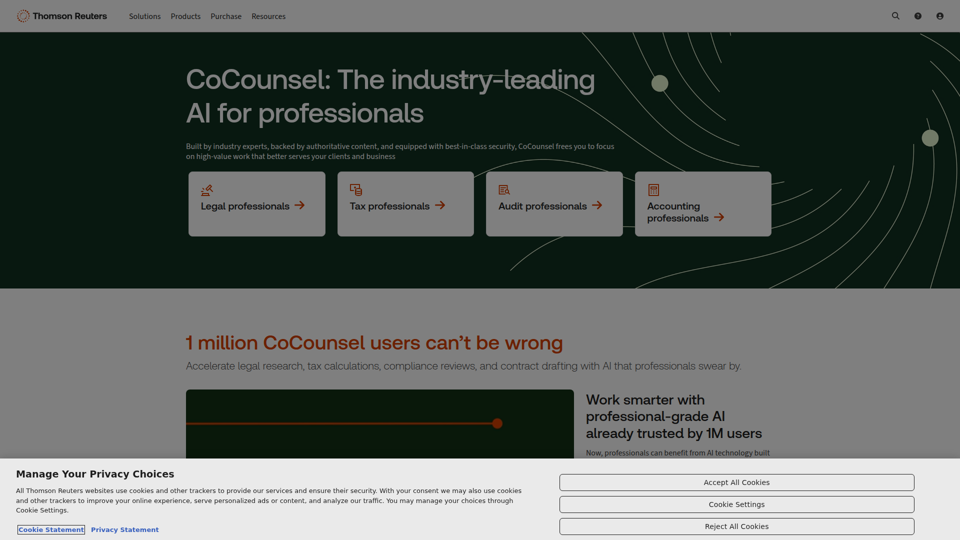
Tax preparation is the most visibly disrupted segment. AI-assisted tools like Intuit's GenAI features in ProConnect, Thomson Reuters' CoCounsel, and Bloomberg Tax's AI research assistant can now draft federal and state returns from imported financial data, flag missing schedules, identify deduction opportunities against a client's prior-year profile, and surface relevant IRS guidance — in minutes rather than hours. For straightforward 1040s and small business returns, the CPA's role has shifted from preparer to reviewer and sign-off authority.
Audit is experiencing a more structural shift. Traditional audit methodology relied on sampling — testing 30 to 60 transactions to infer the health of a population. AI-enabled audit platforms like MindBridge, Galvanize (now part of Diligent), and the proprietary tools being built inside KPMG, Deloitte, and PwC now analyze 100% of transaction populations, flagging statistical anomalies, unusual journal entry patterns, and outlier vendor relationships. This changes what auditors actually do on an engagement: less time pulling samples, more time investigating flagged exceptions.
Accounting operations — accounts payable, accounts receivable, bank reconciliation, expense coding — are being automated at the ERP layer. Tools embedded in NetSuite, Sage Intacct, and QuickBooks Advanced use ML to auto-categorize transactions, match invoices to POs, and flag duplicates. The CPA overseeing these functions is increasingly a process owner and exception handler rather than a transaction processor.
The commercial pressure is real. Clients who once paid $3,000 for a business tax return are asking why the price hasn't dropped when software is doing more of the work. Firms that cannot articulate the value of CPA judgment — in tax planning, risk assessment, and strategic advice — are losing price-sensitive clients to tech-forward competitors like Bench, Pilot, and 1-800Accountant.
Tasks AI Can Automate
- Data entry and transaction coding — ML classification in accounting software handles routine categorization with 90%+ accuracy on trained datasets
- Bank and account reconciliation — automated matching engines in modern ERPs reconcile the majority of transactions without human intervention
- Standard tax return preparation — AI tools can draft Form 1040, Schedule C, S-corp, and partnership returns from structured financial inputs
- Document extraction and organization — OCR and NLP tools extract data from W-2s, 1099s, K-1s, and financial statements, eliminating manual keying
- Audit sampling and workpaper population — AI platforms pull and organize transaction data, reducing the time auditors spend on evidence gathering
- Tax research for common issues — AI legal research tools surface relevant code sections, regulations, and case law faster than manual research
- Variance analysis and flux commentary — some FP&A tools now auto-generate first-draft explanations of period-over-period changes
- Engagement letter and standard correspondence drafting — LLM-assisted tools in practice management software generate routine client communications
- Depreciation schedules and fixed asset tracking — rule-based automation handles standard MACRS and GAAP depreciation calculations reliably
- Payroll tax filings — platforms like Gusto and ADP have effectively automated routine payroll compliance for most small and mid-size employers
Skills Becoming More Valuable
Tax planning and strategy — The gap between tax compliance (preparing what happened) and tax planning (structuring what will happen) is widening. AI handles compliance; CPAs who can model entity structure decisions, timing strategies, Roth conversion ladders, or Section 199A optimization are providing value that software cannot replicate.
Judgment on ambiguous positions — When a client's situation sits in a gray area — a reasonable basis position, a listed transaction adjacent structure, or a novel digital asset classification — the CPA's professional judgment and willingness to sign off (or not) is irreplaceable. AI tools are trained on historical data and are risk-averse by design.
Client advisory and communication — Translating financial complexity into decisions a business owner or CFO can act on requires contextual understanding of the client's business, risk tolerance, and goals. This is relationship work, not data work.
AI output review and quality control — As AI-generated returns and workpapers become standard, the ability to critically evaluate AI output — catching hallucinated deductions, misapplied code sections, or incorrect entity classifications — becomes a core professional competency.
Cross-functional financial leadership — CPAs embedded in corporate finance who can connect accounting outcomes to operational decisions (pricing, capital allocation, M&A structuring) are increasingly valued over those who only own the close process.
Forensic and investigative accounting — Fraud detection, litigation support, and financial investigation require pattern recognition, skepticism, and narrative construction that AI assists but cannot lead.
International tax and transfer pricing — Complexity, treaty interpretation, and jurisdictional judgment in cross-border structures remain heavily human-dependent.
Skills Becoming Less Important
- Manual data entry and bookkeeping — Automation has commoditized this entirely at the small business level
- Rote tax form preparation — Knowing which line a number goes on is no longer a differentiator; software handles form mechanics
- Basic research on settled tax law — Looking up standard deduction limits, depreciation rules, or contribution limits is now a prompt, not a skill
- Spreadsheet-based financial modeling for routine analysis — ERP-embedded analytics and FP&A tools are replacing standalone Excel models for standard reporting
- Manual workpaper organization and indexing — Audit management platforms automate the administrative structure of an engagement file
- Memorizing tax code provisions — Knowing where to find and how to apply the code matters more than memorization
- Routine payroll processing — Largely automated; CPA involvement is now exception-based
Current AI Adoption in This Industry
Adoption is uneven and follows firm size and client segment closely.
Big Four and large nationals are the furthest along. All four major firms have announced or deployed proprietary AI platforms — Deloitte's PairD, KPMG's KPMG AI, EY's EY.ai, PwC's ChatPwC — primarily for internal use in research, document review, and engagement support. Their audit practices are integrating AI-powered transaction analysis into standard methodology, though regulatory acceptance of AI-assisted audit evidence is still evolving with the PCAOB.
Mid-market regional firms are in active evaluation and early deployment. Most are piloting AI features within their existing tax software stacks (Thomson Reuters, Wolters Kluwer, Drake) rather than building proprietary tools. The constraint is not technology access but change management — getting experienced staff to trust and use AI-generated drafts rather than starting from scratch.
Small practices and sole practitioners are the most price-sensitive and the most exposed to disruption. Many are adopting AI-assisted tools through their existing software subscriptions without a formal strategy. The risk is that they automate compliance work (reducing billable hours) without repositioning toward advisory services that command higher fees.
Corporate accounting departments are adopting AI primarily through ERP upgrades and FP&A platform investments. The CPA in industry is more likely to be managing an AI-assisted close process than using a dedicated accounting AI tool.
Future Workflow Evolution
The CPA workflow in 2027 will look structurally different from 2022, even if the professional responsibilities remain legally unchanged.
Tax practice will operate on an AI-first preparation model. The workflow will be: client data ingestion → AI-drafted return → CPA review and exception resolution → client advisory conversation → sign-off. The time allocation shifts from preparation (currently 60–70% of engagement time) to review and advisory (currently 20–30%). Firms that reprice engagements to reflect this shift will retain margin; those that don't will face client pressure to lower fees.
Audit will move toward continuous auditing models for clients with mature ERP systems. Rather than a point-in-time annual audit, AI tools will monitor transaction populations in near-real-time, with CPAs reviewing exception reports and conducting targeted substantive procedures. The annual audit engagement will compress in hours but increase in analytical complexity.
Advisory services will become the primary revenue driver for practices that successfully automate compliance. This includes CFO advisory, tax planning, M&A due diligence support, and financial systems consulting — work that requires CPA credentials and judgment but is not constrained by the billable-hour model of compliance work.
The CPA credential itself will face pressure to evolve. The AICPA is actively discussing changes to the exam and licensure pathway. Expect new specialty credentials, updated exam content reflecting AI tool proficiency, and potential changes to the 150-hour requirement as the profession tries to address the pipeline crisis.
Common AI Use Cases
- AI-assisted tax research — Tools like Thomson Reuters CoCounsel and Bloomberg Tax AI answer complex research questions with cited authority, reducing research time from hours to minutes on common issues
- Anomaly detection in financial data — MindBridge and similar platforms score every transaction in a general ledger for risk, replacing statistical sampling in audit
- Automated financial statement drafting — Some platforms now generate first-draft financial statements and footnotes from trial balance data
- Client communication drafting — LLMs integrated into practice management tools (Karbon, Canopy) draft engagement letters, status updates, and advisory memos
- Predictive cash flow modeling — AI-powered FP&A tools (Mosaic, Cube, Pigment) generate rolling forecasts from actuals, reducing manual modeling work
- Document classification and data extraction — Tools like Docsumo and Hyperscience extract structured data from unstructured tax documents at scale
- Audit evidence analysis — AI platforms cross-reference invoices, contracts, and bank statements to identify inconsistencies that manual review would miss
- Tax provision automation — ASC 740 tax provision calculations, historically one of the most time-intensive close activities, are being partially automated in tools like Longview Tax and OneSource
Recommended AI Stack
Tax practices:
- Thomson Reuters CoCounsel — AI legal and tax research with cited authority
- Intuit ProConnect or Lacerte with AI features — return preparation and review
- SurePrep or Canopy — document collection, OCR, and client portal
- Karbon — AI-assisted practice management and workflow
Audit practices:
- MindBridge — AI-powered transaction risk scoring and anomaly detection
- Caseware IDEA or Galvanize — data analytics for audit evidence
- Workiva — connected reporting and workpaper management with AI features
Corporate accounting:
- NetSuite or Sage Intacct — ERP with embedded ML for transaction coding and reconciliation
- Mosaic, Cube, or Pigment — AI-assisted FP&A and forecasting
- Vena or Planful — financial close and consolidation automation
General productivity:
- Microsoft 365 Copilot — document drafting, Excel analysis, and meeting summarization in the Office environment most CPAs already use
- ChatGPT or Claude with accounting context — first-draft memo writing, client explanation drafting, and scenario modeling support (with appropriate data hygiene)
Risks & Challenges
Liability and sign-off responsibility — AI tools do not carry professional liability. The CPA who signs the return or audit opinion is fully responsible for AI-generated output. As AI drafts become more common, the risk of over-reliance — signing off on AI output without adequate review — is a real professional liability exposure.
Data privacy and client confidentiality — Inputting client financial data into third-party AI tools raises confidentiality obligations under AICPA ethics rules and state CPA licensing requirements. Firms need clear policies on which tools are approved for client data and what data handling agreements are in place.
AI hallucination in tax and audit contexts — LLMs can confidently cite nonexistent IRS rulings, misstate code section numbers, or apply the wrong year's rules. In a compliance context, this is not a minor error — it is a potential malpractice exposure. CPAs using AI research tools must verify citations against primary sources.
Fee compression without service repositioning — Automating compliance work reduces hours but does not automatically create advisory revenue. Firms that automate without repositioning their service model will see revenue decline without a corresponding cost reduction sufficient to maintain margins.
Workforce transition — Entry-level CPA roles have historically been training grounds where staff learned by doing compliance work. As AI handles more of that work, firms face a pipeline problem: how do you develop judgment and technical depth in staff who are reviewing AI output rather than building returns from scratch?
Regulatory lag — PCAOB standards, IRS practice rules, and state licensing requirements were not written for AI-assisted practice. Regulatory uncertainty around AI-generated audit evidence, AI-assisted tax positions, and the supervision requirements for AI tools creates compliance risk for early adopters.
Future Outlook (3–5 Years)
By 2028, the CPA profession will have bifurcated more sharply than it has at any point in the past 30 years.
One segment — practices and professionals who have repositioned around advisory, planning, and judgment-intensive work — will be more valuable and better compensated than today. The automation of compliance work will have freed capacity for higher-margin services, and the CPA credential will carry more weight as a signal of judgment and accountability precisely because routine work is automated.
The other segment — practices that remained compliance-focused without investing in AI tools or service repositioning — will face severe margin compression. Clients will increasingly compare their CPA's fees against tech-forward competitors offering AI-assisted compliance at lower price points. The practices most at risk are mid-size firms serving small business clients on annual compliance engagements with limited advisory relationships.
The talent pipeline crisis will force structural changes to the credential. Expect the AICPA and NASBA to implement meaningful changes to the 150-hour requirement or create alternative pathways by 2026–2027. The exam itself will likely incorporate AI tool proficiency and data analytics competencies within the same timeframe.
Audit methodology will be formally updated to accommodate AI-assisted evidence gathering. The PCAOB has already begun exploring how AI changes the nature of audit procedures. Within three to five years, AI-assisted full-population testing will be an accepted — and eventually expected — audit approach for clients with structured ERP data.
The CPA who thrives in this environment will be one who uses AI to handle the mechanical and the routine, and invests their professional time in the work that requires credentials, accountability, and human judgment: advising on ambiguous positions, building client trust, and making calls that carry professional and legal weight.
Final Insight
The CPA credential was built on a foundation of technical competence and legal authority. AI is eroding the value of the technical competence component — specifically, the ability to prepare, organize, and process financial information accurately. What it cannot erode is the legal authority component: the licensed professional who can sign an audit opinion, represent a client before the IRS, and take professional responsibility for a financial position.
The CPAs who will be most exposed over the next five years are those whose value proposition rests primarily on doing work that AI now does faster and cheaper. The CPAs who will be most valuable are those who understand that their credential is a license to exercise judgment on behalf of clients — and who build their practice around the decisions, conversations, and accountability that no AI tool can assume.
The profession is not disappearing. It is being restructured around what the credential actually means: trusted, accountable, licensed judgment in financial matters. That is a narrower but more defensible position than it might appear.