
Minusx | Agentic Data Platform
Rate this Tool
Average Score
Total Votes
Select your score (1-10):
Detail Information
What
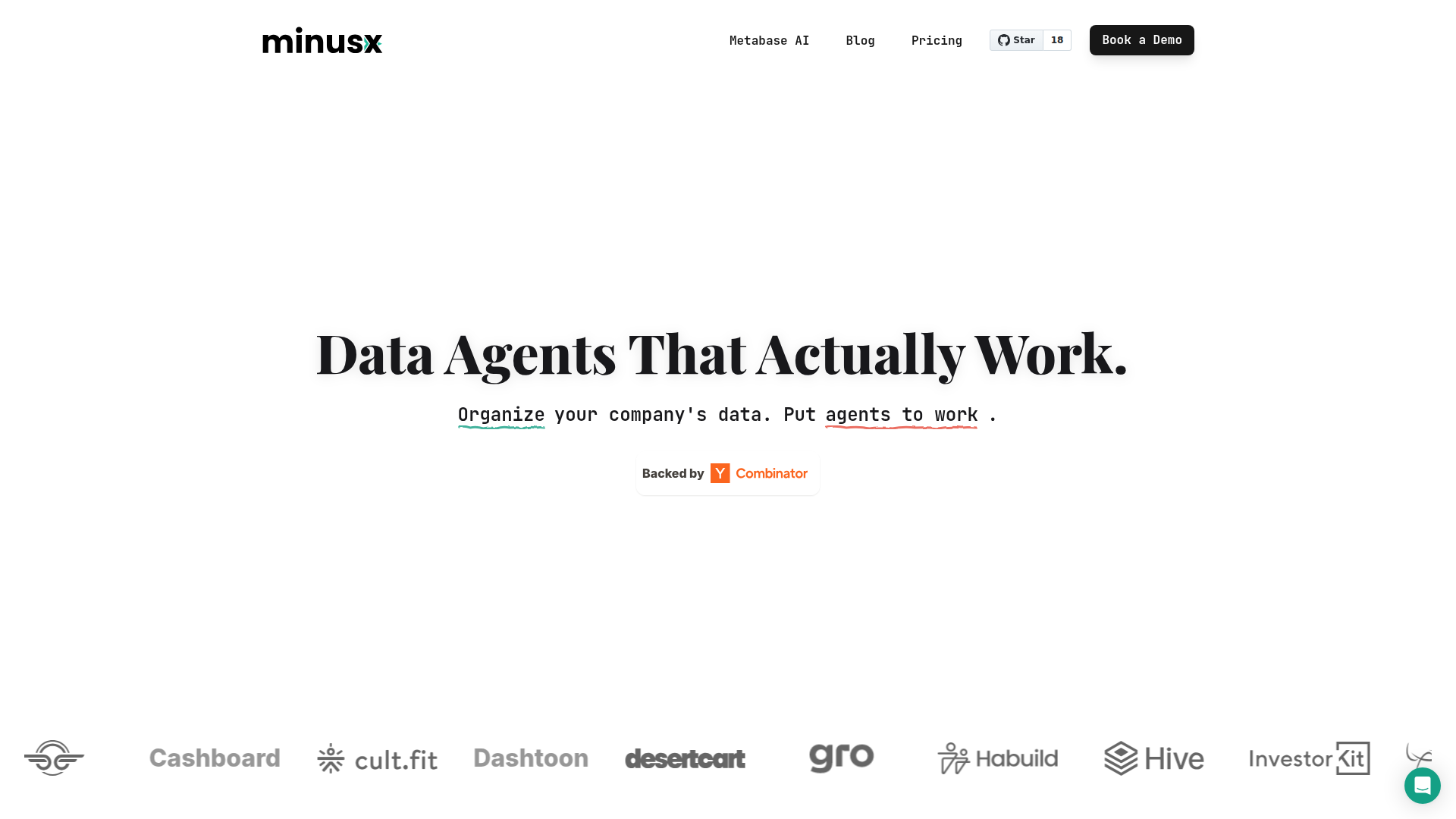
MinusX is an agentic data platform focused on helping teams organize company data, build governed data models, and use AI agents for analysis, dashboard interrogation, and proactive monitoring. Based on the page, it is designed for data teams as well as business users who need reliable answers from company data without depending entirely on manual SQL workflows.
The product appears positioned as an alternative to basic text-to-SQL tools by emphasizing context, governed models, automated testing, and closed-loop agent workflows. Its core workflow spans data engineering, ad hoc analysis, dashboard modification, and always-on metric monitoring, with a strong emphasis on trust, reuse of business context, and self-serve analytics.
Features
- Data engineering agent for model creation: Generates dbt-style data models from business questions and includes automated evaluation, which can help teams convert informal analytics needs into reusable data structures.
- Clarification-driven workflow: Surfaces missing business definitions, such as how a term like “active user” should be defined, which helps reduce ambiguity before analysis is produced.
- Governed analyst agent: Answers questions and modifies dashboards using governed data models and team-specific context, which can make ad hoc analysis more consistent and easier to audit.
- Dashboard interrogation: Lets users ask follow-up questions about trends or anomalies in dashboards, helping teams investigate changes without manually rebuilding every query.
- Proactive analytics agent: Monitors important metrics and generates alerts and reports, including examples shown through email, presentations, and Slack-style notifications.
- Metabase-focused AI layer: The page references Metabase AI, dashboard Q&A, and an MBQL AI assistant, indicating a strong product orientation around enhancing Metabase-based analytics workflows.
Helpful Tips
- Verify the scope of data stack support: The page clearly shows dbt-style modeling and strong Metabase alignment, but broader warehouse, BI, or orchestration support is not fully described on this page.
- Treat reliability claims carefully during evaluation: The site emphasizes trust and reliability, but buyers should validate performance on their own schemas, business definitions, and edge cases before broad rollout.
- Start with high-value recurring questions: This type of product is likely most effective when applied first to repeated business queries, KPI monitoring, and dashboard follow-ups where context reuse matters.
- Establish metric definitions early: Because the workflow includes clarification and codification of tribal knowledge, adoption will likely improve when teams standardize terms such as churn, active user, and revenue.
- Review governance expectations with analysts: Products in this category can reduce manual query work, but success usually depends on analysts curating models, evaluation rules, and trusted semantic definitions.
OpenClaw Skills
MinusX could fit well into the OpenClaw ecosystem as a data reasoning and business-intelligence execution layer. Likely OpenClaw skills could include natural-language KPI investigation, anomaly triage agents, board-report generation, metric-definition assistants, and workflow agents that translate business questions into reusable analytics tasks. If native integrations are not confirmed, these should be treated as likely workflow patterns rather than built-in product behavior.
In practice, an OpenClaw agent paired with MinusX could watch operating metrics, detect a change, interrogate the relevant dashboard, summarize probable drivers, and draft outputs for Slack, email, or review decks. For product, finance, and growth teams, that combination could shift analytics from a request-driven model toward a more continuous decision-support system, where analysts spend less time answering repetitive questions and more time refining definitions, data models, and strategic interpretation.
Embed Code
Share this AI tool on your website or blog by copying and pasting the code below. The embedded widget will automatically update with the latest information.
<iframe src="https://aimyflow.com/ai/minusx-ai/embed" width="100%" height="400" frameborder="0"></iframe>
Explore Similar Tools
Generate SQL Queries in Seconds for Free - SQLAI.ai
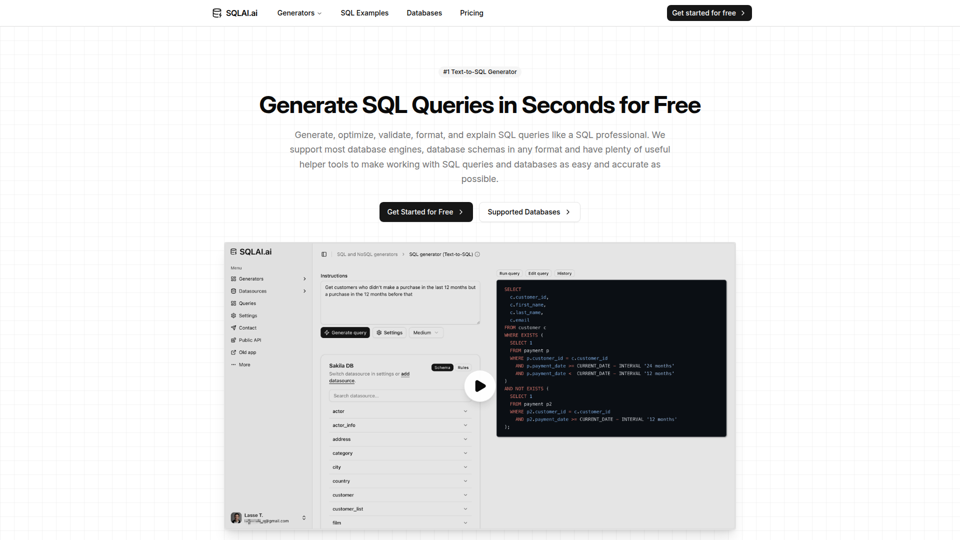
SQLAI.ai is an AI SQL assistant that helps analysts, data engineers, developers, and data teams generate, optimize, validate, format, explain, and run SQL or NoSQL queries from natural language across many database engines. For analytics and engineering work, it can shorten query drafting and review cycles by combining schema-aware generation with validation and readable explanations.

Blackshark.ai - AI Infrastructure for the Physical World
Blackshark.ai is an AI geospatial infrastructure platform that turns satellite, aerial, drone, and sensor imagery into structured world models and simulation-ready 3D environments for government and enterprise teams working with large-scale physical-world data. For geospatial analysts, disaster response planners, and simulation teams, it can speed change detection, situational awareness, and AI training by converting massive imagery streams into operational intelligence.
Autonomous AI for Data Teams | Databricks
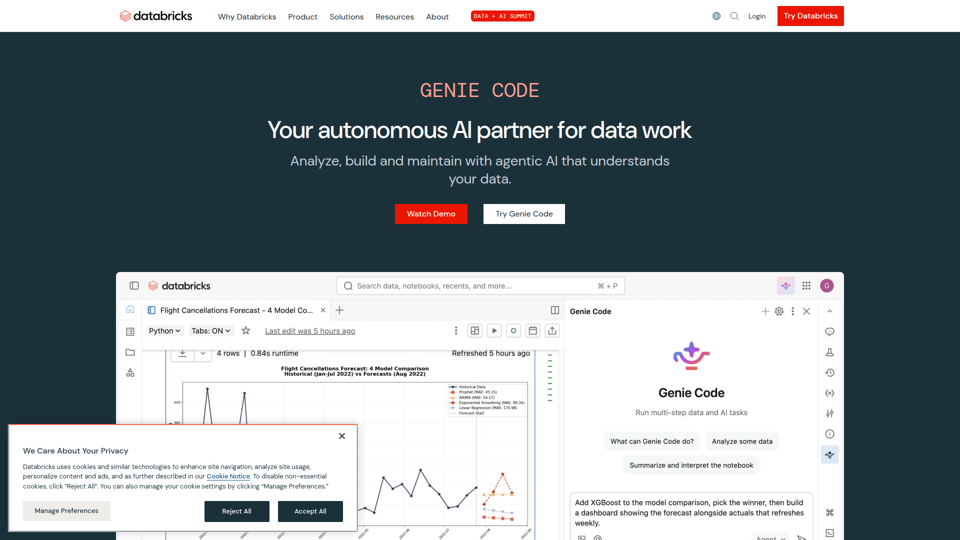
Databricks Genie Code is an autonomous AI tool in the Databricks workspace that helps data teams plan, execute, and maintain data science, machine learning, data engineering, analytics, and dashboard workflows using natural language and enterprise data context. For data engineers, data scientists, and analysts, it can reduce manual orchestration by grounding work in governed metadata and proactively supporting production pipelines, models, and BI assets.
Home | Deasy Labs
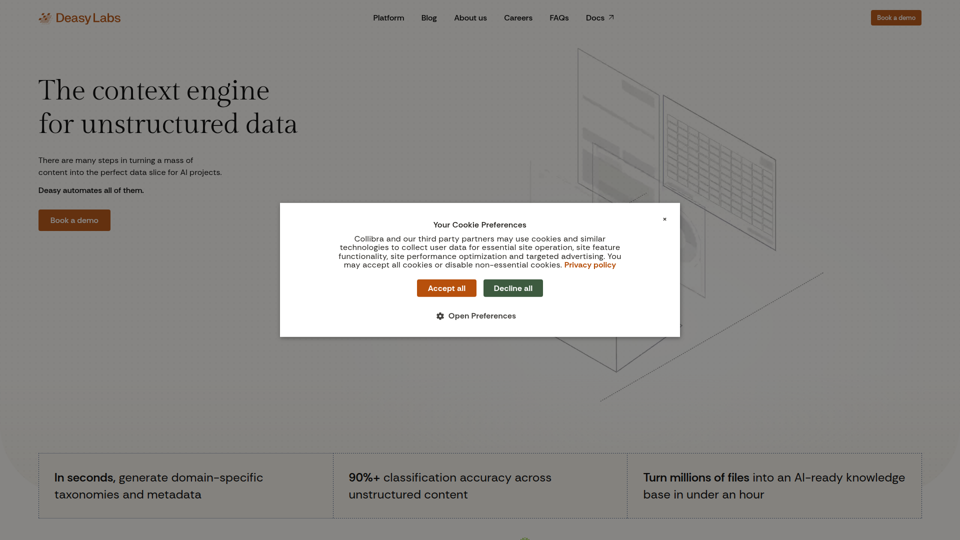
Deasy Labs is a context engine for unstructured data that automates content discovery, tagging, filtering, enrichment, and maintenance to create AI-ready knowledge bases, mainly for teams building AI and retrieval systems. For AI engineers, data teams, and knowledge management functions, it can reduce manual data preparation while helping keep RAG and other AI applications accurate, governed, and up to date.
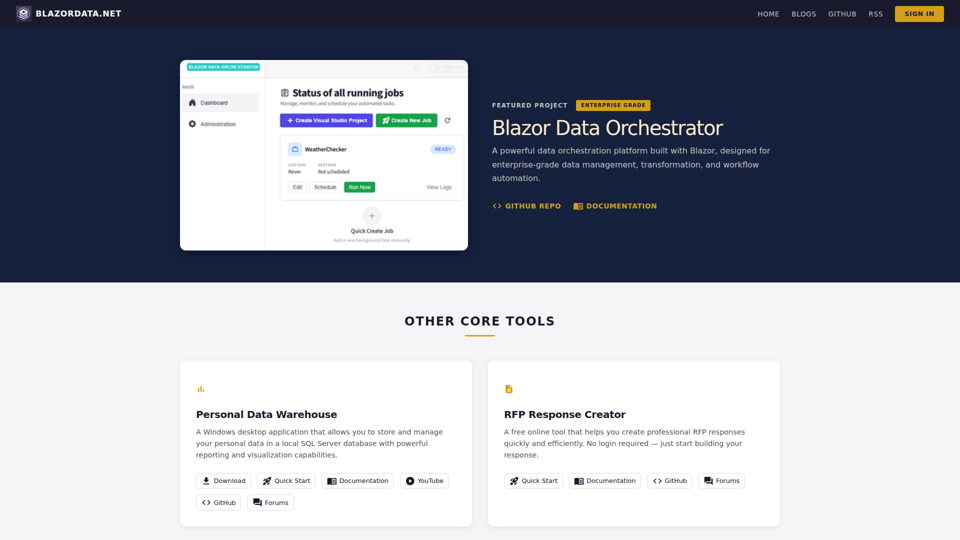
BlazorData - Home
BlazorData is a Blazor-based data orchestration platform for enterprise-grade data management, transformation, and workflow automation, mainly aimed at teams handling structured data processes in business or technical environments. In AI-era workflows, it can help data and operations professionals organize cleaner, more reliable pipelines that support automation and downstream analysis.
Bright Data for AI – Connect Your AI to the Web
Bright Data for AI is a web data platform that helps AI teams search, crawl, extract, and collect structured real-time and training data from the web through APIs, remote browsers, datasets, and automation tools. For AI engineers, data scientists, and agent builders, it can reduce the effort of building web access and data acquisition pipelines so they can focus more on model behavior and application logic.
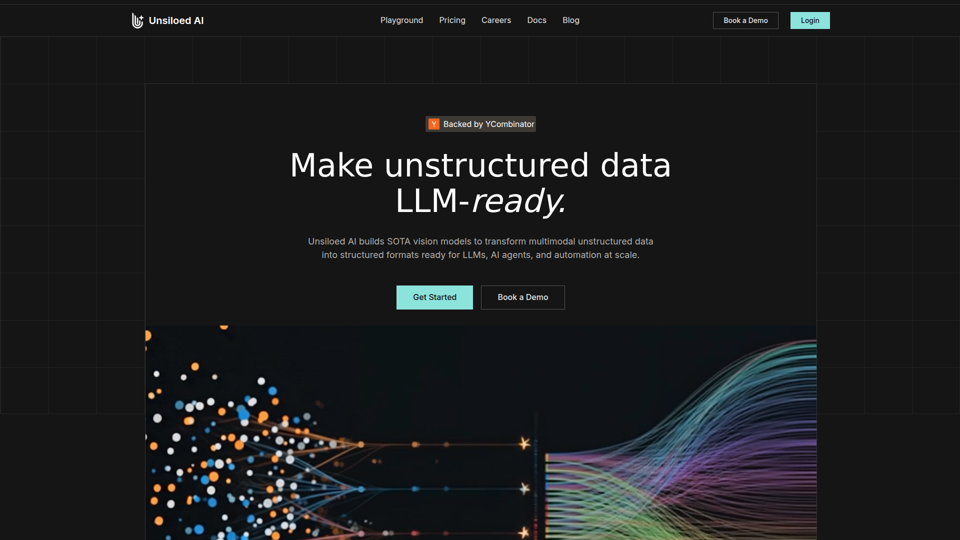
Unsiloed AI
Unsiloed AI is a document processing platform that turns multimodal unstructured data like PDFs, spreadsheets, slides, and images into structured JSON or Markdown for LLMs, AI agents, and automation, mainly for developers, AI engineers, and data teams in accuracy-critical enterprises. In AI workflows, it can help data engineering, ML, and operations teams reduce manual parsing work and improve retrieval quality by preserving document structure, hierarchy, and domain context.
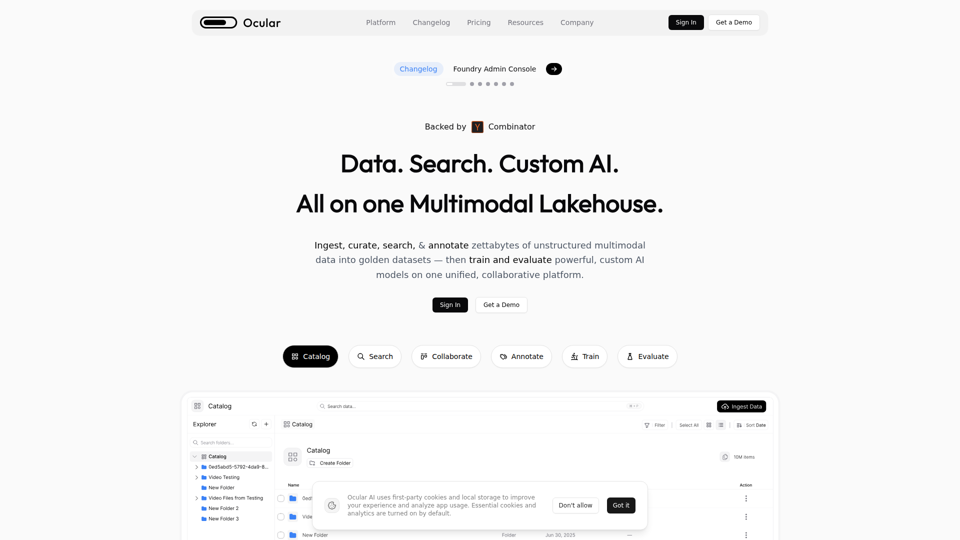
Ocular AI
Ocular AI is a multimodal data lakehouse and AI development platform that helps teams ingest, curate, search, annotate, and version unstructured data, then train and evaluate custom models, mainly for AI engineers and data teams building production systems. In AI workflows, it can streamline handoffs between data engineering, annotation operations, and ML engineering by keeping data, labeling, evaluation, and governance in one collaborative environment.