
Blackshark.ai - AI Infrastructure for the Physical World
Rate this Tool
Average Score
Total Votes
Select your score (1-10):
Detail Information
What
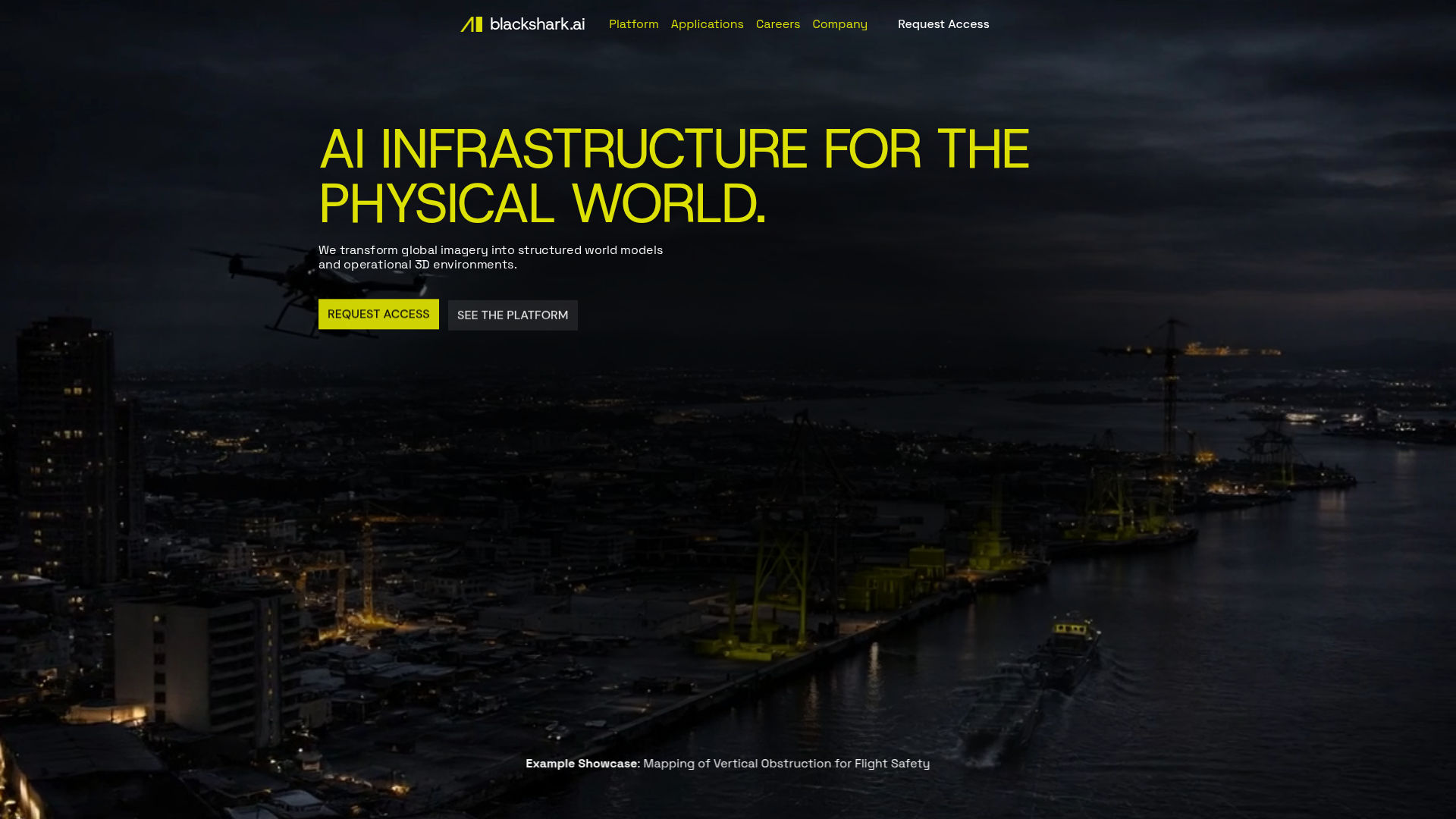
Blackshark.ai is an AI infrastructure platform that turns large volumes of geospatial sensor data into structured world models and operational 3D environments. It is positioned as a planet-scale system for organizations that need to process satellite, aerial, drone, and ground-sensor imagery into usable spatial intelligence.
The platform appears aimed at government, defense, simulation, and enterprise users working with high-frequency mapping, disaster response, digital twins, autonomy, and physical AI training. Its core workflow moves from sensing and AI-based detection to distributed world-model computation, 3D reconstruction, and deployment into operational environments across cloud, on-premise, and edge infrastructure.
Features
- Multi-source sensor ingestion: Accepts imagery from satellites, aerial systems, drones, and ground sensors, helping teams consolidate varied geospatial inputs into one processing pipeline.
- AI-driven detection and extraction with HUNTR™: Supports analyst-led identification of infrastructure and terrain features, which can speed interpretation of very large image volumes.
- Distributed world-model computation with VEOS™: Converts trillions of pixels into structured world models, enabling large-scale processing for mapping and analysis workflows.
- 3D environment generation with REPLIKA™: Reconstructs physical spaces into simulation-ready environments, useful for training, planning, and spatial exploration.
- Operational domain support: Applies the same platform to high-frequency mapping, physical AI training, rapid disaster response, and synthetic environment generation.
- Flexible deployment options: Can be deployed in cloud, sovereign on-premise, and edge settings, which is practical for organizations with security, latency, or infrastructure constraints.
Helpful Tips
- Verify operational fit by domain: The platform spans mapping, simulation, disaster response, and AI training, so buyers should define the primary workflow first and assess whether the product’s strongest value is analysis, reconstruction, or simulation support.
- Scrutinize data readiness: Success with this kind of system depends heavily on imagery access, refresh frequency, sensor quality, and labeling or analyst workflows, even when the platform automates much of the processing.
- Plan for deployment constraints early: Since Blackshark.ai supports sovereign on-premise and edge deployments, implementation teams should clarify infrastructure, governance, and operational ownership requirements before evaluation.
- Separate confirmed features from likely workflow extensions: The site clearly describes world modeling, extraction, and 3D generation, but prospective users should confirm downstream integrations and domain-specific tooling in detail.
- Assess non-technical user adoption carefully: The careers content suggests tools for non-technical users to train models, but the public page provides limited product detail on usability, governance, and collaboration features.
OpenClaw Skills
Blackshark.ai could fit well within the OpenClaw ecosystem as a foundation layer for geospatial reasoning, imagery triage, and operational world-model workflows. Likely OpenClaw skills could include agents that monitor incoming imagery, classify event types, route scenes into extraction pipelines, summarize detected infrastructure changes, and generate mission- or domain-specific reports from the resulting spatial data. This is a likely use case rather than a confirmed native integration, since the page does not describe APIs or direct connectors.
In practice, that combination could be especially useful for public-sector analysts, emergency response teams, defense planners, and digital twin operators. OpenClaw agents could likely sit on top of Blackshark-generated outputs to coordinate damage-assessment workflows, automate alerts for infrastructure change, prepare simulation scenarios, or create decision briefings from updated 3D environments. If implemented well, this could shift work from manual imagery review toward orchestrated human-plus-agent operations built around continuously refreshed models of the physical world.
Embed Code
Share this AI tool on your website or blog by copying and pasting the code below. The embedded widget will automatically update with the latest information.
<iframe src="https://aimyflow.com/ai/blackshark-ai/embed" width="100%" height="400" frameborder="0"></iframe>
Explore Similar Tools
Generate SQL Queries in Seconds for Free - SQLAI.ai
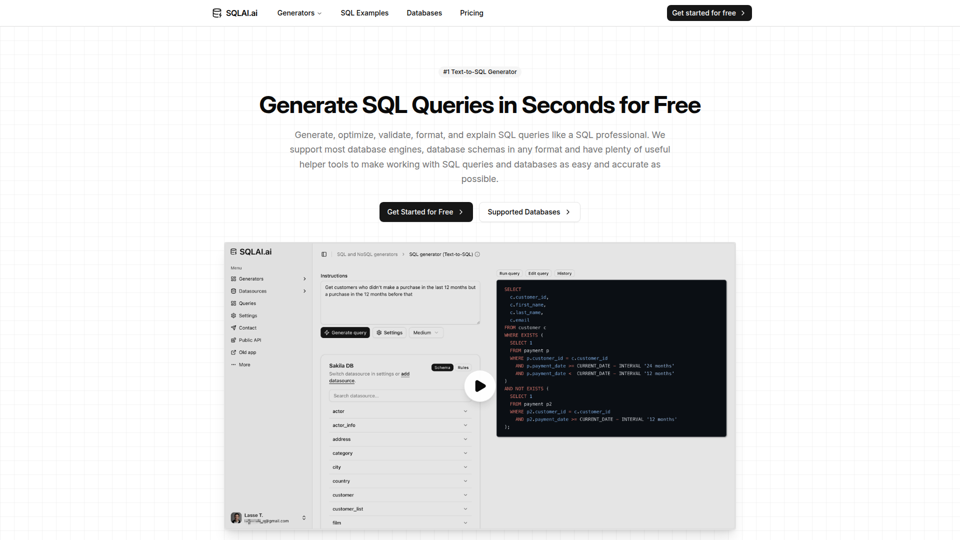
SQLAI.ai is an AI SQL assistant that helps analysts, data engineers, developers, and data teams generate, optimize, validate, format, explain, and run SQL or NoSQL queries from natural language across many database engines. For analytics and engineering work, it can shorten query drafting and review cycles by combining schema-aware generation with validation and readable explanations.
Autonomous AI for Data Teams | Databricks
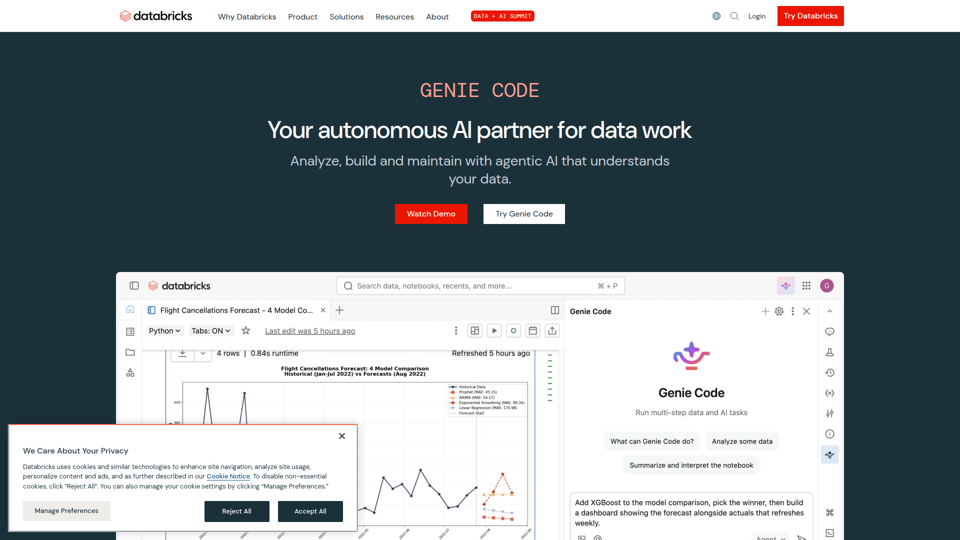
Databricks Genie Code is an autonomous AI tool in the Databricks workspace that helps data teams plan, execute, and maintain data science, machine learning, data engineering, analytics, and dashboard workflows using natural language and enterprise data context. For data engineers, data scientists, and analysts, it can reduce manual orchestration by grounding work in governed metadata and proactively supporting production pipelines, models, and BI assets.
Home | Deasy Labs
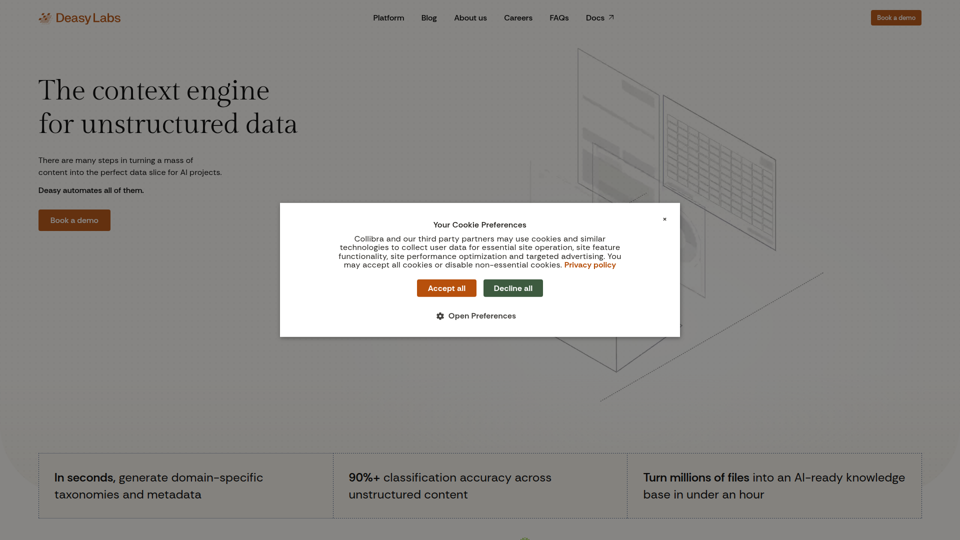
Deasy Labs is a context engine for unstructured data that automates content discovery, tagging, filtering, enrichment, and maintenance to create AI-ready knowledge bases, mainly for teams building AI and retrieval systems. For AI engineers, data teams, and knowledge management functions, it can reduce manual data preparation while helping keep RAG and other AI applications accurate, governed, and up to date.
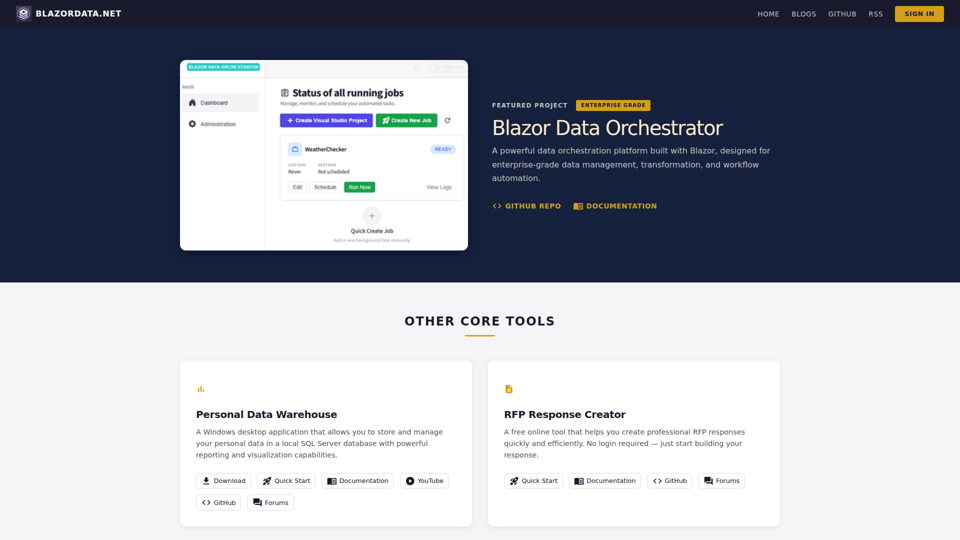
BlazorData - Home
BlazorData is a Blazor-based data orchestration platform for enterprise-grade data management, transformation, and workflow automation, mainly aimed at teams handling structured data processes in business or technical environments. In AI-era workflows, it can help data and operations professionals organize cleaner, more reliable pipelines that support automation and downstream analysis.
Bright Data for AI – Connect Your AI to the Web
Bright Data for AI is a web data platform that helps AI teams search, crawl, extract, and collect structured real-time and training data from the web through APIs, remote browsers, datasets, and automation tools. For AI engineers, data scientists, and agent builders, it can reduce the effort of building web access and data acquisition pipelines so they can focus more on model behavior and application logic.
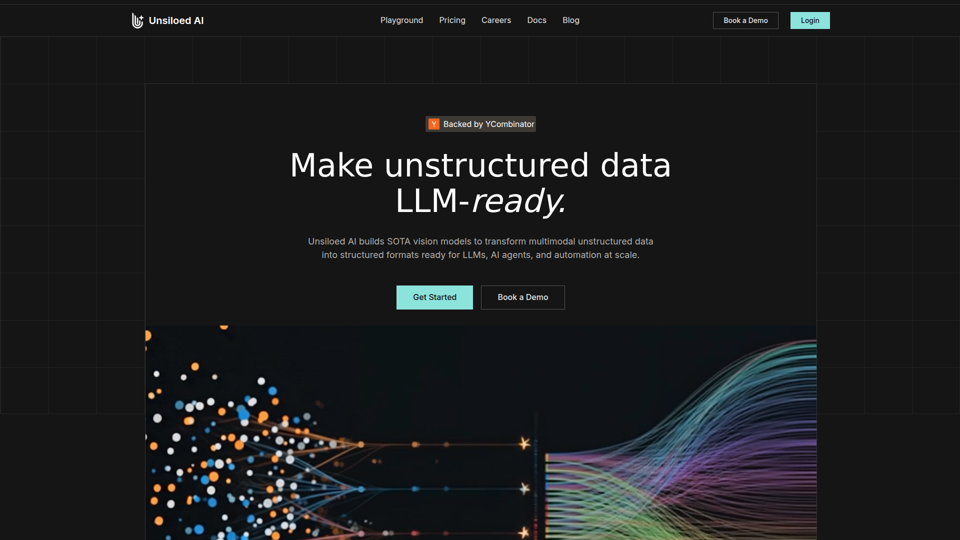
Unsiloed AI
Unsiloed AI is a document processing platform that turns multimodal unstructured data like PDFs, spreadsheets, slides, and images into structured JSON or Markdown for LLMs, AI agents, and automation, mainly for developers, AI engineers, and data teams in accuracy-critical enterprises. In AI workflows, it can help data engineering, ML, and operations teams reduce manual parsing work and improve retrieval quality by preserving document structure, hierarchy, and domain context.
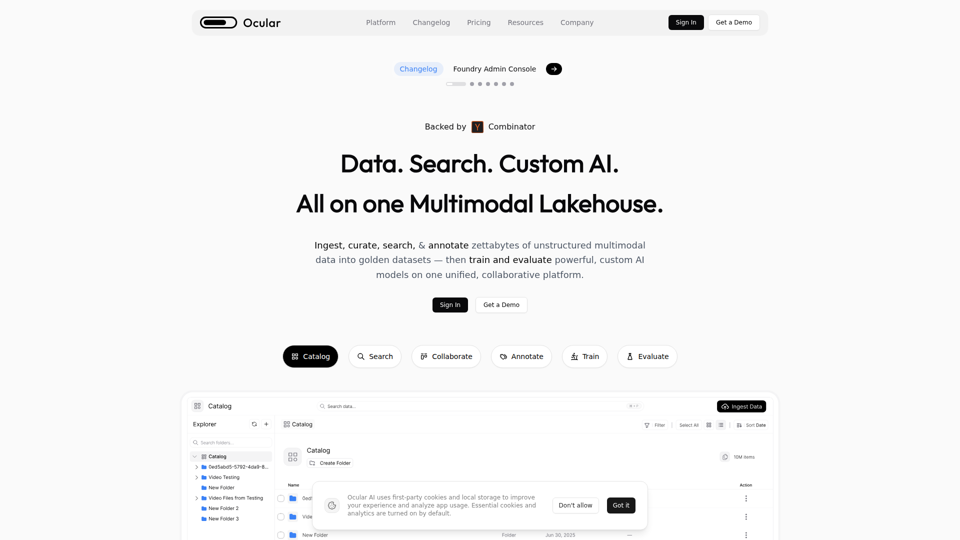
Ocular AI
Ocular AI is a multimodal data lakehouse and AI development platform that helps teams ingest, curate, search, annotate, and version unstructured data, then train and evaluate custom models, mainly for AI engineers and data teams building production systems. In AI workflows, it can streamline handoffs between data engineering, annotation operations, and ML engineering by keeping data, labeling, evaluation, and governance in one collaborative environment.
OSSUS
OSSUS is a self-healing data infrastructure platform that helps organizations turn fragmented records into trusted, agent-ready systems of truth, mainly for teams responsible for data and AI foundations. As AI adoption grows, it can help data, analytics, and engineering professionals improve reliability by giving AI systems cleaner, more dependable information to work from.