
Bright Data for AI – Connect Your AI to the Web
Rate this Tool
Average Score
Total Votes
Select your score (1-10):
Detail Information
What
Bright Data for AI is a web access and data acquisition platform designed to help AI systems connect to, retrieve from, and interact with the public web. Based on the page, it supports both real-time inference workflows and training-data preparation through APIs, managed browser infrastructure, structured data pipelines, datasets, and a large web archive.
It appears to serve AI teams, developers, and enterprises building agents, search workflows, crawlers, and model-training pipelines. Its positioning is likely infrastructure-level rather than end-user application software: the emphasis is on removing operational work around blocking, CAPTCHAs, browser management, crawling, search access, and data formatting so teams can focus on AI use cases.
Features
- Web access APIs: Provides tools to search, crawl, extract, and navigate websites with an emphasis on avoiding blocks, CAPTCHAs, and JavaScript-rendering issues.
- LLM-ready content extraction: Converts website content into Markdown, HTML, or JSON, which helps teams feed cleaner web data into models and agent workflows.
- SERP data retrieval: Returns real-time, geo-targeted search results from major search engines, which is useful for discovery, monitoring, and query-based data collection.
- Managed browser infrastructure for agents: Offers remote browsers built for automated web interaction, allowing AI agents to execute actions on websites without teams managing browser fleets directly.
- Structured data pipelines and feeds: Supports scheduled or triggered ingestion of structured data from selected sources for AI apps and downstream processing.
- Historical web archive and training data options: Includes access to archived web content and mentions custom datasets across text, image, audio, and video for model training use cases.
Helpful Tips
- Validate the exact product scope before purchase or rollout: Bright Data presents many adjacent products on one page, so teams should map each use case—search, crawling, browser automation, feeds, archive, or training data—to the specific API or service involved.
- Test output quality for your model workflow: “LLM-ready” formatting is useful, but teams should verify whether Markdown, HTML, or JSON best preserves the structure, metadata, and context their models require.
- Separate inference and training pipelines early: Real-time search/browser workflows and bulk dataset acquisition usually have different latency, reliability, and governance needs, so they should be architected differently.
- Plan around source volatility: For products that rely on live web access, implementation should account for changing page structures, availability, and query behavior even when access infrastructure is managed.
- Review archive and feed relevance carefully: Historical pages and prebuilt feeds can accelerate development, but suitability depends on freshness, source coverage, and whether the available schema matches the target use case.
OpenClaw Skills
Bright Data could be a strong upstream data and execution layer for OpenClaw-based agents and skills. Likely use cases include research agents that search the web and extract clean source material, monitoring agents that watch competitor or market pages for changes, and browser-execution agents that complete multi-step web tasks using managed remote browsers. The Bright Data MCP Server is especially relevant here because it suggests a model-context-friendly way to expose web capabilities to AI systems, though the page does not describe the exact OpenClaw integration model.
In an OpenClaw ecosystem, teams could likely build reusable skills for web search, source validation, structured extraction, historical lookup, and trigger-based data refresh. That combination could materially change work in market intelligence, sales research, eCommerce analysis, logistics monitoring, and AI operations by shifting teams from manual browsing and brittle scraping stacks toward orchestrated agent workflows. Where native interoperability is not stated, this should be treated as a likely workflow design pattern rather than a confirmed built-in integration.
Embed Code
Share this AI tool on your website or blog by copying and pasting the code below. The embedded widget will automatically update with the latest information.
<iframe src="https://aimyflow.com/ai/get-brightdata-com-datatoolify/embed" width="100%" height="400" frameborder="0"></iframe>
Explore Similar Tools
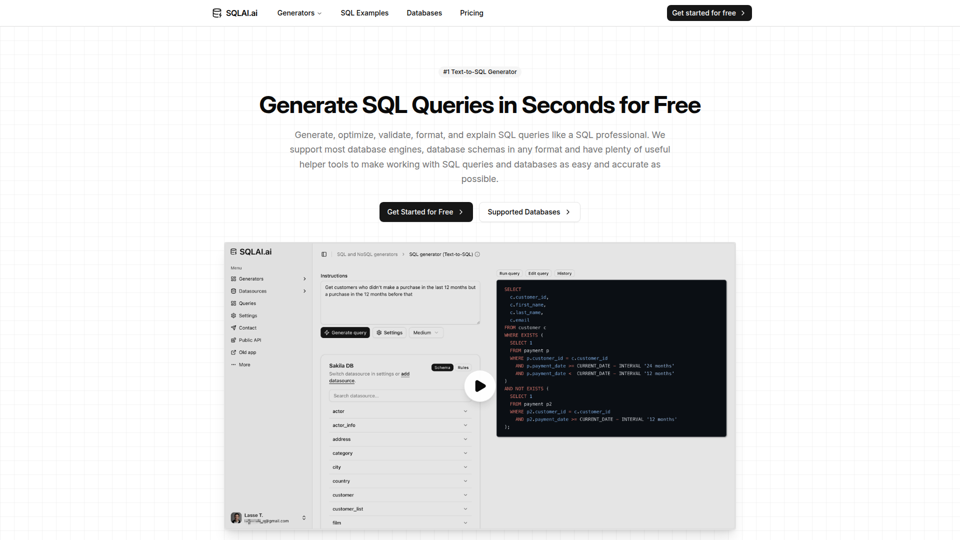
Generate SQL Queries in Seconds for Free - SQLAI.ai
SQLAI.ai is an AI SQL assistant that helps analysts, data engineers, developers, and data teams generate, optimize, validate, format, explain, and run SQL or NoSQL queries from natural language across many database engines. For analytics and engineering work, it can shorten query drafting and review cycles by combining schema-aware generation with validation and readable explanations.

Blackshark.ai - AI Infrastructure for the Physical World
Blackshark.ai is an AI geospatial infrastructure platform that turns satellite, aerial, drone, and sensor imagery into structured world models and simulation-ready 3D environments for government and enterprise teams working with large-scale physical-world data. For geospatial analysts, disaster response planners, and simulation teams, it can speed change detection, situational awareness, and AI training by converting massive imagery streams into operational intelligence.
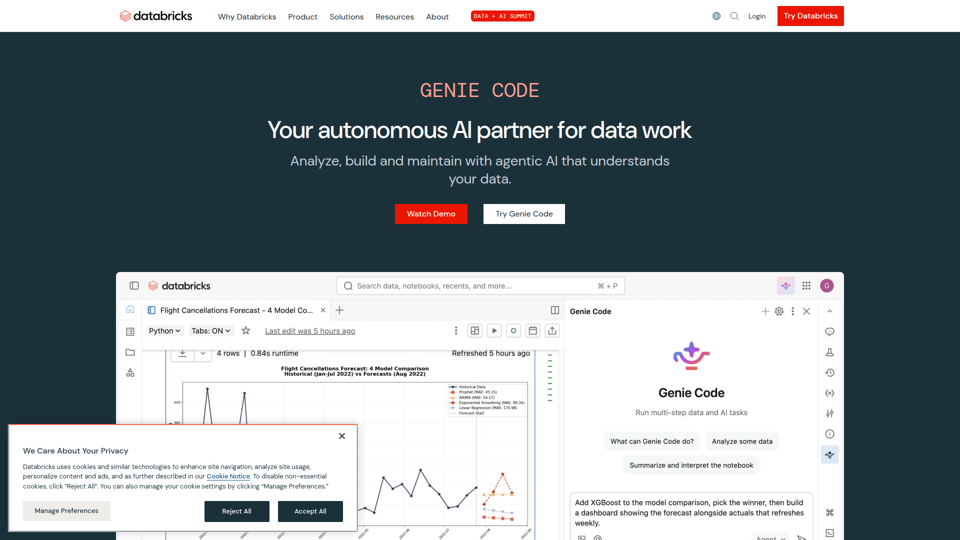
Autonomous AI for Data Teams | Databricks
Databricks Genie Code is an autonomous AI tool in the Databricks workspace that helps data teams plan, execute, and maintain data science, machine learning, data engineering, analytics, and dashboard workflows using natural language and enterprise data context. For data engineers, data scientists, and analysts, it can reduce manual orchestration by grounding work in governed metadata and proactively supporting production pipelines, models, and BI assets.
Home | Deasy Labs
Deasy Labs is a context engine for unstructured data that automates content discovery, tagging, filtering, enrichment, and maintenance to create AI-ready knowledge bases, mainly for teams building AI and retrieval systems. For AI engineers, data teams, and knowledge management functions, it can reduce manual data preparation while helping keep RAG and other AI applications accurate, governed, and up to date.
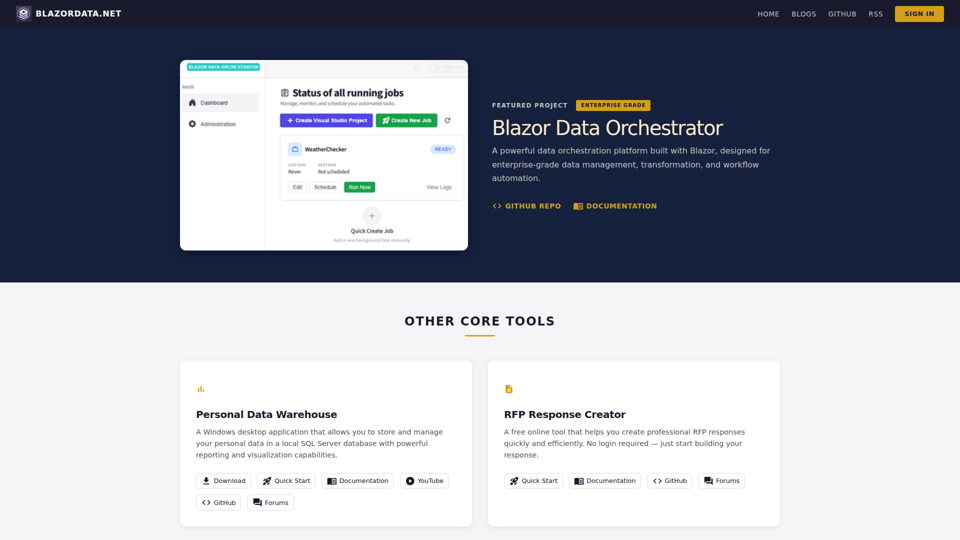
BlazorData - Home
BlazorData is a Blazor-based data orchestration platform for enterprise-grade data management, transformation, and workflow automation, mainly aimed at teams handling structured data processes in business or technical environments. In AI-era workflows, it can help data and operations professionals organize cleaner, more reliable pipelines that support automation and downstream analysis.
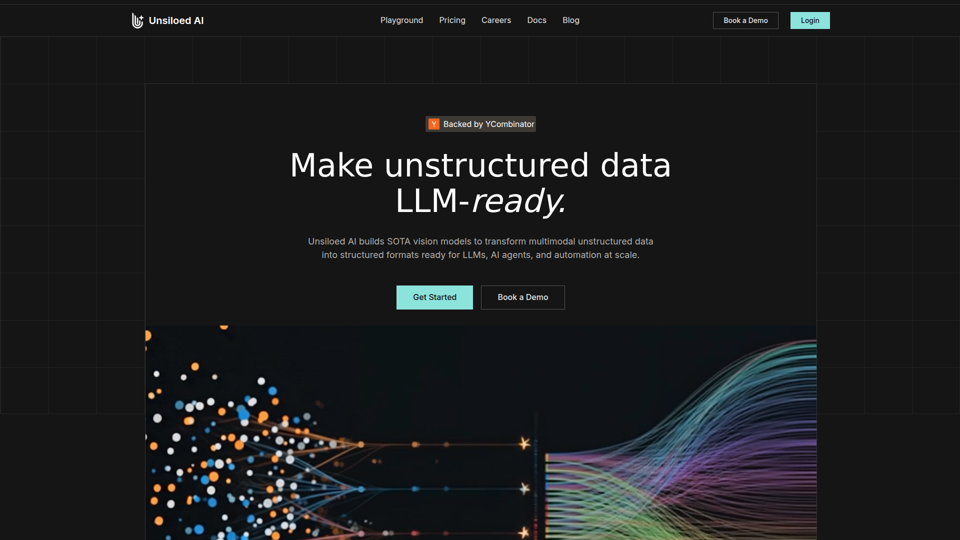
Unsiloed AI
Unsiloed AI is a document processing platform that turns multimodal unstructured data like PDFs, spreadsheets, slides, and images into structured JSON or Markdown for LLMs, AI agents, and automation, mainly for developers, AI engineers, and data teams in accuracy-critical enterprises. In AI workflows, it can help data engineering, ML, and operations teams reduce manual parsing work and improve retrieval quality by preserving document structure, hierarchy, and domain context.
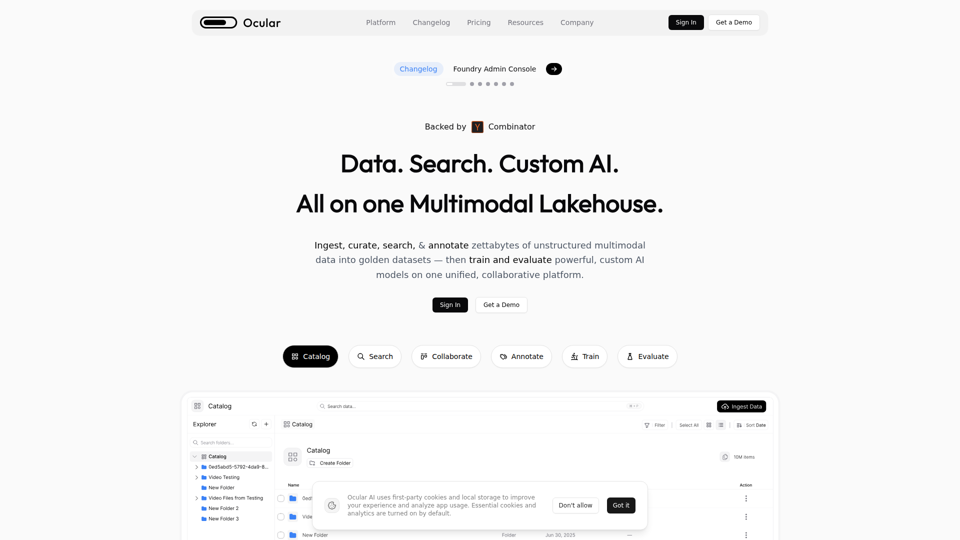
Ocular AI
Ocular AI is a multimodal data lakehouse and AI development platform that helps teams ingest, curate, search, annotate, and version unstructured data, then train and evaluate custom models, mainly for AI engineers and data teams building production systems. In AI workflows, it can streamline handoffs between data engineering, annotation operations, and ML engineering by keeping data, labeling, evaluation, and governance in one collaborative environment.

OSSUS
OSSUS is a self-healing data infrastructure platform that helps organizations turn fragmented records into trusted, agent-ready systems of truth, mainly for teams responsible for data and AI foundations. As AI adoption grows, it can help data, analytics, and engineering professionals improve reliability by giving AI systems cleaner, more dependable information to work from.