
Anto | A Frontier Biology AI Lab

Rate this Tool
Average Score
Total Votes
Select your score (1-10):
Detail Information
What
Anto is a biology AI lab focused on making the gut microbiome computationally usable for research and drug development. Its work centers on turning large, noisy microbiome datasets into tractable signal through sparsification, tokenization, causal modeling, and multimodal foundation models for microbial communities.
The product positioning appears to be research infrastructure and applied modeling for pharmaceutical and translational biology teams that need to understand how microbiome variation affects drug efficacy, toxicity, and intervention outcomes. Based on the page, Anto’s core workflow moves from noisy metagenomic and multi-omics data to causal signal, prediction, and AI-guided validation, with a stated emphasis on microbiome-informed drug development.
Features
- Quality-aware sparsification algorithms: Anto removes low-quality and non-predictive microbiome data to reduce noise and make high-dimensional datasets more computationally tractable.
- Tokenization methods for microbiome data: The lab develops representation methods intended to convert complex microbial information into forms usable by large-scale AI models.
- Foundation models for microbial communities: Anto is building multimodal models designed to generalize across organisms, environments, and interventions in microbiome research.
- Causal modeling of microbial ecosystems: The platform aims to forecast ecosystem dynamics, estimate counterfactual intervention outcomes, and support inverse design of microbial therapies.
- Drug response prediction: Anto states that its Darwin model series predicts drug toxicity and efficacy across diverse populations, targeting microbiome-driven variation in treatment outcomes.
- Lab-in-the-loop research workflow: The company combines large-scale multi-omics, over 100,000 interventional trajectories, and AI-guided validation to connect computational predictions with experimental testing.
Helpful Tips
- Verify maturity by use case: The site describes frontier research capabilities, so buyers should separate published research assets from production-ready workflows and ask which components are available for active programs.
- Assess data fit early: For microbiome AI products, value depends heavily on sample quality, intervention design, and metadata completeness, so evaluate whether internal datasets can support causal rather than purely correlational modeling.
- Prioritize decision points in drug development: The strongest practical use cases are likely program stages where microbiome effects materially change efficacy, toxicity, population stratification, or molecule selection.
- Request validation details: Claims around counterfactual prediction, inverse design, and cross-population generalization should be reviewed against experimental design and external validation evidence where available.
- Plan cross-functional adoption: Successful deployment in this category usually requires coordination across computational biology, translational medicine, pharmacology, and wet-lab teams.
Embed Code
Share this AI tool on your website or blog by copying and pasting the code below. The embedded widget will automatically update with the latest information.
<iframe src="https://aimyflow.com/ai/anto-bio/embed" width="100%" height="400" frameborder="0"></iframe>
Explore Similar Tools
10x Science: AI-Native Software for Scientists
10x Science is AI-native software for scientists that helps characterize proteins and analyze omics data at scale, with features for peptide mapping, de novo sequencing, PTM detection, and proteoform analysis, especially for protein therapeutics workflows. For protein scientists and analytical teams, this can speed interpretation of complex mass spectrometry data and help reveal sequence variants or modifications that conventional tools may miss.
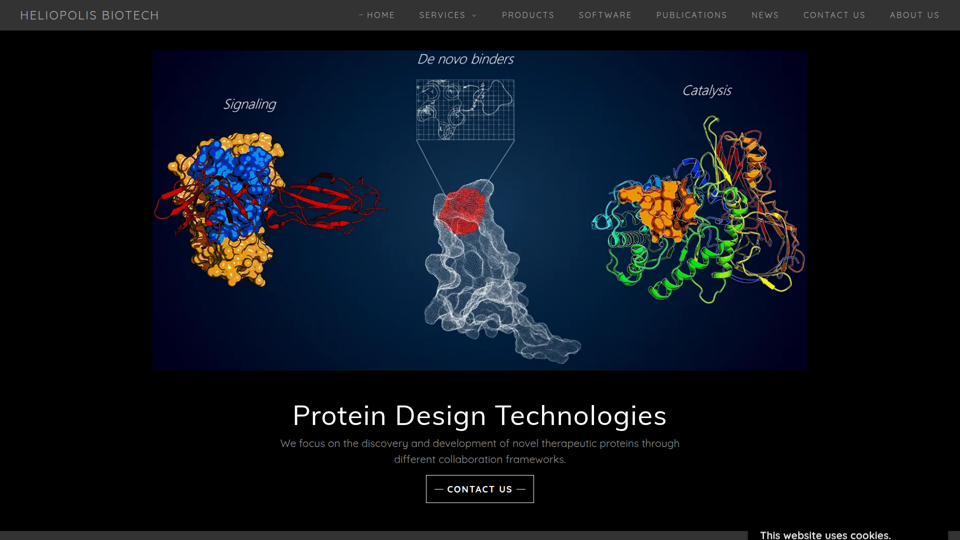
HELIOPOLIS BIOTECH - Protein Design, Antibody Design
Heliopolis Biotech is a protein and antibody design company that uses computational algorithms and experimental characterization to help biotechnology and drug discovery teams develop novel therapeutic proteins, binders, and redesigned proteins. In AI-driven therapeutic R&D, this kind of platform can help protein engineers and discovery scientists move faster from molecular design to preclinical candidate evaluation.
Undermind - Radically better research and discovery
Undermind is an AI-powered scientific literature research assistant that explores papers and citation networks to help researchers and R&D teams quickly find relevant evidence, assess novelty, and understand complex topics. In AI-enabled research workflows, it can help scientists, research leads, and technical teams reduce time spent on manual literature review while improving traceability through source-linked answers and relevance filtering.
Anthrogen
Anthrogen is an AI research lab that builds protein language models and experimental validation systems to generate and develop biologics and molecular machines, mainly for scientists working in drug discovery, biotechnology, and related research. By combining multimodal protein design with massively parallelized experimentation, it can help research and platform teams evaluate candidates faster and support more efficient biologics development workflows.
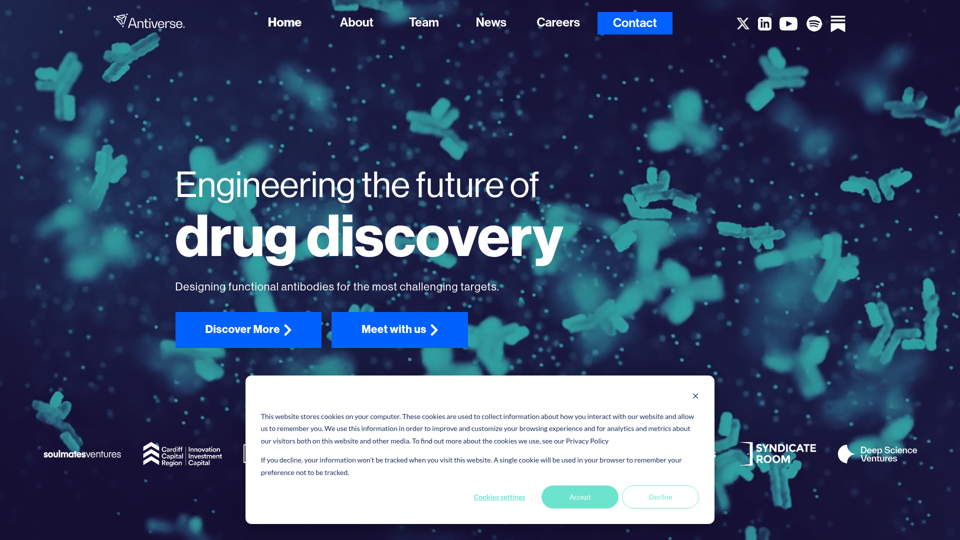
Antiverse: Designing Antibodies For Challenging Targets
Antiverse is a machine learning-driven antibody design platform focused on helping drug discovery teams design antibodies for challenging targets in therapeutic development. In AI-enabled biologics R&D, this can help antibody discovery scientists and computational biology teams prioritize candidates more efficiently when tackling hard-to-address targets.
Blank Bio | RNA Intelligence for Precision Medicine
Blank Bio is an RNA intelligence platform that uses foundation models combining isoform, mutation, and expression signals to improve patient stratification, diagnostics, target discovery, and therapeutic design for precision medicine teams and researchers. For clinical researchers and biomarker teams, this AI approach can uncover transcript-level patterns that gene-level RNA analysis may miss, helping refine subgroup identification and disease classification from routine RNA-seq data.
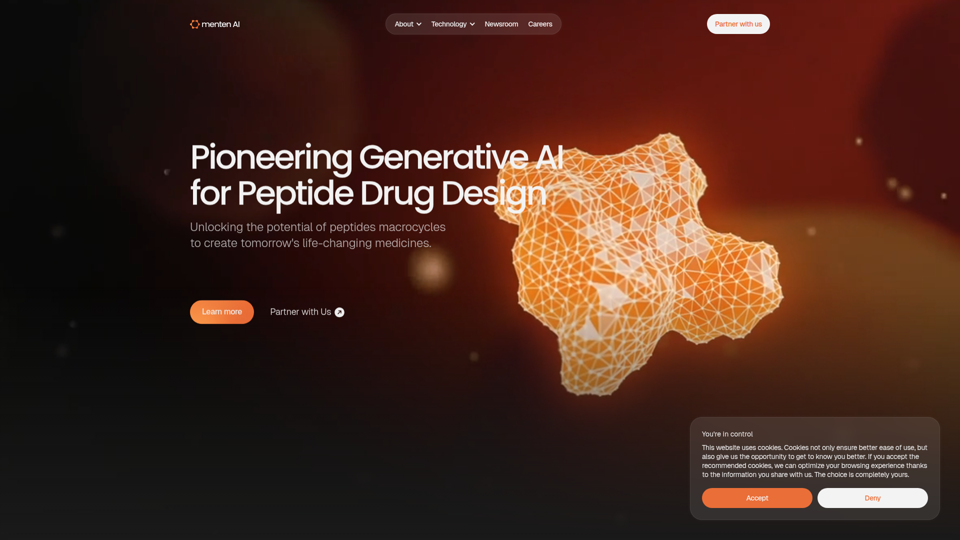
Menten AI
Menten AI is a generative AI platform for peptide macrocycle drug design that helps teams design and optimize peptides for complex targets, mainly for pharmaceutical and drug discovery researchers. For medicinal chemists and computational biology teams, it can speed preclinical candidate discovery by combining generative models with physics-based and quantum simulations.
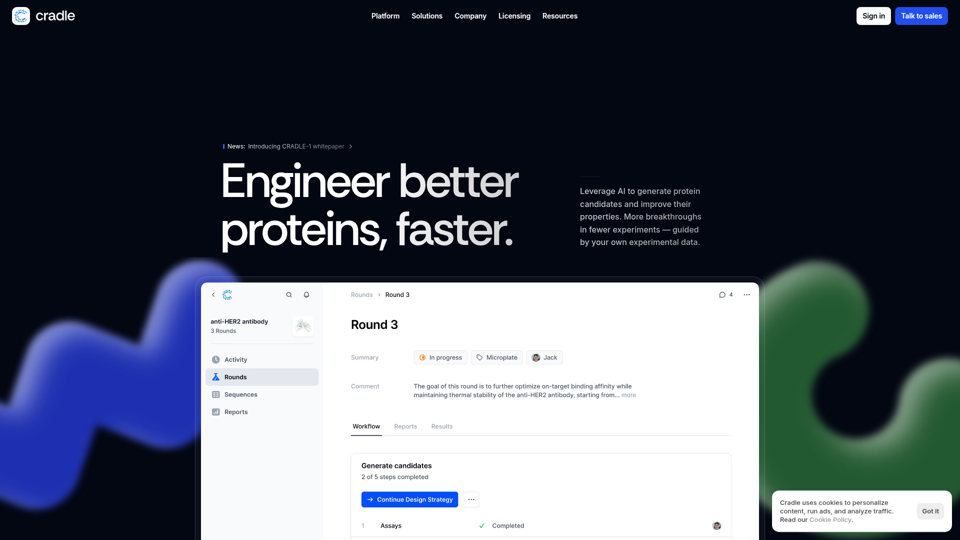
Cradle
Cradle is an AI platform for protein engineering that helps biopharma and industrial bio R&D teams generate and optimize protein candidates using their own experimental data. For protein engineers and R&D scientists, it can shorten design-build-test cycles by learning from each assay round to support faster multi-property optimization with fewer experiments.