How AI fits this role
Customer Success Manager
Role Overview
A Customer Success Manager (CSM) in a B2B SaaS environment is the operational bridge between a vendor's product and a customer's business outcomes. The role exists because software subscriptions only renew when customers achieve measurable value — and that value rarely materializes without active guidance.
In practice, a CSM manages a portfolio of accounts ranging from 20 to 200 customers depending on the segment (enterprise vs. mid-market vs. SMB), with annual recurring revenue (ARR) responsibility typically between $1M and $10M. Day-to-day work involves onboarding new accounts, running business reviews, monitoring product adoption, escalating churn risks, and identifying expansion opportunities. The role sits at the intersection of account management, product consulting, and relationship management.
The commercial pressure is direct: CSMs are increasingly measured on net revenue retention (NRR), not just satisfaction scores. That shift has changed the job from a support-adjacent function into a revenue-critical one, which is exactly why AI adoption in this role is accelerating faster than most people in it realize.
How AI Is Transforming This Role
The transformation is not about replacing CSMs — it is about eliminating the administrative and reactive work that consumes 40–60% of their time, and forcing the remaining work to be higher-stakes and more strategic.
The most concrete shift is in signal detection. Historically, a CSM learned a customer was at risk when the customer told them, or when a renewal conversation went badly. AI-powered health scoring now surfaces behavioral signals — declining login frequency, feature abandonment, support ticket velocity, champion job changes — weeks or months before a human would notice. The CSM's job shifts from discovering problems to triaging and responding to a prioritized queue of predicted problems.
The second major shift is in content generation. CSMs spend significant time writing: onboarding plans, QBR decks, success plans, renewal summaries, escalation briefs. Generative AI tools integrated into CRM and CS platforms now draft these documents from structured account data. The CSM's role becomes editorial — reviewing, contextualizing, and adding relationship nuance — rather than authoring from scratch.
The third shift is in coverage economics. AI-assisted digital CS motions (automated onboarding sequences, in-app guidance, AI chat for common questions) are allowing companies to serve SMB and long-tail accounts at scale without proportional headcount growth. This is compressing CSM hiring at the low end of the market while concentrating human CSM effort on complex, high-ARR accounts.
Tasks AI Can Automate
- Health score calculation — aggregating product usage, support history, NPS, and CRM signals into a dynamic risk score without manual data pulling
- Churn risk alerts — triggering notifications when behavioral patterns match historical churn signatures
- QBR and EBR deck generation — pulling account metrics, usage trends, and goal progress into pre-structured slide templates
- Renewal and expansion forecasting — predicting likelihood of renewal or upsell based on engagement and usage trajectory
- Onboarding sequence management — triggering milestone-based email and in-app nudges without CSM intervention for standard onboarding paths
- Meeting preparation briefs — summarizing recent activity, open tickets, stakeholder changes, and last interaction notes before a call
- Sentiment analysis on communications — flagging negative tone in emails or support tickets for proactive outreach
- Success plan drafting — generating first-draft success plans from account goals captured during onboarding
- CRM data hygiene — auto-logging calls, updating contact records, and filling in missing account fields from email and calendar data
Skills Becoming More Valuable
Strategic account planning — With AI handling monitoring and documentation, CSMs who can build multi-year account strategies, align with customer executive priorities, and map product roadmap to business outcomes become disproportionately valuable.
Executive presence and stakeholder navigation — AI cannot build trust with a CFO who is skeptical of a renewal price increase. The ability to navigate complex organizational politics, manage champion transitions, and influence without authority is increasingly the core differentiator.
Commercial acumen — CSMs who understand ARR math, gross margin implications, and how to frame expansion conversations in terms of customer ROI (not product features) are being pulled into revenue conversations that previously belonged to sales.
Data interpretation and storytelling — AI surfaces data; humans decide what it means for a specific customer's context. CSMs who can translate usage analytics into a compelling narrative about business impact — and present it credibly — are harder to replace.
Cross-functional influence — Escalating product gaps, coordinating with professional services, and advocating for customer needs in roadmap discussions requires organizational credibility that AI tools cannot build.
AI tool fluency — Not prompt engineering as a specialty, but practical literacy: knowing which outputs to trust, how to edit AI-generated content to match a customer's voice, and how to configure health score models to reflect actual churn drivers in their book of business.
Skills Becoming Less Important
- Manual data aggregation — Pulling usage reports, compiling metrics from multiple dashboards, and building health trackers in spreadsheets is being absorbed by CS platforms with native analytics
- Template-based writing — Drafting standard onboarding emails, check-in messages, and renewal summaries from scratch is increasingly redundant when AI can generate accurate first drafts in seconds
- Reactive monitoring — Waiting for customers to raise issues and then responding is being replaced by proactive, AI-triggered intervention queues
- Basic product education — In-app guidance, AI chat, and self-serve knowledge bases are handling the routine "how do I do X" questions that previously required CSM involvement
- Administrative CRM maintenance — Manual activity logging, contact updates, and pipeline hygiene are being automated through CRM-native AI features
Current AI Adoption in This Industry
AI adoption in B2B SaaS customer success is past the early-adopter phase and entering mainstream deployment, but implementation quality varies significantly.
What is widely deployed: Predictive health scoring is now a standard feature in CS platforms like Gainsight, Totango, ChurnZero, and Planhat. Most mid-market and enterprise SaaS companies have some form of automated health scoring in production. AI-assisted meeting summaries (via Gong, Chorus, or native integrations) are near-universal in sales-adjacent CS teams.
What is actively being piloted: Generative AI for QBR content, success plan drafting, and renewal narrative generation is in active pilot at a significant portion of SaaS companies with dedicated CS operations. Salesforce's Einstein for CS, Gainsight's Horizon AI, and standalone tools like Copilot for CS are seeing real enterprise deployments.
What is still early: Fully autonomous digital CS motions — where AI manages the entire customer journey for SMB accounts with minimal human touchpoints — are operational at a handful of product-led growth companies but not yet standard practice. AI-driven expansion opportunity identification (beyond basic upsell flags) is still maturing.
Commercial pressure driving adoption: The 2022–2024 SaaS correction forced CS teams to do more with fewer headcount. Companies that previously had 1:20 CSM-to-account ratios are now targeting 1:50 or higher for mid-market segments, which is only operationally viable with AI-assisted workflows.
Future Workflow Evolution
The CSM workflow in 2026–2027 will look structurally different from 2022, even if the job title stays the same.
The morning queue replaces the morning inbox. Instead of scanning emails and manually checking dashboards, CSMs will start the day with an AI-prioritized intervention queue: accounts flagged for risk, expansion signals identified, stakeholder changes detected, and recommended next actions pre-populated. The CSM's first decision is not "what do I need to do today" but "which of these AI-identified priorities do I agree with, and how do I act on them."
Meetings become the primary work product. As documentation, monitoring, and content generation shift to AI, the irreducible human contribution concentrates in live interactions — executive business reviews, escalation calls, expansion conversations, and onboarding kickoffs. CSMs who are excellent in rooms (physical or virtual) will have a structural advantage.
Segmentation becomes dynamic. Static account tiers (enterprise, mid-market, SMB) will give way to AI-driven dynamic segmentation that adjusts the level of human CSM involvement based on real-time risk, growth potential, and engagement signals. A mid-market account approaching renewal with a champion change and declining usage gets elevated to enterprise-level attention automatically.
The CSM-to-account ratio will bifurcate. High-ARR, complex accounts will have dedicated CSMs with deeper strategic mandates. Long-tail accounts will be managed through AI-orchestrated digital journeys with human escalation paths. The middle tier — accounts that currently justify a CSM but don't require deep strategy — will shrink as digital CS motions improve.
Common AI Use Cases
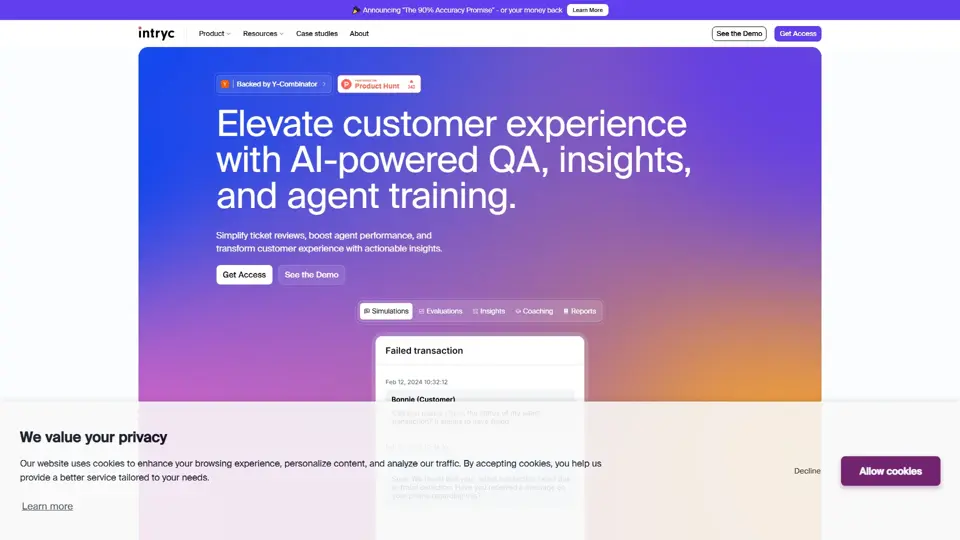
Churn prediction and early intervention — Health score models trained on historical churn data identify at-risk accounts 60–90 days before renewal, giving CSMs a window to intervene before the customer has mentally decided to leave.
Automated onboarding orchestration — For standard onboarding paths, AI triggers milestone-based communications, tracks completion, and escalates to a human CSM only when a customer falls behind or hits a defined friction point.
QBR preparation and content generation — AI pulls account metrics, usage trends, support history, and goal progress into a structured QBR template. The CSM reviews, adds context, and customizes — cutting prep time from 3–4 hours to 30–45 minutes.
Conversation intelligence — Call recording platforms analyze customer conversations for sentiment, competitor mentions, budget signals, and risk language, surfacing insights the CSM may have missed and feeding them back into the account record.
Expansion signal identification — Usage pattern analysis identifies accounts that have outgrown their current tier, are using features associated with higher-value plans, or have added users at a rate suggesting broader organizational adoption.
Champion tracking — LinkedIn and CRM integrations flag when key contacts change roles or leave the company, triggering a CSM alert to re-establish relationships before the account becomes vulnerable.
Voice of customer synthesis — AI aggregates NPS responses, support tickets, and conversation transcripts to surface recurring themes by segment, giving CSMs and product teams a structured view of what customers are struggling with.
Recommended AI Stack
CS Platform with native AI
- Gainsight (Horizon AI) — enterprise-grade health scoring, lifecycle automation, and generative content features
- ChurnZero — strong mid-market fit with AI-driven health scores and automated playbooks
- Planhat — flexible data model with growing AI capabilities, popular with product-led growth companies
Conversation Intelligence
- Gong — industry standard for call analysis, deal intelligence, and CSM coaching
- Chorus (ZoomInfo) — strong integration with Salesforce, good for teams already in the ZoomInfo ecosystem
CRM with AI features
- Salesforce (Einstein for Service/Success) — deep integration for teams with existing Salesforce infrastructure
- HubSpot (AI features) — better fit for mid-market teams that don't need Salesforce complexity
Generative AI for content
- Copilot for Microsoft 365 — useful for CSMs who live in Word, PowerPoint, and Outlook
- Notion AI — for teams using Notion as their success plan and documentation layer
- ChatGPT / Claude — for ad hoc drafting, email rewriting, and meeting prep when platform-native tools fall short
Scheduling and meeting intelligence
- Calendly with routing logic — reduces back-and-forth for high-volume CSM books
- Fireflies.ai or Otter.ai — lightweight meeting transcription and summary for teams not on Gong
Risks & Challenges
Over-reliance on health scores that don't reflect reality. Health score models are only as good as the data feeding them. A customer who logs in daily but never achieves their core use case will score healthy until they don't renew. CSMs who defer to the score rather than the relationship will miss these accounts.
AI-generated content that erodes trust. Customers who receive QBR decks or success plans that feel templated and impersonal will notice. The efficiency gain from AI-generated content disappears if it damages the relationship quality that drives retention.
Digital CS motions that create coverage gaps. Automating SMB account management works until a high-growth SMB becomes a mid-market account and realizes they've had no meaningful human interaction for 18 months. Transition points between digital and human-led coverage are operationally fragile.
Data privacy and integration complexity. AI tools require access to product usage data, CRM records, communication history, and sometimes financial data. Integrating these sources across enterprise tech stacks is expensive and creates data governance obligations that many CS teams underestimate.
Skill atrophy in junior CSMs. If AI handles monitoring, documentation, and content generation, junior CSMs lose the learning opportunities that previously built their skills. The pipeline of experienced CSMs may thin if the entry-level work disappears before the training infrastructure adapts.
Vendor consolidation risk. The CS platform market is consolidating. Companies that have built workflows deeply dependent on a single platform's AI features face significant switching costs if that vendor is acquired, pivots, or degrades in quality.
Future Outlook (3–5 Years)
The Customer Success Manager role will survive the current wave of AI adoption, but the job description will be substantially different by 2028.
The clearest trend is role bifurcation. The market will increasingly distinguish between a strategic CSM — focused on executive relationships, complex account planning, and commercial outcomes for high-ARR accounts — and a digital CS specialist who designs and optimizes AI-driven customer journeys for scaled segments. These are different skill sets, and companies will hire for them differently.
NRR accountability will deepen. As AI removes the excuse of "I didn't have visibility into that account," CSMs will be held to tighter commercial standards. The role will look more like a revenue-owning account executive with a retention mandate than a support-adjacent relationship manager.
The CSM-to-ARR ratio will increase. Expect the industry benchmark to shift from $1–2M ARR per CSM toward $3–5M ARR per CSM for mid-market segments, driven by AI-assisted coverage. This will not necessarily mean fewer CSM jobs — it will mean fewer CSMs managing the same total ARR, with the difference absorbed by digital motions.
Product-led growth will reshape the entry point. As more SaaS products adopt PLG motions, CSMs will engage later in the customer journey (post-activation rather than post-sale) and will focus more on expansion from a self-serve base than on driving initial adoption.
AI will create new CSM specializations. Roles like CS Operations (owning the AI tooling, health score models, and automation logic) and Digital CS Manager (designing and optimizing scaled customer journeys) are already emerging and will become standard job categories within CS organizations.
Final Insight
The Customer Success Manager role is not being automated — it is being filtered. AI is removing the work that never required human judgment in the first place: the data pulling, the template writing, the reactive monitoring. What remains is the work that actually drives retention and expansion: understanding a customer's business well enough to connect product value to their strategic priorities, navigating organizational complexity when a champion leaves or a budget gets cut, and building the kind of trust that makes a customer choose to grow with a vendor rather than evaluate alternatives.
The CSMs who will struggle are those who built their identity around being organized, responsive, and thorough — qualities that AI now replicates at scale. The CSMs who will thrive are those who built their identity around being genuinely useful to the businesses they serve, which requires judgment, context, and human credibility that no health score can replicate.
The commercial pressure is real and the timeline is short. CS teams that treat AI adoption as an IT project rather than a workflow redesign will find themselves with expensive tools and unchanged outcomes. The transformation requires rethinking what CSMs are actually for — and being honest that the answer has changed.