
Video Diffusion Models
Rate this Tool
Average Score
Total Votes
Select your score (1-10):
Detail Information
What
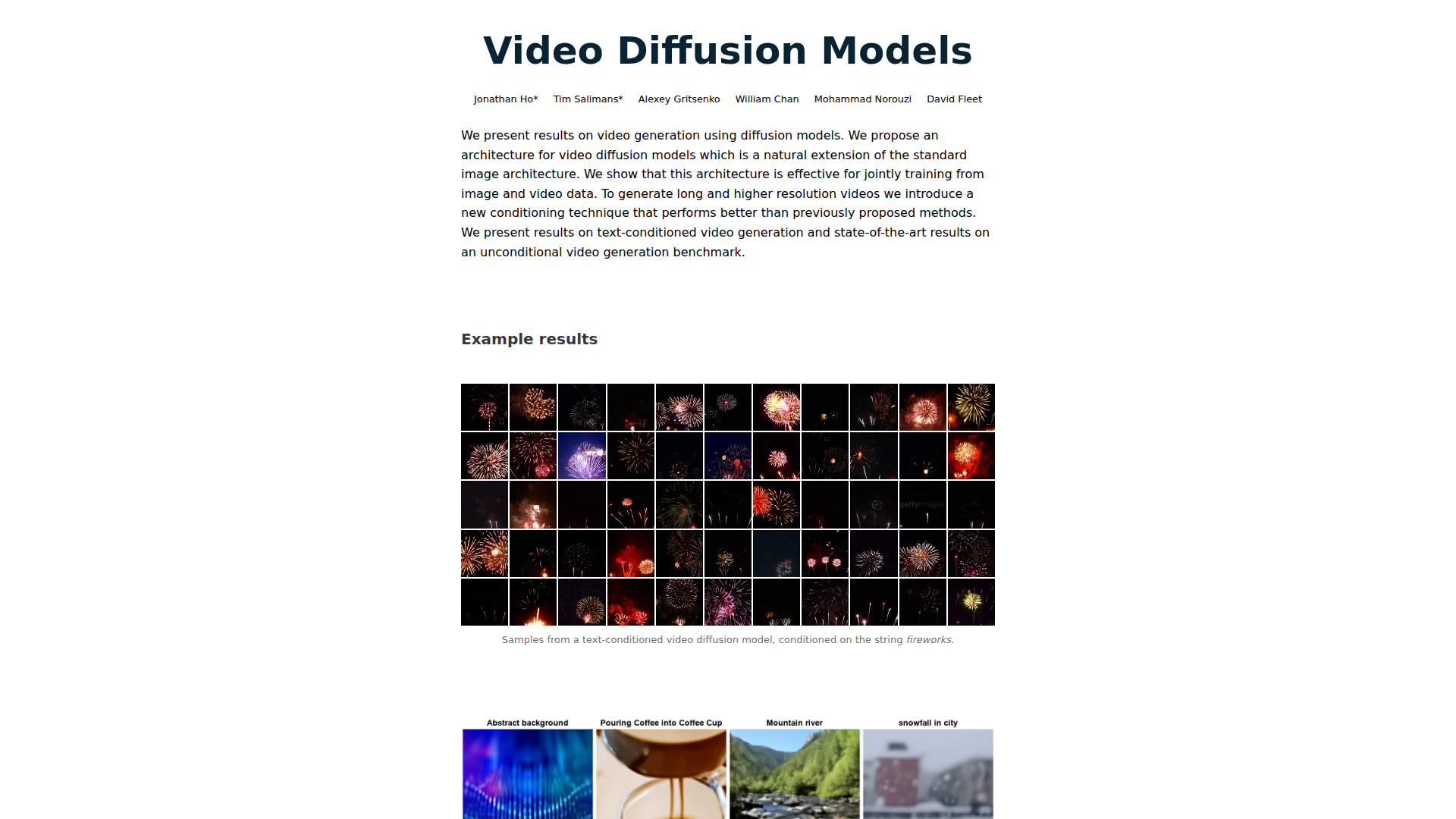
Video Diffusion Models is a research system for generating video with diffusion models. It targets machine learning researchers and teams working on generative media, especially those exploring text-conditioned video generation, unconditional video generation, and methods for extending standard image diffusion architectures to video.
The core workflow is to train a diffusion model on fixed-length video frame blocks, optionally combine image and video training, and then extend generation to longer or higher-resolution videos through a conditioning method during sampling. Based on the page content, this is best understood as a research approach and model architecture rather than a packaged end-user product.
Features
- Video generation with diffusion models: Applies Gaussian diffusion modeling to video, showing that high-quality video can be produced with relatively limited changes to standard image diffusion setups.
- Factorized space-time UNet architecture: Extends the common 2D image UNet to video in a way designed to handle spatiotemporal data within accelerator memory constraints.
- Joint image-video training: Supports training across both image and video objectives, which the authors report as important for improving video sample quality.
- Text-conditioned video generation: Generates videos from text prompts, with examples shown for prompt-conditioned outputs.
- Autoregressive extension for longer videos: Repurposes a trained fixed-block model to generate videos beyond its native frame window by operating block-autoregressively over frames.
- Gradient-based conditioning method: Improves consistency with conditioning information during sampling and is presented as better than prior replacement-style methods for temporal coherence and higher-resolution extension.
Helpful Tips
- Treat this as a research foundation, not a turnkey platform: The page presents methods and results, but it does not describe deployment tooling, APIs, or production controls.
- Check fit for your use case: The strongest evidence here is for generative video research, especially unconditional benchmarks and text-conditioned generation, rather than editing, commercial asset production, or enterprise workflow management.
- Evaluate temporal consistency carefully: For video systems, coherence across frames matters as much as single-frame quality, and this work specifically emphasizes conditioning methods that improve that property.
- Consider mixed image-video training strategies: If reproducing or adapting this approach, the reported benefit of joint image-video training may be important when video-only data is limited or noisy.
- Review the full paper before implementation: The page is a summary, so practical details on training setup, limitations, and benchmarking likely require the cited paper.
OpenClaw Skills
Within the OpenClaw ecosystem, this work would most likely serve as a model-centric building block for generative video workflows rather than a standalone business application. Likely skills could include prompt-to-video experimentation agents, benchmark evaluation workflows, dataset preparation pipelines for image-video joint training, and research copilots that compare sampling strategies, temporal coherence, and conditioning behavior across runs. These are inferred use cases; the page does not state any native OpenClaw integration.
For media R&D teams, AI labs, or creative tooling companies, an OpenClaw-based layer around this model could change work by making video generation more operational and testable. Likely agents could automate prompt sweeps, run quality reviews on generated clips, manage block-autoregressive long-video generation jobs, and summarize experimental findings for researchers or product teams. In practice, that would shift the model from a paper result into a repeatable workflow component for prototyping and evaluation in generative video pipelines.
Embed Code
Share this AI tool on your website or blog by copying and pasting the code below. The embedded widget will automatically update with the latest information.
<iframe src="https://aimyflow.com/ai/video-diffusion-github-io/embed" width="100%" height="400" frameborder="0"></iframe>
Explore Similar Tools

Free AI Photo Editor: Edit & Generate Image Online | Pokecut
Pokecut is an AI photo editor that helps users remove backgrounds, enhance images, and generate visuals online, mainly for ecommerce sellers, marketers, and creators who need quick design-ready assets. It speeds up routine image production so visual teams can create polished content with less manual editing.
Roboflow: Computer vision tools for developers and enterprises
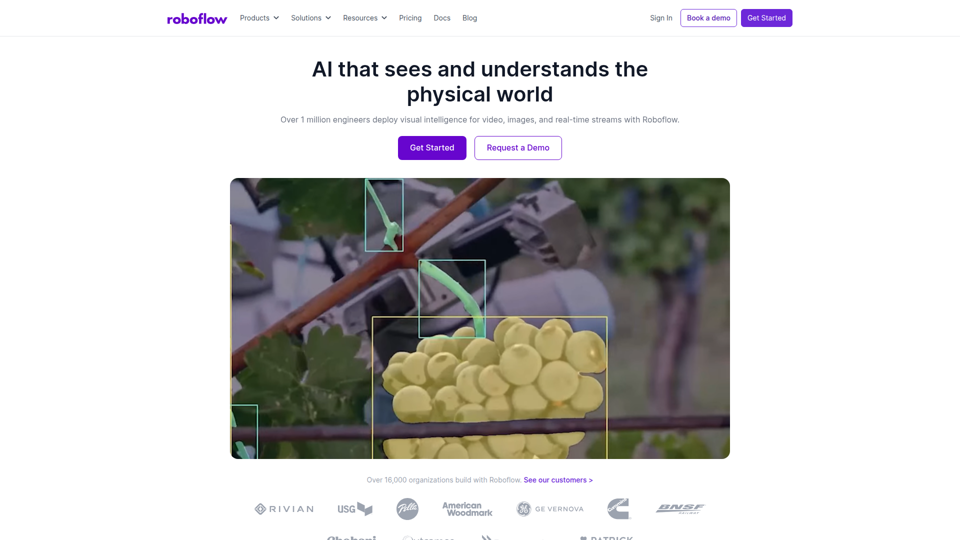
Roboflow is a computer vision platform that helps developers, machine learning engineers, and enterprises annotate data, train models, build workflows, and deploy vision AI for images, video, and real-time streams. In AI-driven operations, it can help computer vision and ML teams move faster from prototype to production by combining data labeling, model training, and deployment in one workflow.
Seedance 2.0
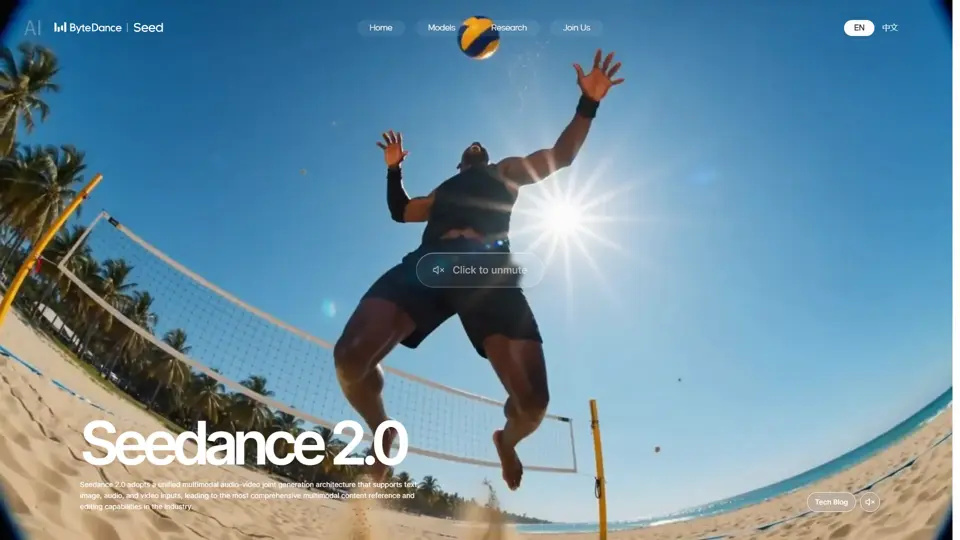
Seedance 2.0 is ByteDance's AI video generation model designed to create high-quality videos from prompts and multimodal inputs, mainly for creators, developers, and media teams. In the AI era, it helps visual content roles turn ideas into production-ready motion assets with far less manual editing effort.
Struct | Automate your on-call runbook
Struct is an AI on-call agent that investigates engineering alerts and bugs by analyzing logs, metrics, traces, and codebases, mainly for software engineers and SRE teams. In the AI era, it helps incident responders shorten triage time by delivering root-cause findings and suggested fixes directly in workflows.
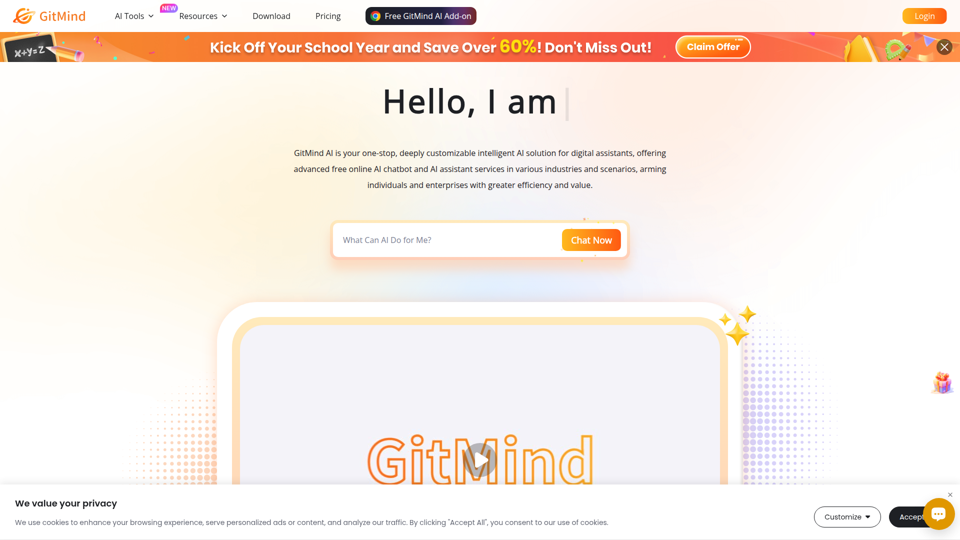
GitMind Chat - Your Best AI Assistant
GitMind Chat is an AI assistant and chatbot platform that helps individuals and enterprises handle conversations, analysis, writing, coding, translation, customer service, and custom AI agent creation through prebuilt or configurable assistants. For roles such as marketers, analysts, support teams, educators, and developers, it can streamline repetitive knowledge work by combining chat, file and link inputs, image analysis, and contextual responses in one workflow.
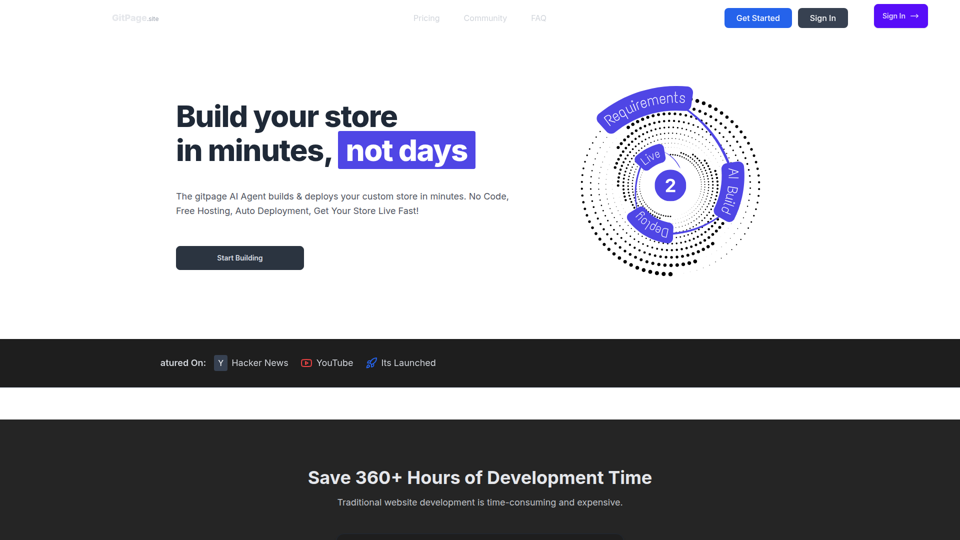
GitPage AI Website Builder | GitPage
GitPage is an AI website builder that generates and deploys websites, online stores, and landing pages from a form, mainly for freelancers, agencies, startups, and businesses that want no-code site creation with code ownership. For web professionals and client-service teams, it can reduce manual setup and content drafting by automating page generation, blog content, and deployment to GitHub or GitLab Pages.

Rohan Mehta
Rohan Mehta is a personal website for a New York–based software engineer at OpenAI, outlining his background at Meta and as a YC-backed startup founder, and highlighting his creator role behind the Subway Time NYC transit app. For software engineers and technical hiring teams, this kind of concise profile helps AI-era talent evaluation by quickly surfacing relevant build, scale, and product experience.
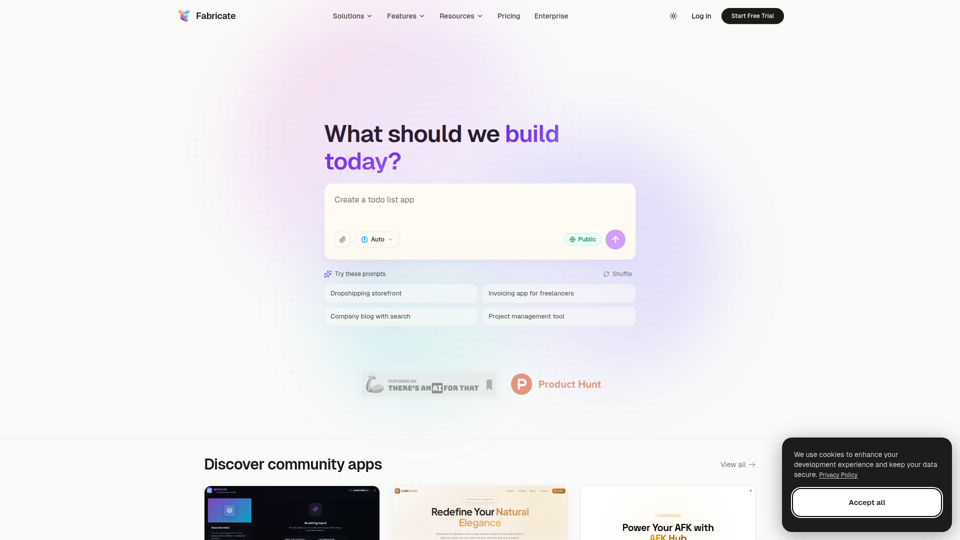
Fabricate - AI Full-Stack App Builder | Build Anything, Ship Faster
Fabricate is an AI full-stack app builder that helps users describe an app idea and generate production-ready web applications, mainly for founders, developers, designers, freelancers, agencies, and enterprises. In AI-assisted product development, it can help these teams move faster from concept to deployable React, TypeScript, and backend code with less manual setup.