
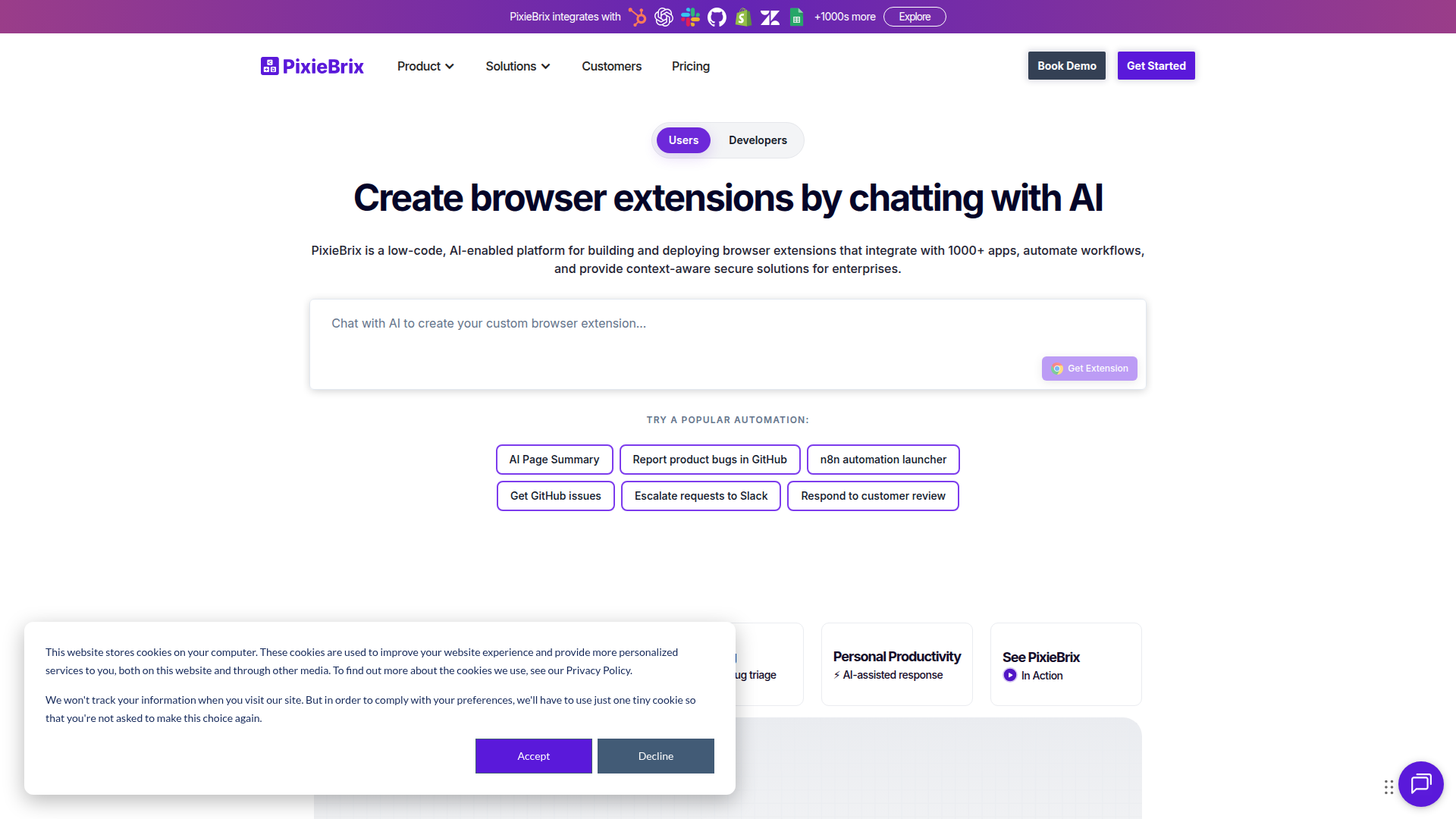
PixieBrix: Extend your apps, accelerate work
Rate this Tool
Average Score
Total Votes
Select your score (1-10):
Detail Information
What
PixieBrix is a low-code, AI-enabled platform for building, deploying, and managing browser extensions that work inside existing web apps. It is positioned as a way for enterprises to extend SaaS tools, automate workflows, surface contextual guidance, and connect browser-based work with data, APIs, AI, and a large library of integrations.
The product appears to serve operations-heavy teams such as customer support, contact centers, HR, marketing, engineering, and digital transformation groups. Its core workflow is to add context-aware interface elements and automations directly into the browser so teams can reduce app switching, standardize processes, and deploy changes without traditional browser extension development or heavy DevOps.
Features
- Low-code browser extension builder — Lets teams create and customize browser-based mods faster than building custom extensions from scratch.
- Context-aware in-app experiences — Embeds prompts, guidance, data, and actions directly inside web apps so users can work without leaving their current system.
- 1000+ app integrations — Connects browser workflows to many business tools and APIs, which helps automate handoffs such as CRM updates, support escalations, and shared data capture.
- Prebuilt templates and connectors — Provides ready-made starting points that can shorten implementation time for common automation and agent-assist use cases.
- 1-click deployment and centralized management — Supports distribution and sharing across teams with group-based access control, reducing operational overhead for rollout.
- Enterprise-focused controls — The site highlights audit logging, guardrails, analytics, and stated SOC 2 and GDPR compliance to support governance and scale.
Helpful Tips
- Evaluate PixieBrix first where work happens across multiple browser-based systems, because its value is strongest when teams need guidance or automation inside existing web apps rather than a separate standalone workspace.
- Start with a narrow, high-friction workflow such as ticket handling, escalation routing, or bug reporting to prove usability and operational fit before broader rollout.
- Map the required app connections and browser environments early; the site states broad integrations, but each target workflow still depends on the specific systems, data sources, and permissions involved.
- For enterprise adoption, involve operations owners and security teams together, since UI changes, AI assistance, and embedded workflow rules can affect process design as much as technical deployment.
- Treat AI features as assistive layers that need clear guardrails and review paths, especially in customer-facing or regulated environments.
OpenClaw Skills
PixieBrix could likely work well with the OpenClaw ecosystem as the browser-side execution and interface layer for agentic workflows. An OpenClaw skill could monitor on-screen context in tools like Zendesk, Intercom, Salesforce, or Jira, then trigger guided actions, summaries, data lookups, or next-step recommendations through PixieBrix mods embedded in those applications.
A likely use case is pairing OpenClaw agents with PixieBrix to create role-specific assistants for support agents, operations teams, or account managers. OpenClaw could orchestrate decision logic, retrieval, and multi-step workflow automation, while PixieBrix delivers those outputs exactly where users work in the browser. This combination could shift teams from switching between separate automation tools toward in-context, governed operational assistance layered directly onto everyday SaaS systems.
Embed Code
Share this AI tool on your website or blog by copying and pasting the code below. The embedded widget will automatically update with the latest information.
<iframe src="https://aimyflow.com/ai/pixiebrix-com/embed" width="100%" height="400" frameborder="0"></iframe>
Explore Similar Tools

W.AI - Global AI Supercomputer
W.AI is a decentralized AI supercomputer that lets people with GPU-equipped devices contribute idle compute power to AI tasks, mainly for device owners and infrastructure participants who want to support distributed AI networks. For AI infrastructure operators and technical teams, it can expand available compute capacity through a distributed model while using sandboxed execution and privacy-focused architecture.
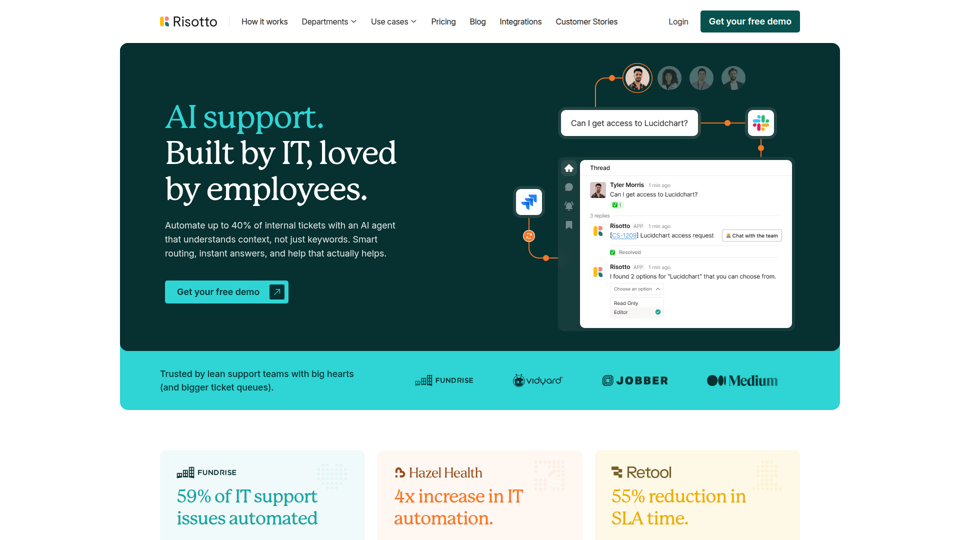
Risotto | IT help desk with AI ticketing automation
Risotto is an AI help desk and ticketing automation platform that helps IT teams automate internal support, access requests, and cross-department workflows in tools like Slack. For IT managers, help desk teams, and systems administrators, it can reduce repetitive tier-1 work by using context-aware automation, self-updating knowledge, and automated routing to speed resolution and approvals.
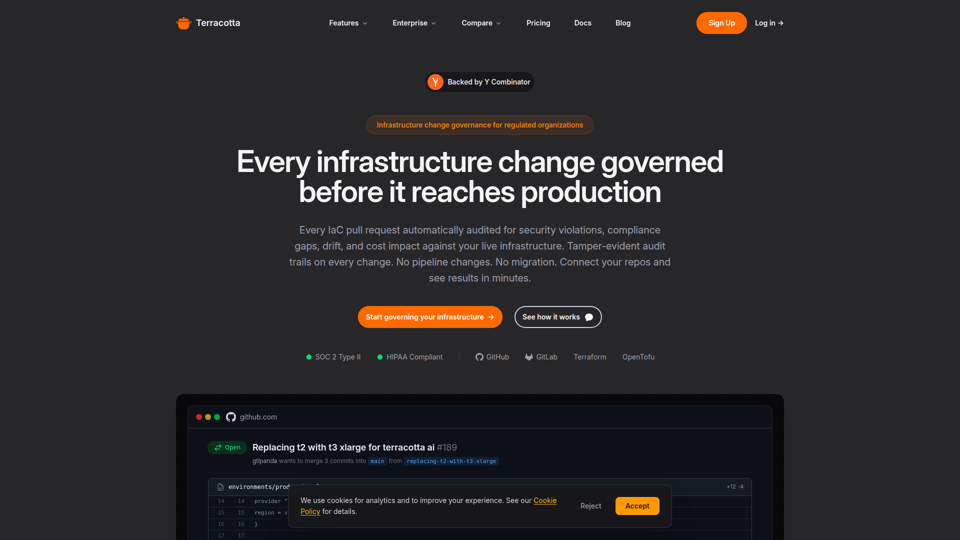
Terracotta AI | Infrastructure Change Governance
Terracotta AI is an infrastructure change governance tool that audits Terraform, Kubernetes, and Terragrunt pull requests for security, compliance, drift, and cost before merge, mainly for regulated organizations and platform engineering teams. For platform, security, and compliance teams, it adds AI-assisted PR review and audit trails that can reduce manual infrastructure review work and improve pre-production change control.
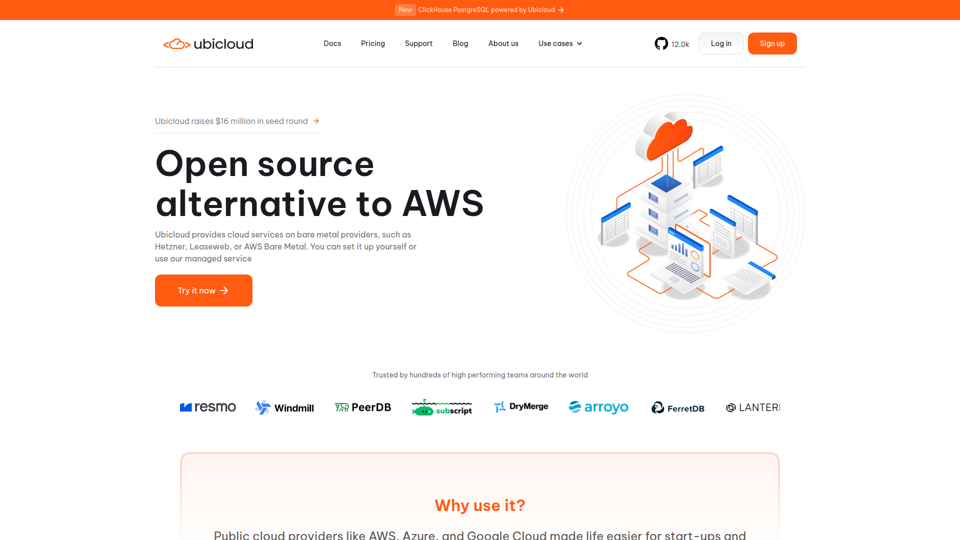
Ubicloud - Open source alternative to AWS
Ubicloud is an open source cloud platform and AWS alternative that helps teams run elastic compute, block storage, networking, managed PostgreSQL, and GitHub Actions runners on bare metal providers, mainly for engineering and infrastructure teams that want self-hosted or managed cloud services. For DevOps, platform, and database engineers, it can support more portable, automated infrastructure and CI workflows while reducing dependence on closed public cloud platforms.
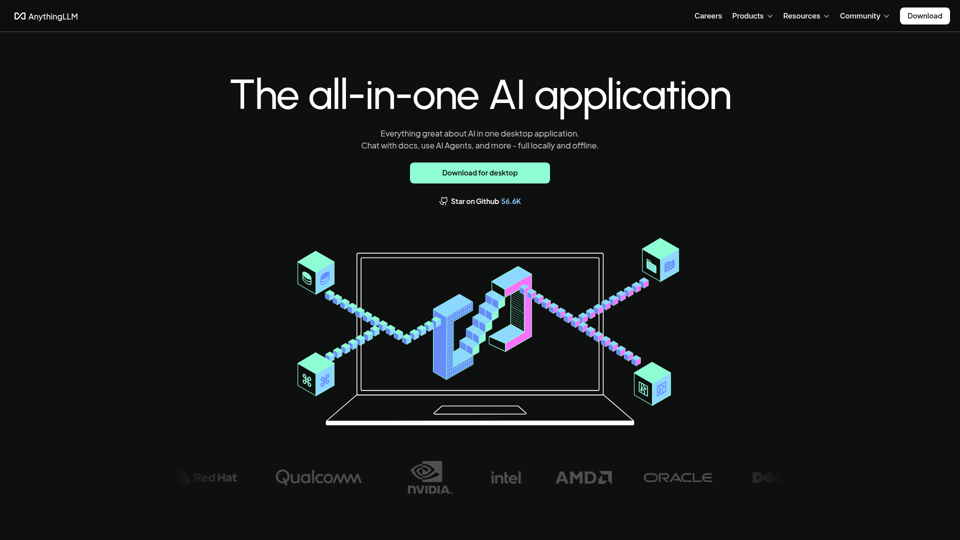
AnythingLLM | The all-in-one AI application for everyone
AnythingLLM is an all-in-one AI application that lets users chat with documents, run AI agents, and use local or cloud LLMs with privacy-focused, low-setup workflows, mainly for individuals and teams that want desktop, self-hosted, or cloud AI tools. For knowledge workers, developers, and IT teams, its local-first design and built-in API can make document-based analysis, internal automation, and controlled AI deployment easier in everyday work.

IncidentFox - The AI SRE for Teams
IncidentFox is an AI SRE tool that investigates production incidents in Slack, analyzes codebases and past incidents, and proposes or executes approved fixes for engineering, SRE, and platform teams. For on-call and reliability work, it can reduce manual triage by correlating alerts, logs, metrics, and deployment history into root-cause findings and auditable remediation steps.
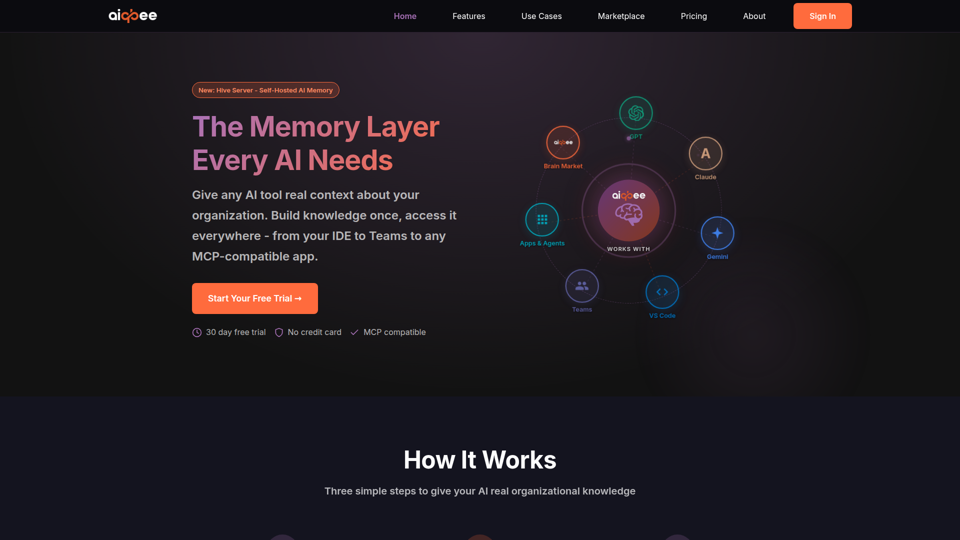
Aiqbee - Universal AI Memory Platform | Enterprise Knowledge for Any LLM
Aiqbee is an enterprise AI memory platform that gives any LLM or AI tool persistent organizational context by centralizing company knowledge, connecting it to tools like Teams and IDEs, and adding governance controls, mainly for businesses managing AI use across teams. For IT, operations, support, and development functions, it can reduce repeated prompting and improve consistency by making shared knowledge available across approved AI workflows.
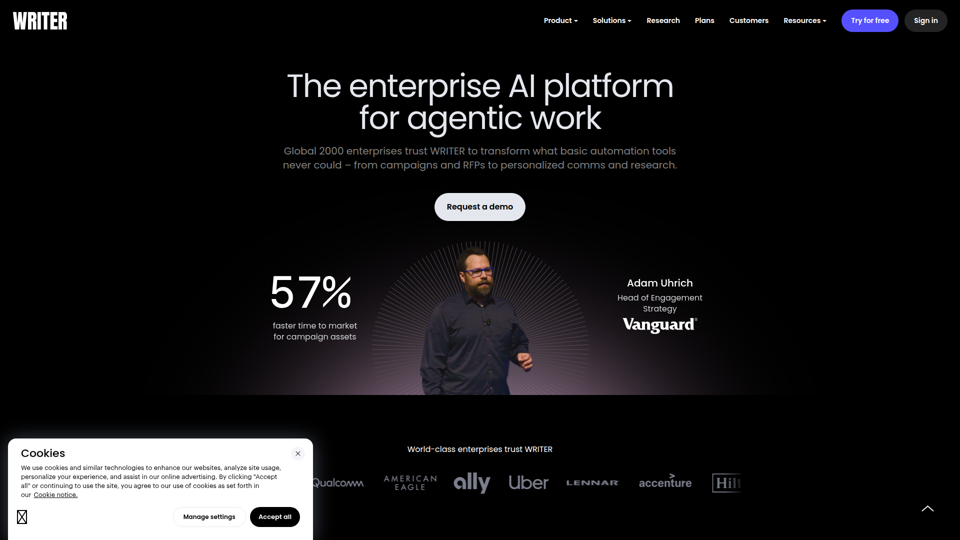
WRITER - The enterprise AI platform for agentic work
WRITER is an enterprise AI platform for agentic work that helps Global 2000 companies build, activate, and supervise AI agents for tasks like campaigns, RFPs, personalized communications, and research, with a focus on IT governance and security. For marketing, sales, support, and IT teams, it can improve productivity by combining shared knowledge, workflow automation, and oversight in one system.