
NodeLand | Collaborative Visual Workspace on an Infinite Canvas
Rate this Tool
Average Score
Total Votes
Select your score (1-10):
Detail Information
What
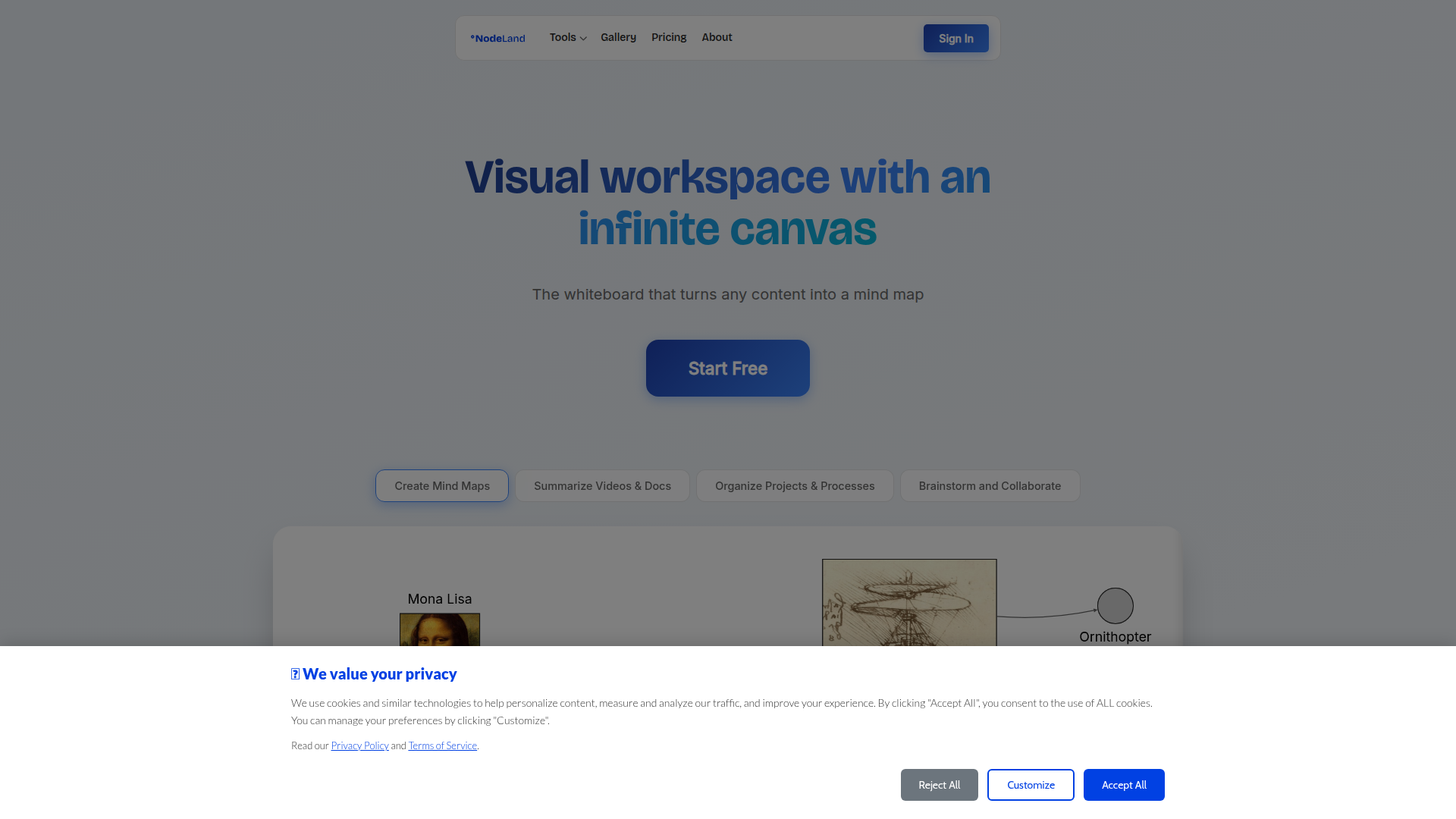
NodeLand is a collaborative visual workspace built on an infinite canvas. It is designed to turn documents, videos, notes, and other content into mind maps and structured visual boards so individuals and teams can organize complex information, connect context, and keep planning work visible.
The product appears positioned for knowledge workers such as consultants, strategists, creators, operators, analysts, researchers, and product managers, as well as teams that need shared planning spaces. Its core workflow combines visual mapping, attached context within nodes, and AI-assisted summarization to move from brainstorming and research synthesis to project planning and execution.
Features
- Infinite canvas workspace — lets users zoom from high-level strategy to detailed execution without being constrained by page-based layouts.
- Mind map and visual board creation — helps structure ideas, workflows, roadmaps, and initiatives in a format that makes relationships and dependencies easier to understand.
- AI-assisted summarization of documents and videos — converts long-form content such as reports, transcripts, PDFs, and videos into structured visual summaries for faster review and refinement.
- Context-rich nodes — each node can hold notes, files, links, and evidence, which keeps decisions, rationale, and next steps connected to the relevant idea.
- Collaborative workspace for teams — supports shared mapping of processes, plans, and knowledge when multiple stakeholders need to work in the same environment.
- Embedding for mind maps — source content indicates users can display mind maps externally, which is useful for publishing or sharing visual explanations.
Helpful Tips
- Evaluate whether your team works better with spatial, visual planning than with linear documents; this type of tool is most useful when relationships between ideas matter as much as the ideas themselves.
- Use AI-generated maps as a starting point rather than a final output, since summaries of complex documents or meetings usually need human review and restructuring.
- Establish simple conventions for node naming, evidence attachment, and map structure early so shared canvases remain usable as projects grow.
- For client-facing or cross-functional work, test how easily stakeholders can understand maps without extensive explanation; clarity of visual structure is a key adoption factor.
- If search and retrieval across maps are important in your workflow, verify the current depth of knowledge management features directly, since the page does not fully define discovery capabilities.
OpenClaw Skills
NodeLand could likely fit well into an OpenClaw environment as the visual layer for research synthesis, planning, and decision tracking. An OpenClaw skill could ingest meeting transcripts, reports, product briefs, or video content, summarize them into structured themes, and then generate a draft map for review in NodeLand. Another likely workflow would be an agent that organizes scattered notes into initiative maps, decision trees, or process diagrams for consulting, product, and strategy teams.
In a broader professional context, this combination could help knowledge workers shift from passive note collection to active visual operating systems. For example, consultants could use OpenClaw agents to prepare client research maps, product managers could maintain evolving insight boards from interviews and documents, and operations teams could turn recurring meetings into visual process updates. These are likely use cases rather than confirmed native integrations, but they show how NodeLand’s canvas model could support agent-driven knowledge work when paired with OpenClaw.
Embed Code
Share this AI tool on your website or blog by copying and pasting the code below. The embedded widget will automatically update with the latest information.
<iframe src="https://aimyflow.com/ai/nodeland-io/embed" width="100%" height="400" frameborder="0"></iframe>
Explore Similar Tools
Transcribe Meetings & Generate Files with AI on TicNote Cloud
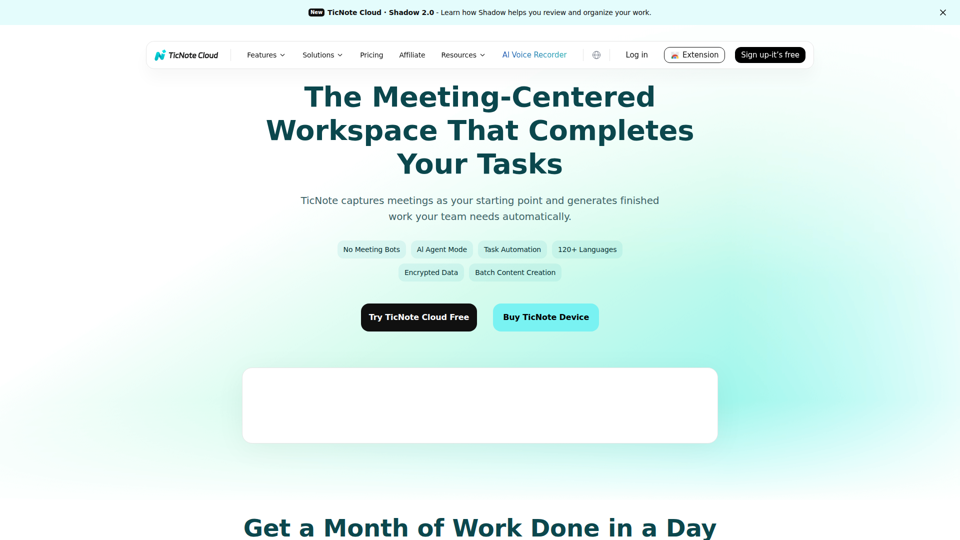
TicNote Cloud is an AI meeting workspace that records and transcribes meetings, creates summaries, action items, and files, and organizes transcripts and project materials for teams that rely on meetings to drive work. For product, operations, sales, and project management roles, it can reduce manual note-taking and speed follow-up by turning conversations into structured outputs and searchable knowledge.

Tingwu CN
通义听悟 is an AI meeting and media transcription tool that converts speech to text, provides multilingual translation, distinguishes speakers, and generates summaries such as chapter overviews and action items, mainly for people who need to capture and review meetings efficiently. For project managers and similar knowledge workers, it can reduce manual note-taking and speed up turning long discussions into usable minutes and follow-up tasks.
RowFlow - the modern AI-native form
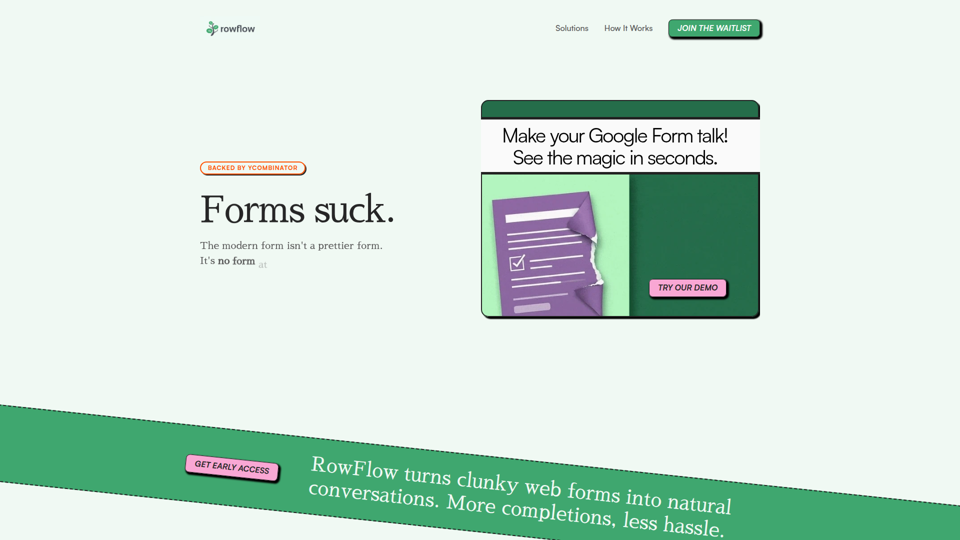
RowFlow is an AI-native form platform that turns traditional forms into conversational outreach across channels like SMS, email, Slack, WhatsApp, and phone, helping teams collect structured information faster with fewer manual follow-ups; it is mainly for operations, onboarding, research, and revenue teams. For functions such as customer onboarding, lead qualification, and internal reporting, it can reduce time spent chasing responses while producing cleaner data from messy user input.
1ClickClaw - OpenClaw Hosting | One-Click AI Bot
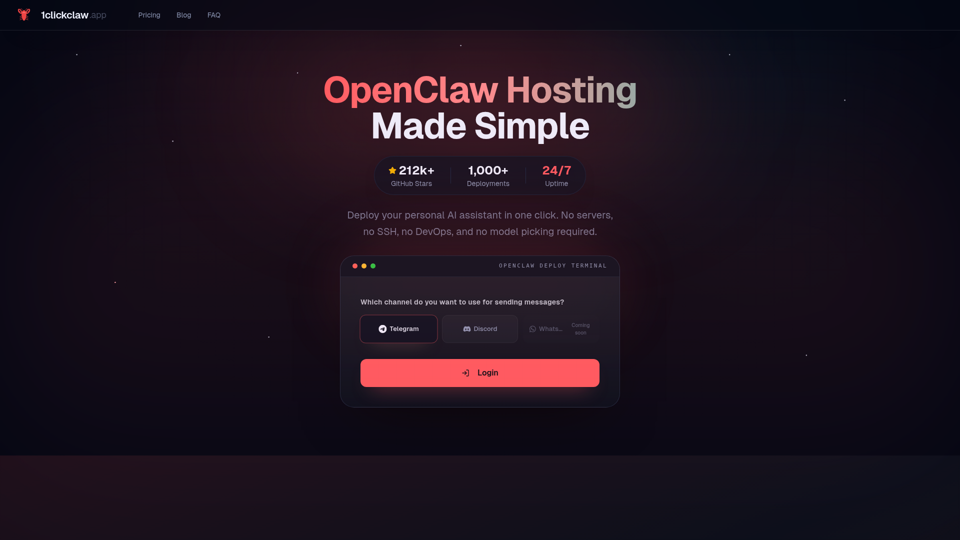
1ClickClaw is a hosting service for deploying OpenClaw as a personal AI assistant on Telegram, Discord, or WhatsApp in one click, mainly for users who want an always-on bot without managing servers, SSH, or DevOps setup. For operators, community managers, and solo builders, this can shorten deployment time and simplify AI bot maintenance so they can focus more on conversations and workflows than infrastructure.
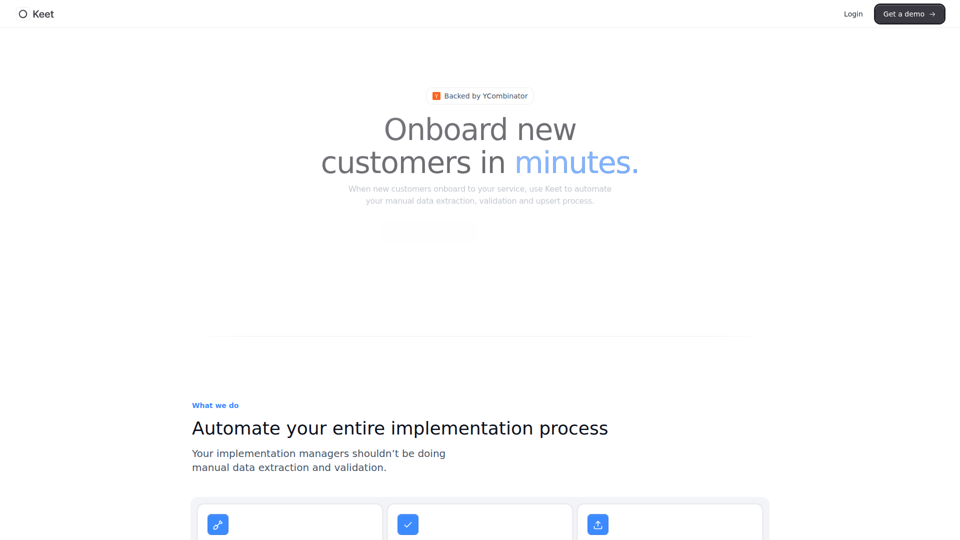
Keet - Automated enterprise onboarding
Keet is an automated enterprise onboarding tool that extracts, validates, and uploads customer migration data to help implementation managers onboard new customers faster. In AI-driven implementation workflows, it can reduce manual review and data handling so implementation and onboarding teams can focus on exception handling and customer setup quality.
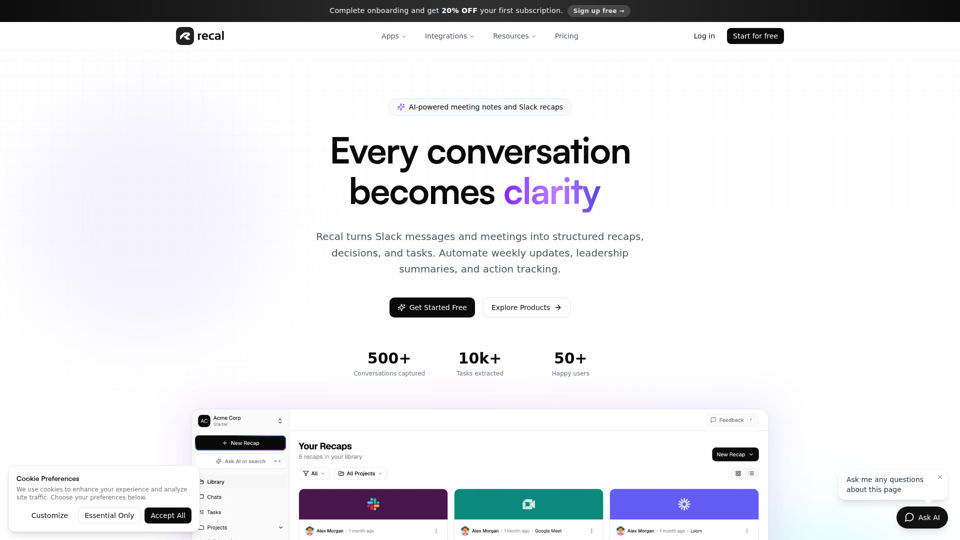
Never forget what matters | Recal
Recal is an AI-powered meeting notes and conversation memory tool that captures meetings, Slack threads, voice memos, uploads, and links, then turns them into transcripts, summaries, decisions, and tasks for teams and professionals who need reliable context and follow-through. For managers, operations leads, and product teams, it can reduce manual note-taking and improve alignment by making searchable recaps and action items available across conversations.
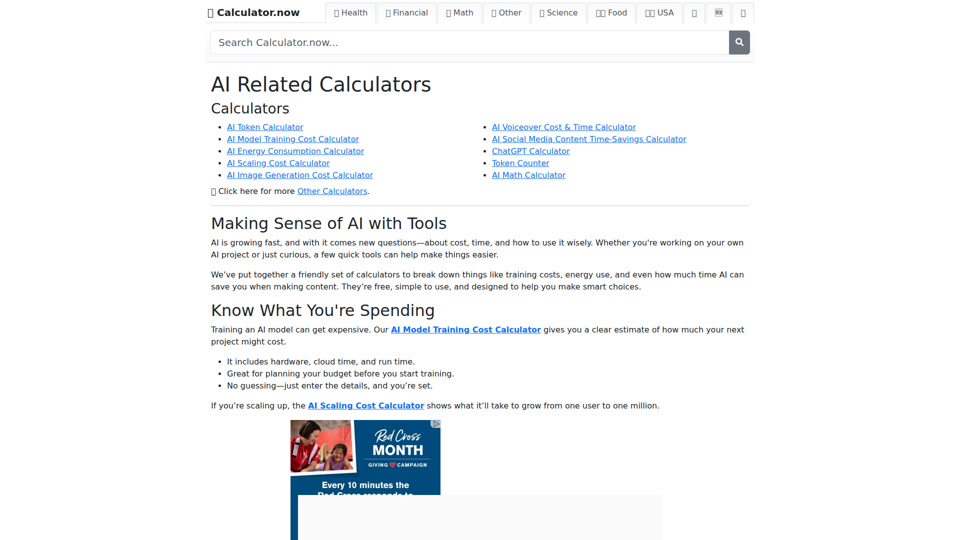
AI Related Calculators | Calculator.now
Calculator.now’s AI Related Calculators is a collection of online calculators that help users estimate token usage, model training and scaling costs, energy consumption, image generation costs, and AI workflow time savings, mainly for people planning or running AI projects. For AI developers, content teams, and project managers, these tools support faster budgeting and capacity planning by turning model and usage assumptions into clear operational estimates.
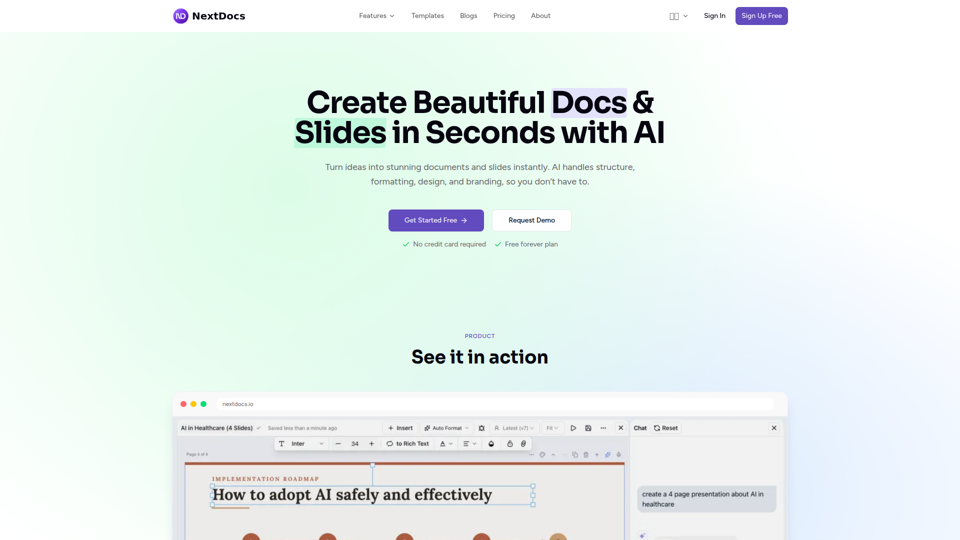
Create Beautiful Docs & Slides in Seconds with AI
NextDocs is an AI document and presentation creation tool that helps professionals and teams turn prompts into branded docs, slides, social posts, proposals, reports, and contracts with built-in editing, research, and export options. For roles like project managers, marketers, founders, and sales teams, it can reduce manual formatting and versioning work so more time goes to reviewing content and making decisions.