
MiroMind | Mirror and Connect Human Intelligence and AI

Rate this Tool
Average Score
Total Votes
Select your score (1-10):
Detail Information
What
MiroMind presents itself as a reasoning-first AI company building a “General Purpose Solver” for critical tasks where accuracy and traceability matter more than fast, open-ended generation. Its core product stack appears to center on MiroMind OS, a reasoning operating system, and MiroThinker, a 235B-parameter model designed for long-chain, structured problem solving with verification at each step.
The product is positioned for technical and high-stakes domains such as software engineering, legal and compliance, finance, scientific research, biology, and manufacturing. The workflow described on the page emphasizes planning a reasoning graph, executing steps, verifying outputs, rolling back failed branches, and replanning when new evidence changes the solution path, suggesting a platform aimed at enterprise-grade analytical and decision-support use cases rather than general chat.
Features
- Deep reasoning engine: MiroThinker is described as being optimized for stable, long-chain reasoning, which is intended to support complex problems with many logical dependencies.
- Step verification workflow: The system checks each reasoning step before proceeding, which is meant to improve trust and reduce error propagation across long problem chains.
- DAG-based reasoning protocol: The platform models reasoning as a directed graph with branching, rollback, and replanning, helping it explore alternatives while preserving confirmed facts.
- Reasoning operating system: MiroMind OS manages state, memory, and policy execution, indicating infrastructure for structured multi-step problem solving rather than one-shot responses.
- Structured memory and policy-as-code: These system components suggest tighter control over how reasoning is stored, governed, and reused in complex workflows.
- Self-evolution framework: The company says the system improves itself through internal benchmarking and “self-surgery,” with current expansion from code tasks into math, science, and finance logic domains.
Helpful Tips
- Use it where traceability matters most: This kind of product is likely best suited to regulated, technical, or high-consequence workflows where an auditable reasoning chain is more valuable than rapid generative output.
- Validate domain depth before rollout: Although the site names several industries, buyers should confirm production maturity in their specific domain because the page provides more detail for some use cases than others.
- Test failure handling, not just accuracy: Since the product emphasizes rollback and replanning, evaluation should include how it behaves when evidence changes or when intermediate steps fail.
- Assess workflow fit with human review: For legal, finance, research, and engineering teams, adoption will likely work best when the system supports expert oversight instead of replacing it outright.
- Separate benchmark claims from operational proof: The page highlights benchmark performance and production deployments, but implementation teams should still request concrete task-level validation for their own scenarios.
OpenClaw Skills
Within the OpenClaw ecosystem, MiroMind would likely fit best as a reasoning backend for high-precision agent workflows. Likely use cases include agents for contract review, financial risk memo generation, failure analysis, research planning, or software architecture diagnostics, where OpenClaw orchestrates tasks, tools, and approvals while MiroMind handles the structured reasoning core. The page does not state a native OpenClaw integration, so this should be treated as an interoperability opportunity rather than a confirmed capability.
This combination could be especially useful for professions that need both automation and defensibility. For example, OpenClaw skills could wrap MiroMind into industry-specific workflows such as a compliance investigation agent, a hypothesis-to-experiment planning agent, or an engineering root-cause analysis agent that documents each branch, rollback, and verified conclusion. If implemented well, that could shift AI from a drafting assistant toward a more governed reasoning layer inside enterprise operations.
Embed Code
Share this AI tool on your website or blog by copying and pasting the code below. The embedded widget will automatically update with the latest information.
<iframe src="https://aimyflow.com/ai/miromind-ai/embed" width="100%" height="400" frameborder="0"></iframe>
Explore Similar Tools

Free AI Photo Editor: Edit & Generate Image Online | Pokecut
Pokecut is an AI photo editor that helps users remove backgrounds, enhance images, and generate visuals online, mainly for ecommerce sellers, marketers, and creators who need quick design-ready assets. It speeds up routine image production so visual teams can create polished content with less manual editing.

Roboflow: Computer vision tools for developers and enterprises
Roboflow is a computer vision platform that helps developers, machine learning engineers, and enterprises annotate data, train models, build workflows, and deploy vision AI for images, video, and real-time streams. In AI-driven operations, it can help computer vision and ML teams move faster from prototype to production by combining data labeling, model training, and deployment in one workflow.

Seedance 2.0
Seedance 2.0 is ByteDance's AI video generation model designed to create high-quality videos from prompts and multimodal inputs, mainly for creators, developers, and media teams. In the AI era, it helps visual content roles turn ideas into production-ready motion assets with far less manual editing effort.
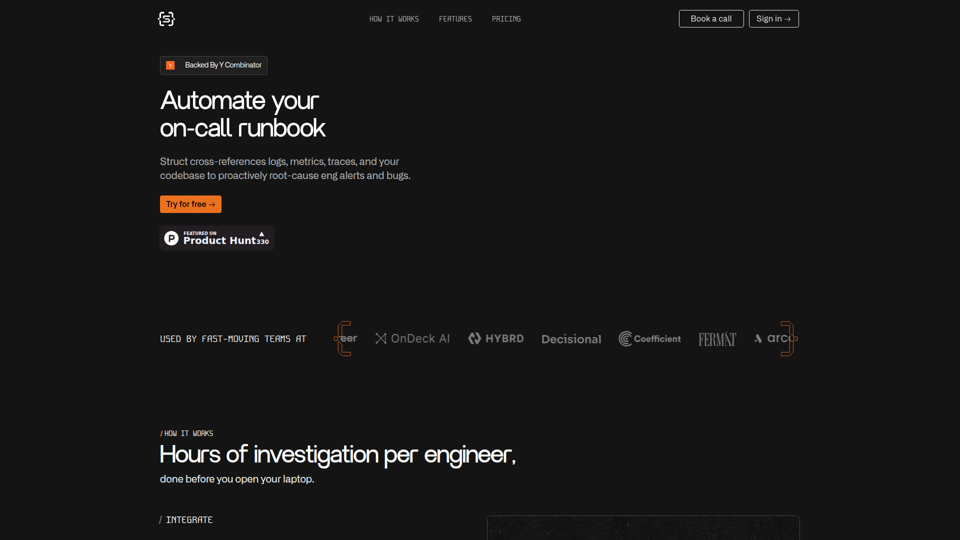
Struct | Automate your on-call runbook
Struct is an AI on-call agent that investigates engineering alerts and bugs by analyzing logs, metrics, traces, and codebases, mainly for software engineers and SRE teams. In the AI era, it helps incident responders shorten triage time by delivering root-cause findings and suggested fixes directly in workflows.

GitMind Chat - Your Best AI Assistant
GitMind Chat is an AI assistant and chatbot platform that helps individuals and enterprises handle conversations, analysis, writing, coding, translation, customer service, and custom AI agent creation through prebuilt or configurable assistants. For roles such as marketers, analysts, support teams, educators, and developers, it can streamline repetitive knowledge work by combining chat, file and link inputs, image analysis, and contextual responses in one workflow.
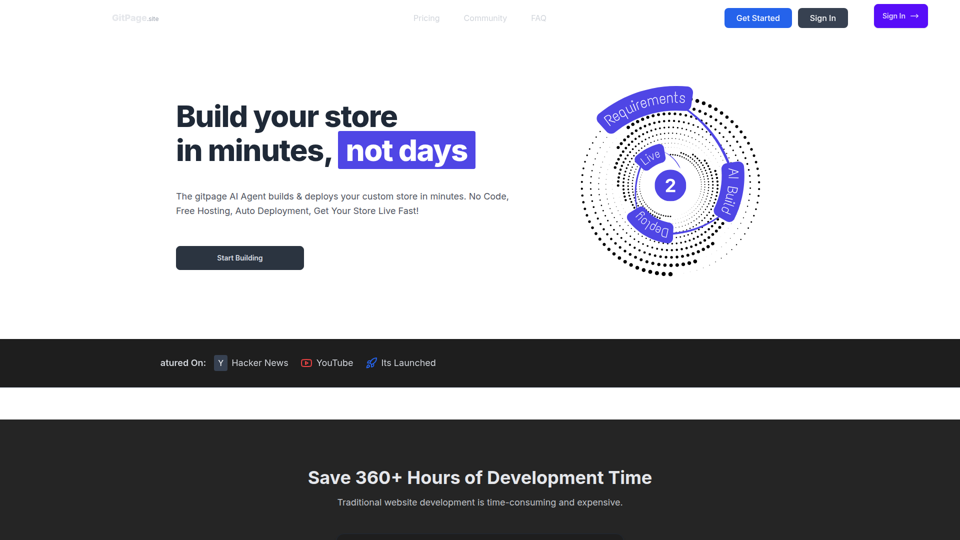
GitPage AI Website Builder | GitPage
GitPage is an AI website builder that generates and deploys websites, online stores, and landing pages from a form, mainly for freelancers, agencies, startups, and businesses that want no-code site creation with code ownership. For web professionals and client-service teams, it can reduce manual setup and content drafting by automating page generation, blog content, and deployment to GitHub or GitLab Pages.

Rohan Mehta
Rohan Mehta is a personal website for a New York–based software engineer at OpenAI, outlining his background at Meta and as a YC-backed startup founder, and highlighting his creator role behind the Subway Time NYC transit app. For software engineers and technical hiring teams, this kind of concise profile helps AI-era talent evaluation by quickly surfacing relevant build, scale, and product experience.

Fabricate - AI Full-Stack App Builder | Build Anything, Ship Faster
Fabricate is an AI full-stack app builder that helps users describe an app idea and generate production-ready web applications, mainly for founders, developers, designers, freelancers, agencies, and enterprises. In AI-assisted product development, it can help these teams move faster from concept to deployable React, TypeScript, and backend code with less manual setup.