
Handled | AI Operations Automation for Commerce

Rate this Tool
Average Score
Total Votes
Select your score (1-10):
Detail Information
What
Handled is an AI operations automation product for commerce brands and 3PLs. It is positioned as an “AI teammate” that learns existing operating workflows and executes recurring operations work across order processing, shipment tracking, returns, and invoice reconciliation.
The product is designed for teams managing growing transaction volume without adding proportional headcount. Its core workflow is: connect current systems, train on team-specific processes and exception patterns, then automate execution with human escalation for edge cases.
Features
- End-to-end returns processing: Automates return initiation, inspection, disposition, restock actions, WMS updates, and customer notifications to reduce manual handling.
- Shipment tracking and exception resolution: Monitors carrier activity in real time and handles delays, delivery failures, and related actions such as reroutes, reships, and carrier claims.
- Forecasting and inventory intelligence: Tracks inventory health across warehouses and channels, flags stockout risk in advance, and supports reorder point calculations.
- Invoice reconciliation and AR automation: Performs three-way matching (PO, receipt, invoice), flags discrepancies, schedules payment reminders, and helps maintain AR aging.
- Wholesale order lifecycle automation: Processes POs from EDI, email, and portals, then manages allocation, fulfillment routing, shipment tracking, and invoicing.
- 3PL and carrier performance management: Tracks SLA/OTIF and quality metrics with automated scorecards, trend alerts, and support for credit claims.
Helpful Tips
- Prioritize one high-friction workflow first (for example returns or shipment exceptions) to validate process fit before expanding to broader automation.
- Confirm data quality and ownership across ERP, WMS, EDI, and carrier inputs early; automation quality is directly tied to source-system reliability.
- Define clear escalation rules and approval thresholds so teams know when the system acts autonomously versus when humans intervene.
- Treat published outcomes as directional benchmarks; expected gains should be modeled by your own order volume, exception rates, and channel mix.
- Plan change management for operations staff, since value depends on teams trusting exception handling and using standardized SOPs consistently.
Embed Code
Share this AI tool on your website or blog by copying and pasting the code below. The embedded widget will automatically update with the latest information.
<iframe src="https://aimyflow.com/ai/itshandled-ai/embed" width="100%" height="400" frameborder="0"></iframe>
Explore Similar Tools

Free Weather Forecasts, Radar & AI Chat | AskWeather.ai
AskWeather.ai is an ad-free weather website with AI chat that helps people check current conditions, 15-day forecasts, live radar, route weather, historical weather, and location-based alerts, mainly for everyday users and drivers. Its natural-language weather search can help travelers, drivers, and event planners make faster decisions by turning detailed location and timing questions into direct forecast answers.

Wilson
Wilson is an AI logistics coordinator from Cartage that helps manufacturers and distributors manage freight shipments end to end, including load creation, booking, tracking, paperwork, and stakeholder updates. For logistics and operations teams, it can reduce manual shipment follow-up and exception handling so staff can spend more time on planning, customer service, and sales support.
Profit Intelligence for Automotive Supply Chains
SupplyWhy is an AI profit intelligence platform for automotive supply chain teams to improve profitability, cash flow, resilience, and planning. Its domain-trained agents help planners and operations leaders make faster, explainable decisions and reduce planning-related waste.

DeftShip: Free Multi-carrier Shipping Software | Deftship
DeftShip is a free cloud-based multi-carrier shipping software platform that helps businesses create shipping labels, compare rates, automate workflows, and manage parcel and freight shipments, mainly for merchants and e-commerce teams. In AI-driven operations, it can help shipping, logistics, and fulfillment teams standardize decisions faster across carriers, orders, and shipment types.
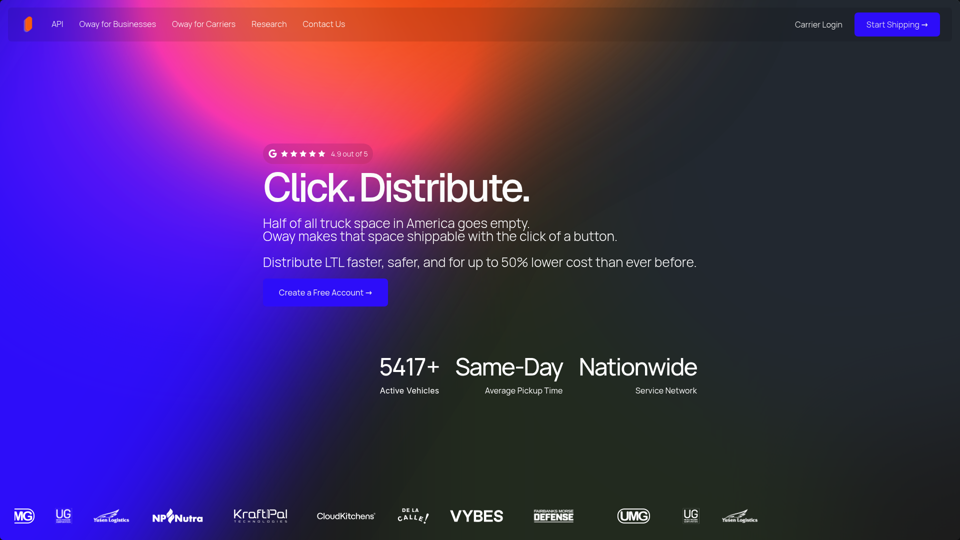
Oway | Simple, Automated Distribution & Industrial Intelligence
Oway is an industrial intelligence and automated distribution platform that helps businesses ship 1 to 12+ pallet LTL freight and helps carriers monetize unused truck capacity through instant quotes, routing, and API-based workflows. For logistics teams, dispatchers, and supply chain operators, its AI-native coordination can reduce manual load planning and speed decisions across fragmented freight operations.

B2B Order Automation Software for Distribution and Logistics
Hyperfox is B2B order automation software for distribution, logistics, manufacturers, and back-office teams that captures orders from email, EDI, web forms, customer portals, and field sales, then validates and routes them into ERP or TMS systems. In AI-supported order operations, it can help customer service, operations, and logistics teams reduce manual entry and focus more on exceptions, accuracy, and throughput.

docbatch.ai - High Volume Document Processing
docbatch.ai is an AI-powered batch document processing platform that helps growing teams extract structured data from PDFs and images at scale, especially for operations, finance, and administrative workflows handling high document volumes. In AI-era back-office work, it can help operations and data teams reduce manual entry by turning large batches of invoices, forms, contracts, and similar documents into CSV, JSON, or Excel outputs.

SWITCH - Street WITCHer - Agentic AI for Mobility and Logistics
SWITCH is an agentic AI platform for urban mobility and logistics that helps organizations simulate scenarios, forecast demand, and optimize real-time operations, mainly for shared mobility operators, logistics teams, car rental companies, and local governments. For fleet managers, planners, and operations teams, combining simulation with autonomous decision-making can improve routing, rebalancing, infrastructure planning, and day-to-day execution.