
AI Data Analytics | Analyze Data 10x Faster - Formula Bot
Rate this Tool
Average Score
Total Votes
Select your score (1-10):
Detail Information
What
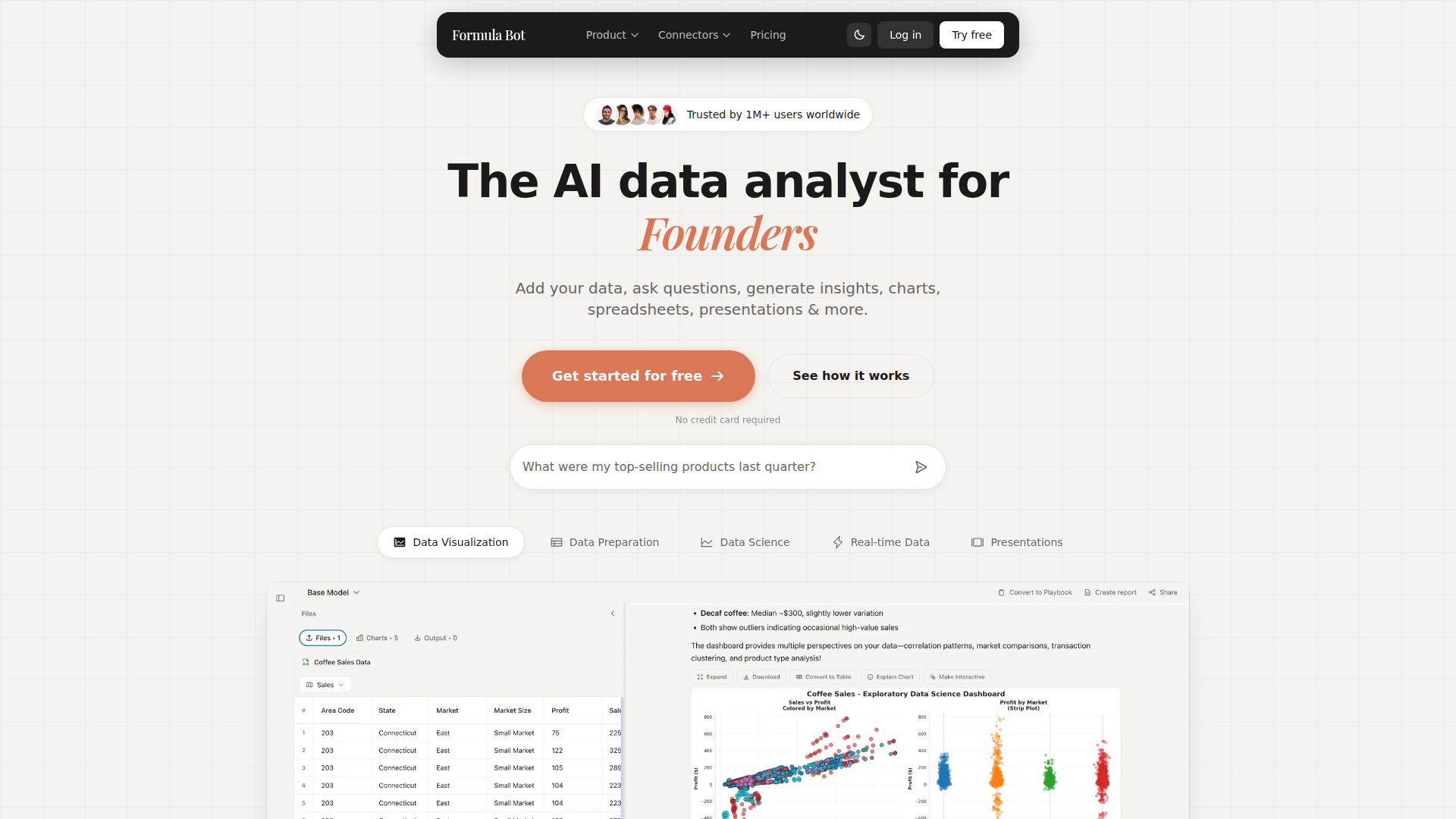
Formula Bot is an AI data analytics platform that lets users upload or connect data, ask questions in plain English, and receive answers, charts, tables, spreadsheets, reports, and presentations. The product is presented for founders and data-oriented teams that want to move from raw data to insight faster without relying entirely on manual analysis workflows.
Its workflow centers on combining data from multiple sources, cleaning and reshaping it, analyzing structured and text data, and automating recurring reporting. Based on the page content, Formula Bot appears positioned as a self-service analytics layer that sits between raw business data and decision-making, with some overlap across BI, spreadsheet automation, lightweight data science, and embedded analytics.
Features
- Natural-language data analysis: Users can ask questions in plain English or other languages and get charts, tables, and answers quickly, which lowers the barrier to exploring data.
- Data preparation and transformation: The platform can clean columns, merge files or sources, filter rows, reshape datasets, and standardize raw inputs so analysis starts from analysis-ready data.
- Charting and visualization: It generates visualizations from uploaded or connected data, helping teams present trends and comparisons more clearly.
- Code transparency: Formula Bot shows the generated Python, SQL, or R for each request, which supports verification, learning, and export into existing workflows.
- Text analysis tools: It can perform sentiment detection, translation, and keyword extraction, making it useful for customer feedback and other text-heavy datasets.
- Automation, connectors, and embeds: The platform supports scheduled reporting, data connectors, knowledge bases for improving SQL accuracy, and embeddable analytics chat for external-facing use cases.
Helpful Tips
- Validate output on important decisions: Natural-language analytics tools are efficient, but teams should still review generated code, filters, and assumptions before using outputs in finance, operations, or executive reporting.
- Start with a narrow use case: Adoption is usually smoother when teams begin with a repeatable workflow such as weekly sales reporting, customer review analysis, or spreadsheet generation.
- Use knowledge context for databases: If your team works with complex schemas, adding context files or documentation can improve query accuracy and reduce ambiguity in SQL generation.
- Check security fit against internal requirements: The page describes encryption, isolated execution, and row-level security, but buyers should still confirm these controls against their own governance and access policies.
- Assess embedded analytics carefully: If you plan to expose analytics to customers or partners, review branding controls, row-level access behavior, and operational ownership before rollout.
OpenClaw Skills
Formula Bot could likely fit well inside the OpenClaw ecosystem as a data-analysis execution layer for agents that need to inspect datasets, generate charts, summarize findings, or produce recurring business reports. Likely OpenClaw skills could include “analyze uploaded CSV,” “generate executive KPI summary,” “run sentiment analysis on feedback,” “prepare spreadsheet export,” or “draft a presentation from latest metrics.” The page does not confirm a native OpenClaw integration, so this should be treated as a likely orchestration use case rather than a built-in connection.
In a broader workflow, OpenClaw agents could use Formula Bot to turn messy operational data into structured outputs for downstream planning, customer success, revenue operations, or founder reporting. For example, a likely multi-agent setup could monitor incoming files, trigger scheduled analysis, classify customer comments, and publish summarized findings into dashboards or internal briefings. Combined this way, the pair could help non-technical business teams operate with faster insight cycles while still giving technical users access to the underlying code for review.
Embed Code
Share this AI tool on your website or blog by copying and pasting the code below. The embedded widget will automatically update with the latest information.
<iframe src="https://aimyflow.com/ai/excelformulabot-com/embed" width="100%" height="400" frameborder="0"></iframe>
Explore Similar Tools
SQL Query Builder & Generator - AI Powered Database Assistant
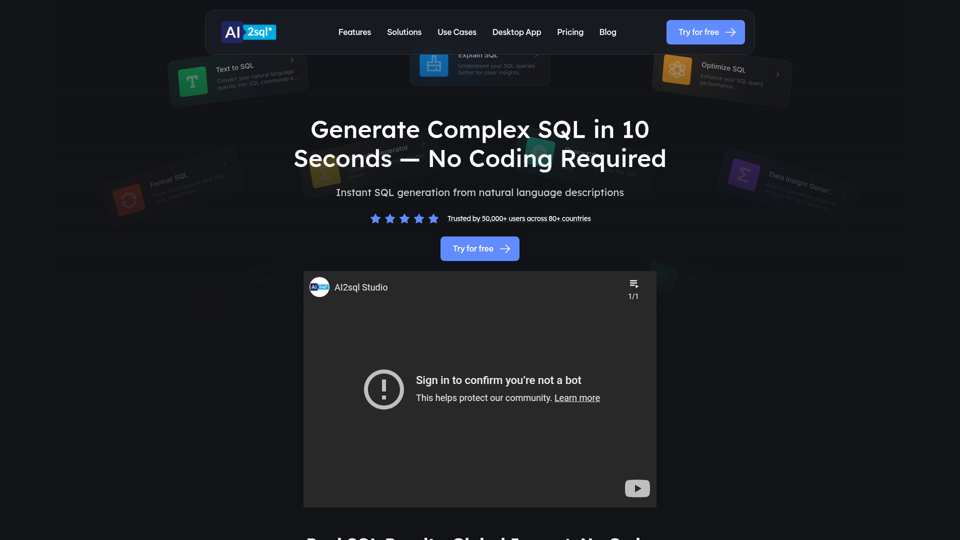
AI2SQL is an AI-powered SQL query builder and database assistant that turns natural language into SQL or NoSQL queries, and also helps explain, fix, optimize, validate, and format queries for beginners, analysts, developers, and database users. In AI-assisted data work, it can help analysts, engineers, and SQL learners move faster from questions to usable queries while reducing time spent on syntax and troubleshooting.
Columns: build data workflow
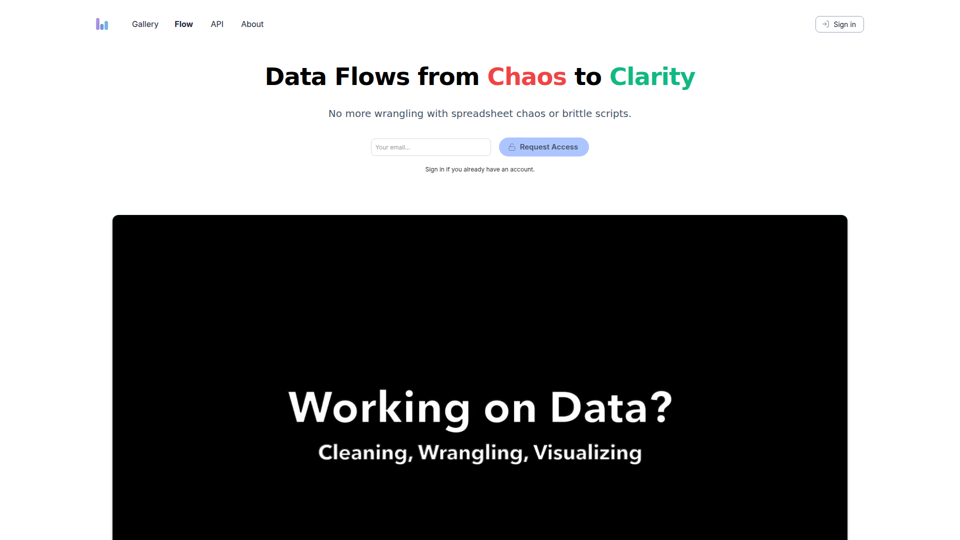
Columns Flow is a data workflow tool that helps spreadsheet users, analysts, engineers, and managers turn connected data sources into visual reports, automated updates, alerts, and shareable summaries using plain-language transformations. For data and operations teams, it can reduce manual wrangling and brittle scripts while keeping reporting and downstream handoffs more consistent in AI-assisted workflows.
StatPecker · Smart insights for business, stunning visuals for content creators.
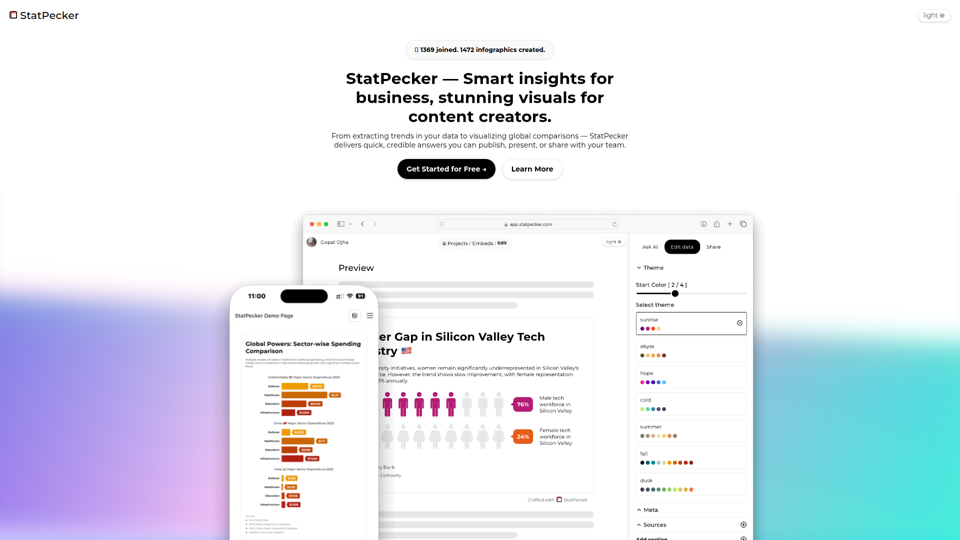
StatPecker is an AI data insight and visualization tool that helps users ask questions about data, analyze local CSV files privately on-device, and create publishable charts and infographics, mainly for content writers and data analysts. In AI-assisted content and reporting workflows, it can help analysts and writers turn raw data into credible visuals faster for articles, presentations, and team sharing.
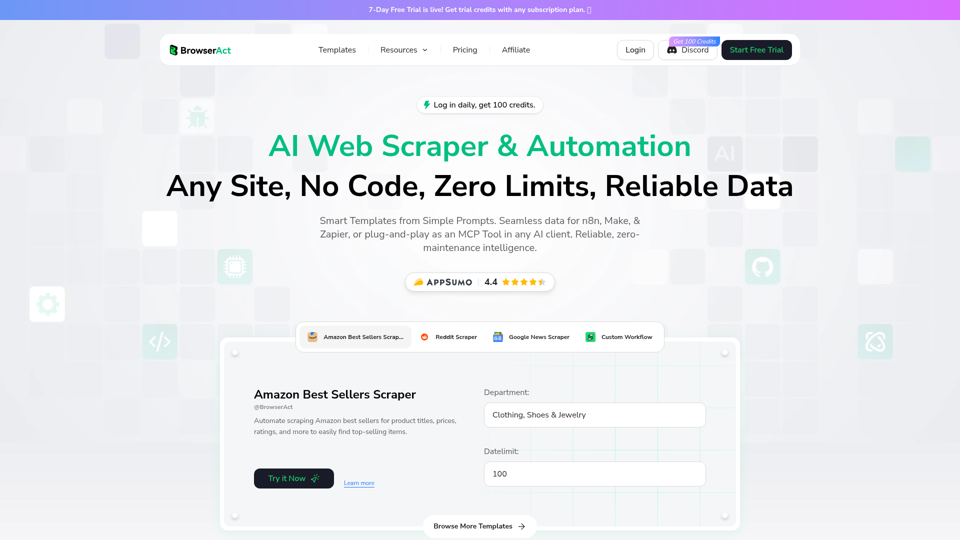
BrowserAct — AI‑powered No‑Code Web Scraper & Automation
BrowserAct is an AI-powered no-code web scraper and browser automation tool that helps users extract website data and build automated workflows from natural language prompts, mainly for operations teams, analysts, and developers. In AI-driven data workflows, it can reduce manual scraping upkeep by turning websites into reusable automation steps for research, monitoring, and system-to-system data handling.
AtlasGrid
AtlasGrid is a data context tool that helps users place and organize information on a visual grid, mainly for teams working with complex datasets and relationships. In an AI-driven workflow, it can help analysts and operators keep data structured and contextualized so models and people can interpret connections more reliably.
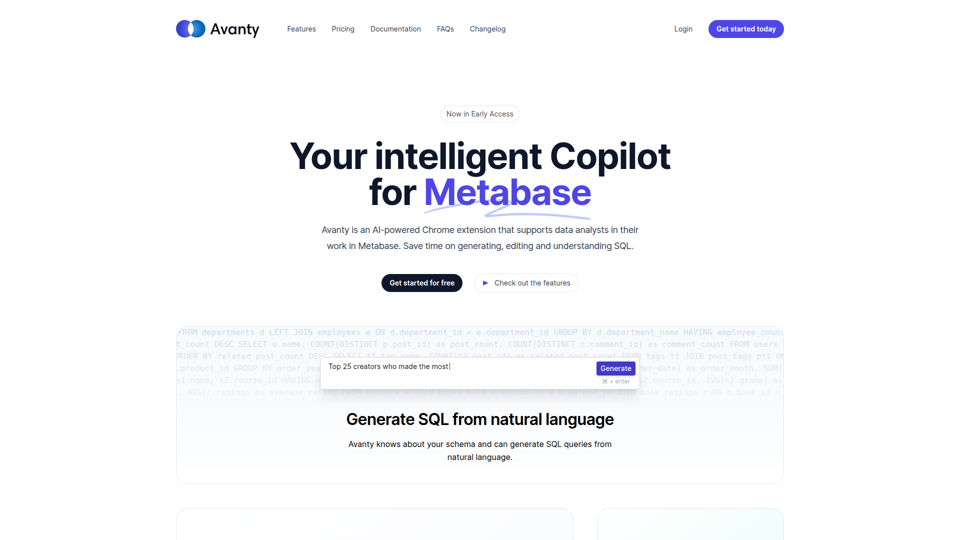
Avanty - AI assistant for data analysts in Metabase.
Avanty is an AI-powered Chrome extension for Metabase that helps data analysts generate, edit, explain, format, and comment SQL queries faster using natural language and schema metadata. For analytics teams and BI professionals, it can reduce time spent on repetitive query writing and make complex SQL easier to review, document, and debug in AI-assisted workflows.
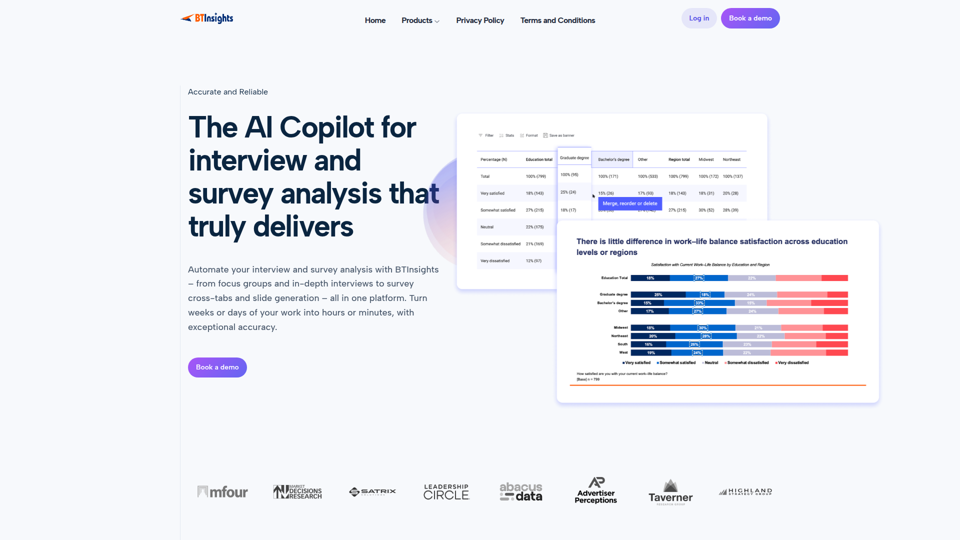
BTInsights | AI Copilot for Interview and Survey Analysis
BTInsights is an AI qualitative research platform that helps market researchers analyze interviews, focus groups, survey open ends, and crosstabs, with tools for transcription, traceable insights, coding, and slide generation. For research and insights teams, it can shorten manual analysis and reporting while keeping findings linked to source data for faster review and client delivery.
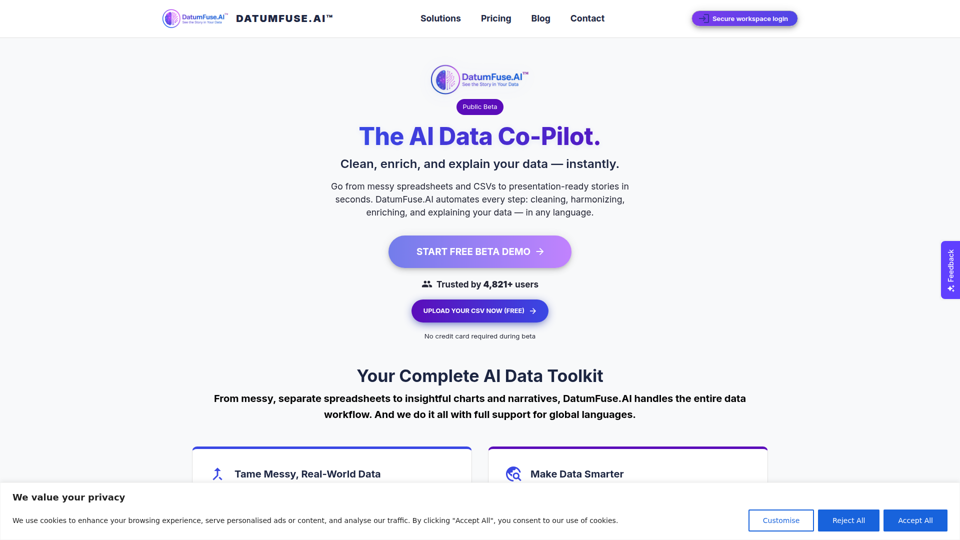
DatumFuse.AI – AI Platform for Data Cleaning, Harmonization, Augmentation, Narration & Visualization
DatumFuse.AI is an AI data platform that helps users clean, harmonize, augment, visualize, and narrate spreadsheet and CSV data, mainly for teams and professionals working with messy business datasets. For marketers, operations teams, consultants, and presenters, it can reduce manual data wrangling and speed up turning exports into clearer charts, summaries, and decision-ready reports.