
Trim: A foundation model for physics.
Rate this Tool
Average Score
Total Votes
Select your score (1-10):
Detail Information
What
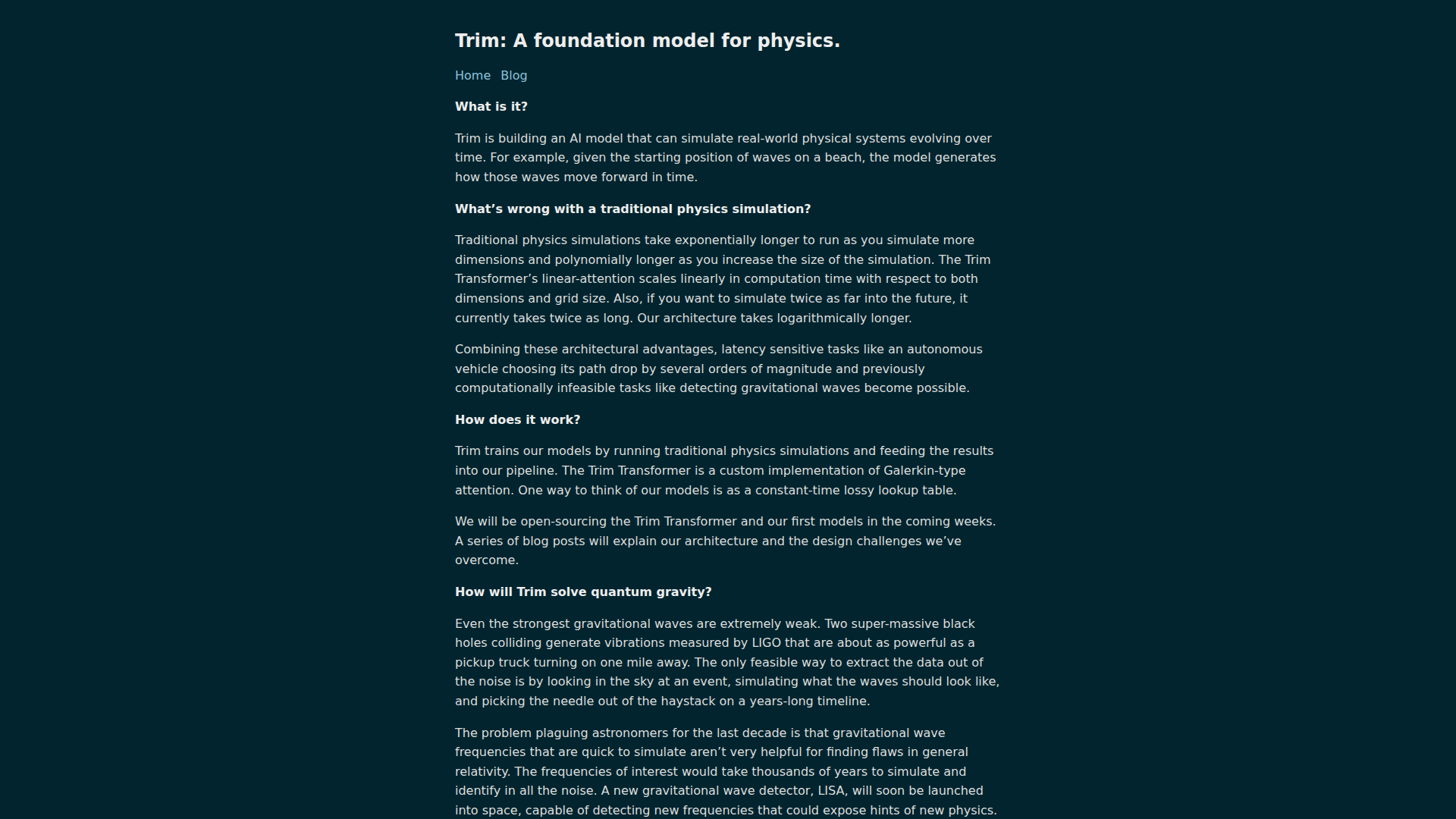
Trim is an AI company developing a foundation model for physics: a model designed to simulate real-world physical systems as they evolve over time. The example given is wave dynamics, where the model takes an initial state and generates how the waves progress forward.
Based on the page, Trim is aimed at researchers and technical teams that need faster physical simulation for time-sensitive or computationally difficult problems. Its positioning appears to be a learned alternative or complement to traditional physics simulation, with a focus on better scaling across dimensions, grid size, and prediction horizon.
Features
- Time-evolution modeling for physical systems — The model is designed to take an initial physical state and predict how that system changes over time.
- Linear-attention simulation architecture — Trim states that its Transformer scales linearly in computation time with respect to both dimensions and grid size, which may reduce the cost of larger simulations.
- Logarithmic scaling over future time horizon — The page says simulating farther into the future grows logarithmically rather than linearly, which could improve long-range forecasting efficiency.
- Training pipeline built from traditional simulations — Trim trains its models on outputs from conventional physics simulations, suggesting a workflow that learns from established numerical methods rather than replacing physics data generation entirely.
- Custom Galerkin-type attention implementation — The underlying model is described as a custom Transformer architecture, indicating a specialized design for physics-related sequence or field modeling.
- Planned open-source release — The company says it plans to open-source the Trim Transformer and its first models, which may make evaluation and experimentation easier once available.
Helpful Tips
- Validate domain fit carefully — Performance claims are framed at a high level on the page, so teams should test accuracy, error behavior, and stability on their own physical systems before relying on it in production or research pipelines.
- Compare against existing solvers on both speed and fidelity — For physics tools, lower latency matters only if the approximation quality remains acceptable for the target decision or scientific task.
- Assess where lossy prediction is acceptable — Trim describes its model as a “constant-time lossy lookup table,” which suggests it may be best suited to use cases where approximate forecasts are useful and full numerical precision is not always required.
- Plan for hybrid workflows — Because training depends on traditional simulations, a likely adoption path is to use the model alongside conventional solvers rather than as a full replacement from day one.
- Watch the open-source release for implementation details — The current page provides broad architectural claims but limited operational detail, so technical evaluation will depend on the promised code and model release.
OpenClaw Skills
Trim could fit into the OpenClaw ecosystem as the simulation engine inside agentic workflows for science, engineering, and autonomy. Likely use cases include skills that launch scenario batches, compare simulation outputs across initial conditions, summarize divergence patterns, and route high-risk cases to slower traditional solvers. If the planned open-source models become accessible programmatically, OpenClaw agents could orchestrate parameter sweeps, dataset generation, and simulation-backed decision support around them.
In research and industrial settings, that combination could shift work from manually configuring isolated simulations toward AI-assisted exploration loops. Likely examples include an R&D analyst agent that frames candidate experiments, a scientific monitoring agent that flags unusual predicted dynamics, or an autonomy planning workflow that uses fast approximate physical forecasting before escalating to more exact tools. These are inferred workflow possibilities rather than confirmed native integrations, but they align well with Trim’s stated focus on fast simulation of complex physical systems.
Embed Code
Share this AI tool on your website or blog by copying and pasting the code below. The embedded widget will automatically update with the latest information.
<iframe src="https://aimyflow.com/ai/trimresearch-com/embed" width="100%" height="400" frameborder="0"></iframe>