
Parachute

Rate this Tool
Average Score
Total Votes
Select your score (1-10):
Detail Information
What
Parachute is governance infrastructure for clinical AI. It is designed for hospitals that need a structured way to review, approve, deploy, monitor, and document AI tools used in clinical settings.
The product appears positioned as an operational governance layer for healthcare organizations adopting clinical AI, especially where patient safety, bias, privacy, compliance, and auditability are material concerns. Its workflow spans vendor discovery, evaluation, deployment monitoring, and audit preparation, with AI agents used to reduce manual review work.
Features
- Vendor discovery and prioritization: Helps identify best-fit AI vendors based on clinical gaps, organizational goals, and budget, which can narrow evaluation effort earlier in the process.
- Automated evaluation and approval support: Auto-scores accuracy, safety, and bias so teams can assess candidate tools without relying on manual test scripts.
- Hands-free deployment monitoring: Automates tracking after rollout and provides early warnings before performance or compliance issues affect patients.
- Audit-ready documentation trail: Creates auditable records intended to support regulator and litigation-related review requirements.
- Governance workflow acceleration: Aims to shorten committee review cycles and reduce stalled pilots by making governance work more systematic.
- Existing-stack compatibility: The site states that it integrates with existing systems, though it does not specify which integrations are currently available.
Helpful Tips
- For products in this category, verify whether governance outputs align with your hospital’s actual review committees, approval policies, and documentation standards before rollout.
- Ask for clear evidence on how automated scoring for safety, bias, and accuracy is performed, since the page does not describe the underlying methodology.
- Confirm what “integrates with your existing stack” means in practice, including data sources, monitoring inputs, and implementation requirements.
- Use a phased adoption model that starts with one clinical AI use case or vendor pipeline, then expands once review workflows and escalation paths are validated.
- In buying and implementation, distinguish between support for governance operations and direct model validation authority; the page supports the former more clearly than the latter.
Embed Code
Share this AI tool on your website or blog by copying and pasting the code below. The embedded widget will automatically update with the latest information.
<iframe src="https://aimyflow.com/ai/parachute-ai-com/embed" width="100%" height="400" frameborder="0"></iframe>
Explore Similar Tools
Scanbase - Solutions for Digital Health Diagnostics
Scanbase is a digital health diagnostics company that uses computer vision to turn photos of rapid diagnostic tests into positive or negative results, mainly for healthcare organizations and teams managing at-home testing workflows. In AI-enabled diagnostics, this can help clinical operations, diagnostic engineering, and healthcare IT teams standardize test interpretation and support more efficient remote testing processes.
UnderstoodCare: Medicare Support & Care Advocates
Understood Care is a virtual Medicare support and patient advocacy service that helps people across the U.S. manage care coordination, claims, paperwork, appointments, medications, transportation, and related benefits, mainly for Medicare patients and their families. For healthcare advocates, nurses, and care coordinators, this kind of remote support can reduce administrative friction and make it easier to keep patients engaged between appointments.
Accessibility Technology for blind & low vision people - Be My Eyes
Be My Eyes is an accessibility app that helps blind and low-vision people get instant visual assistance through live video, AI descriptions, and support from volunteers or companies. For accessibility, customer support, and service teams, it can extend assistance beyond standard channels by making visual problem-solving faster and more responsive.
Andy | 15 minutes OASIS
Andy is an AI-powered, human-reviewed home health documentation tool that helps clinicians complete OASIS charts faster with ambient scribing, built-in QA, and PDGM coding, mainly for home health clinicians and agencies. For home health nurses, QA teams, and coding staff, it can reduce documentation burden while supporting more consistent survey-ready records and reimbursement-related coding accuracy.
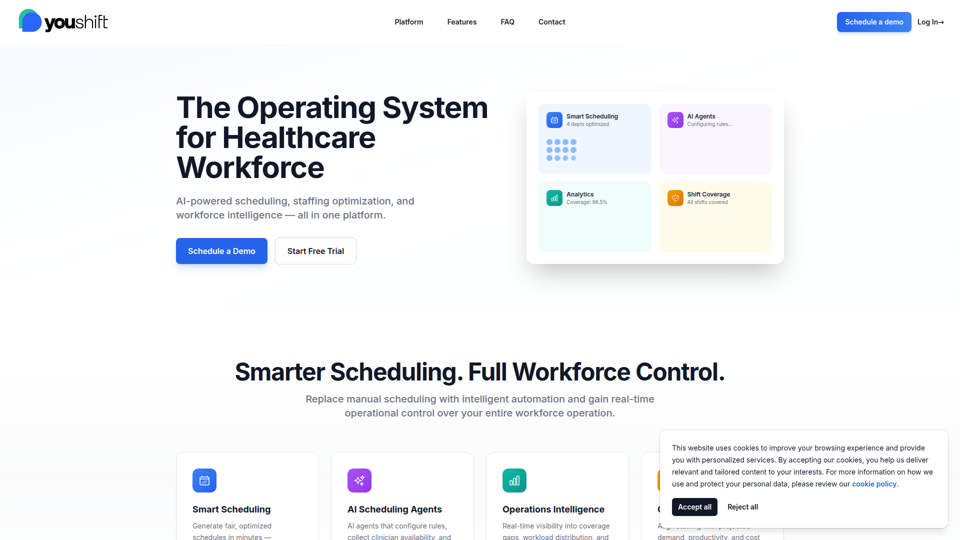
Youshift
YouShift is an AI-powered healthcare workforce platform that helps hospitals and clinician scheduling teams automate shift scheduling, staffing optimization, and workforce analytics. For healthcare operations leaders, schedulers, and department managers, it can reduce manual coordination while improving coverage, compliance, and staffing decisions with real-time workforce intelligence.
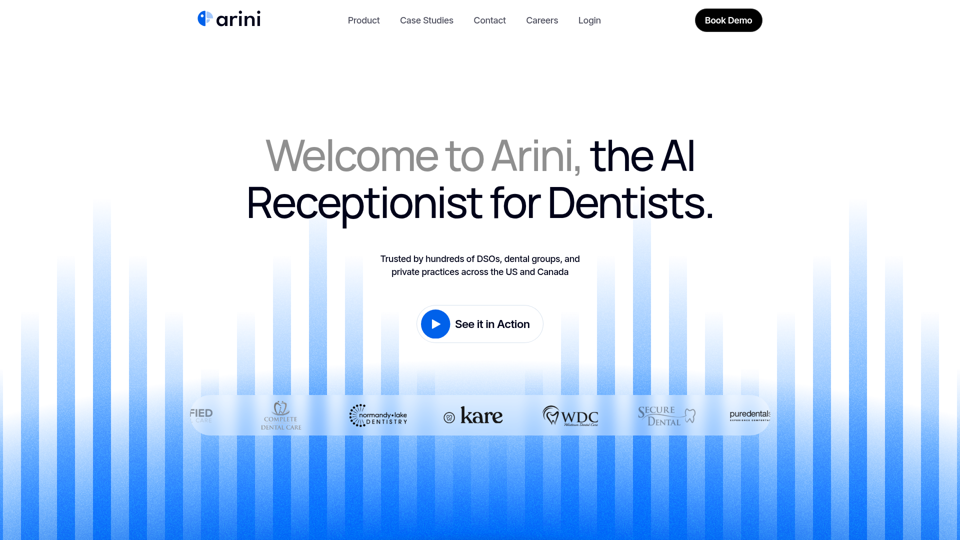
Arini | The leading AI receptionist for dentists
Arini is an AI receptionist for dental practices that answers calls, manages appointments, and handles patient communication across phone and text, mainly for DSOs, dental groups, and solo dentists. For front-desk teams and practice managers, it can automate routine scheduling and after-hours call handling so staff can focus on higher-touch patient needs.
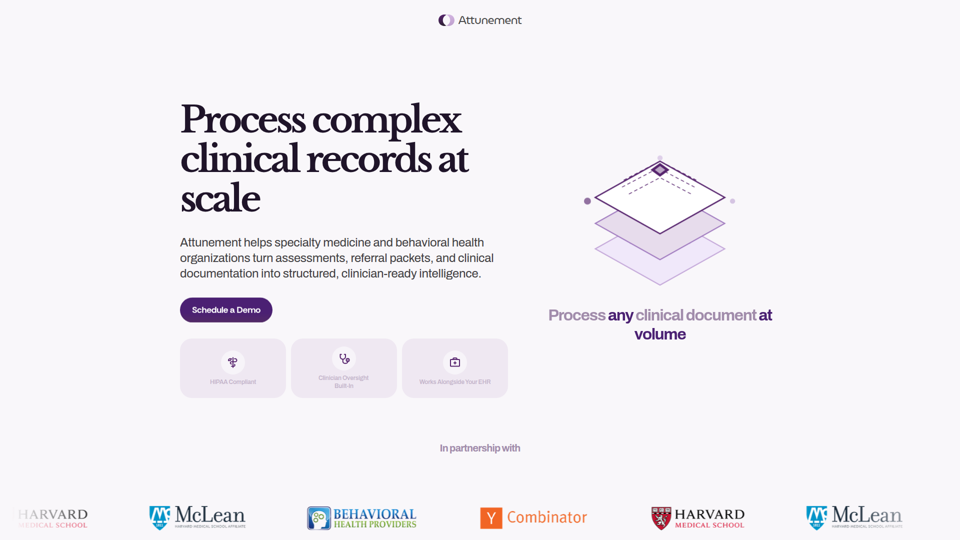
Attunement AI
Attunement AI is a clinical memory layer that helps specialty medicine and behavioral health organizations process assessments, referral packets, and other clinical records into structured, clinician-ready intelligence at scale. For clinical operations and chart review teams, it can improve AI-assisted record interpretation by preserving longitudinal patient context while supporting auditable, HIPAA-compliant workflows.
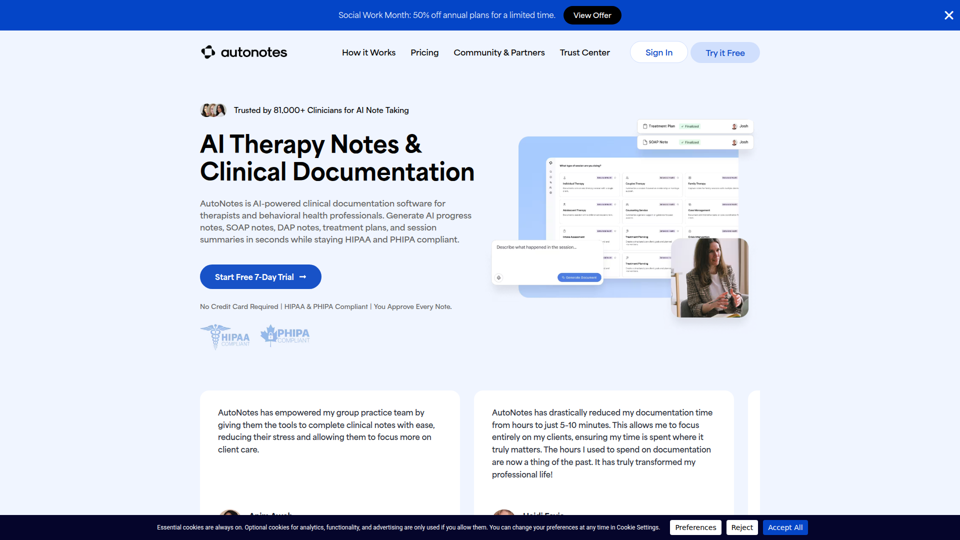
AI Clinical Documentation for Therapists | AutoNotes
AutoNotes is AI-powered clinical documentation software that helps therapists and behavioral health professionals generate compliant progress notes, SOAP and DAP notes, treatment plans, and session summaries from written, dictated, uploaded, or recorded sessions. For therapists, social workers, and practice teams, it can reduce administrative documentation work while preserving editable, structured records and continuity across sessions.