
MiDash - AI Investment Platform | Natural Language Trading
Rate this Tool
Average Score
Total Votes
Select your score (1-10):
Detail Information
What
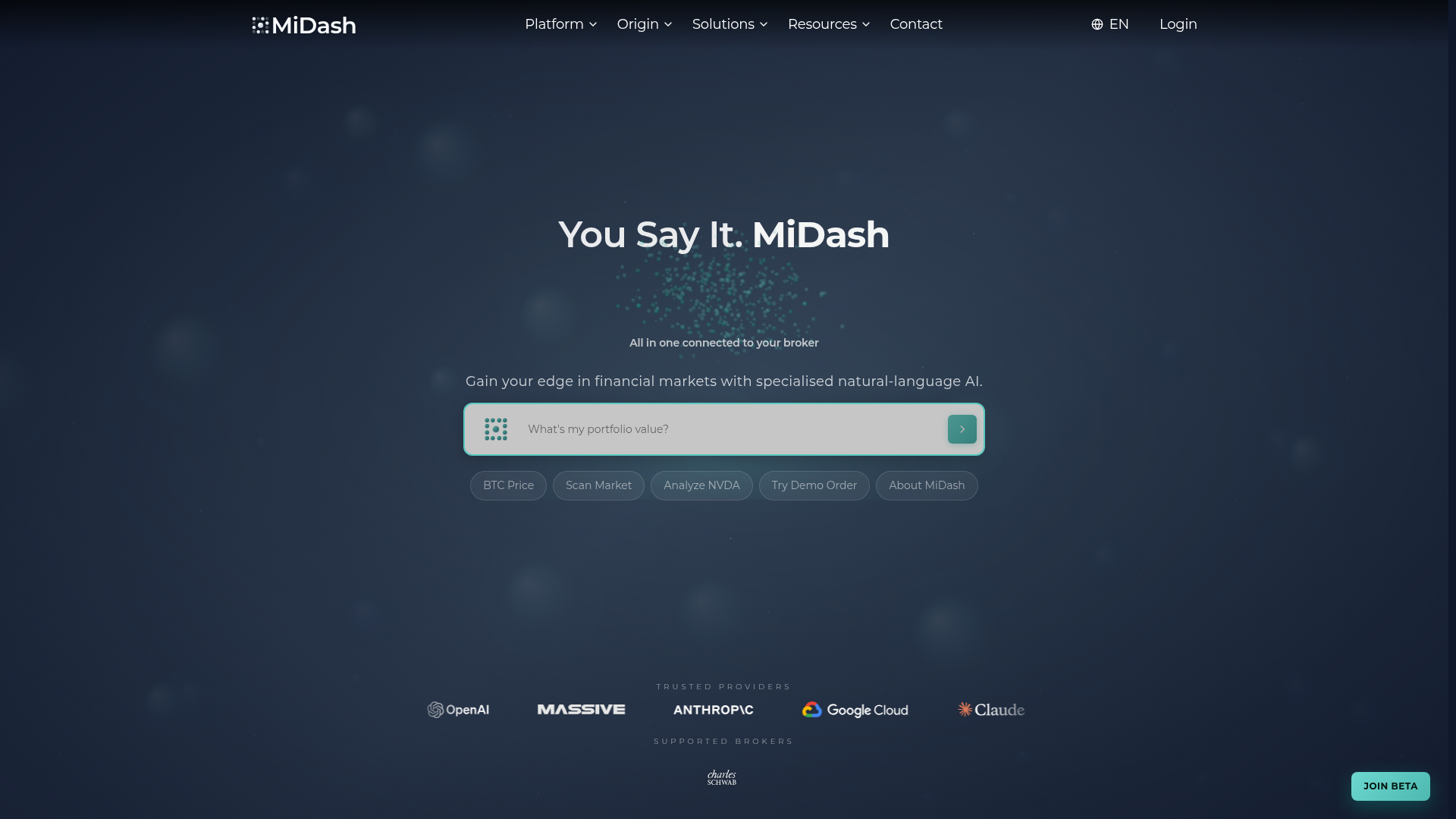
MiDash is a beta-stage AI trading and investment platform that lets users describe trade ideas and market questions in natural language. It is positioned as an all-in-one conversational workspace for capital markets, combining market analysis, strategy design, charting, monitoring, and broker-connected execution within one interface.
The product appears to serve a wide range of users, from beginners and retail traders to professionals and institutional desks. Its core workflow is: describe a trading idea in plain English, have the platform turn that into a strategy or monitoring logic, test or tune it, and then route execution through supported brokers. The site also emphasizes risk controls and oversight for multi-strategy or multi-desk environments, although it clearly states that the platform is currently in beta and that some features may be limited or not fully operational.
Features
- Natural-language trading interface — Users can ask for market analysis, define trade conditions, or describe strategies in plain English instead of using code or complex platform workflows.
- Multi-agent strategy builder — MiDash can turn a trade idea into a tested and monitored execution plan, which is useful for building and refining trading agents without manual scripting.
- Backtesting and tuning workflow — The platform presents strategy simulation and adjustment as part of the conversational process, helping users evaluate ideas before staging deployment.
- Broker-connected execution — MiDash is designed to connect to supported brokers and hand off execution, reducing the need to move between separate analysis and order-entry tools.
- Cross-asset market coverage — The site lists equities, options, FX, crypto, futures, and selected regional markets, which suggests broad market scanning and trade support across multiple asset classes.
- Institutional risk and oversight tools — MiDash highlights portfolio exposure monitoring, drawdown controls, hedging rules, audit trails, and desk-level orchestration for more advanced trading operations.
Helpful Tips
- Verify live readiness carefully — The site states that MiDash is in beta and is not a live trading platform for beta access, so buyers should confirm which broker connections and execution features are currently operational.
- Test natural-language reliability with real workflows — For this type of product, evaluate how consistently it interprets trade instructions, risk rules, and edge cases before relying on automation.
- Review governance needs early — Teams using conversational strategy creation should define approval, monitoring, and change-management processes, especially when multiple agents or desks are involved.
- Separate research assistance from investment advice — The company states it is a software platform, not a broker-dealer or investment advisor, so firms should align usage with their own trading authority and compliance structure.
- Assess fit by user maturity — Beginners may benefit from simplified analysis and guided workflows, while advanced teams should focus on risk controls, auditability, and how well the platform handles multi-strategy coordination.
OpenClaw Skills
MiDash could likely fit well within the OpenClaw ecosystem as the execution and market-intelligence layer inside larger financial workflows. Likely OpenClaw skills could include a market brief agent that summarizes overnight moves, a trade-idea translator that converts analyst notes into structured prompts, and a portfolio watchdog that routes alerts or approval requests to operations teams. If MiDash exposes usable interfaces, OpenClaw agents could help standardize how users generate, review, and escalate trading actions before anything reaches a broker.
For institutional or professional users, the combination could reshape how trading and risk teams work by connecting conversational strategy design with downstream controls, documentation, and collaboration. A likely use case is an OpenClaw workflow that gathers market context, drafts strategy instructions, checks them against internal policy, logs rationale, and then sends approved instructions into MiDash for simulation or monitored execution. The source page does not confirm a native OpenClaw integration, so this should be treated as a plausible workflow design rather than a documented product capability.
Embed Code
Share this AI tool on your website or blog by copying and pasting the code below. The embedded widget will automatically update with the latest information.
<iframe src="https://aimyflow.com/ai/midash-ai/embed" width="100%" height="400" frameborder="0"></iframe>
Explore Similar Tools
AI Stock Analysis, Trading Signals & Investment Ideas | GoAI
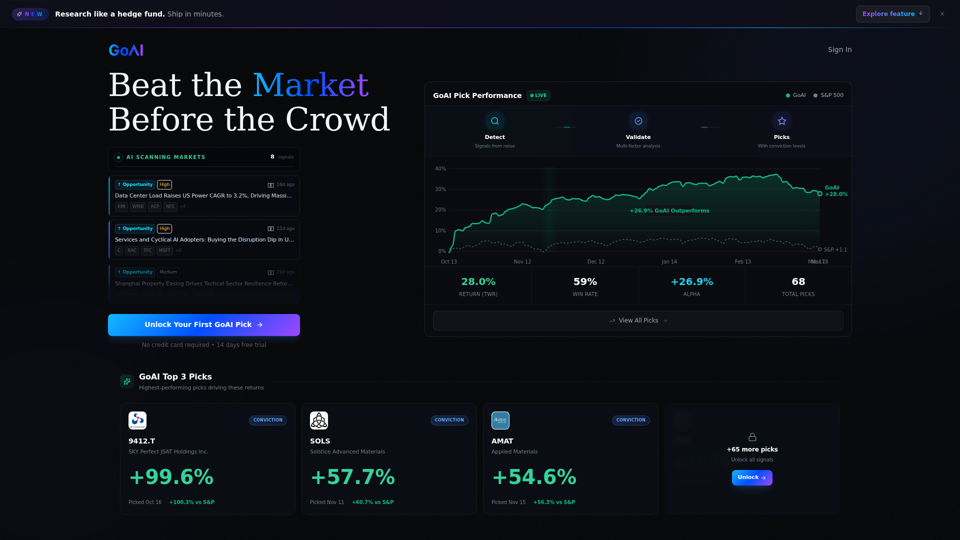
GoAI is an AI-powered stock research and market scanning platform that helps investors and traders analyze companies, track trading signals, and generate investment ideas, with deeper research aimed at more advanced market participants. In an AI-driven investing workflow, it can help portfolio managers and analysts spend less time gathering market data and more time evaluating higher-conviction opportunities.

floatz | AI-Driven Scientific Due Diligence for Life-Science Investors
floatz is an AI-driven scientific due diligence platform that helps biotech and life-science investors assess scientific risk in investments by analyzing evidence across science, trials, IP, and people. For investment teams and scientific diligence professionals, this can support more defensible decisions by surfacing weak, negative, and non-obvious signals that traditional claim-by-claim reviews may miss.
Astor | AI Investment Advisor
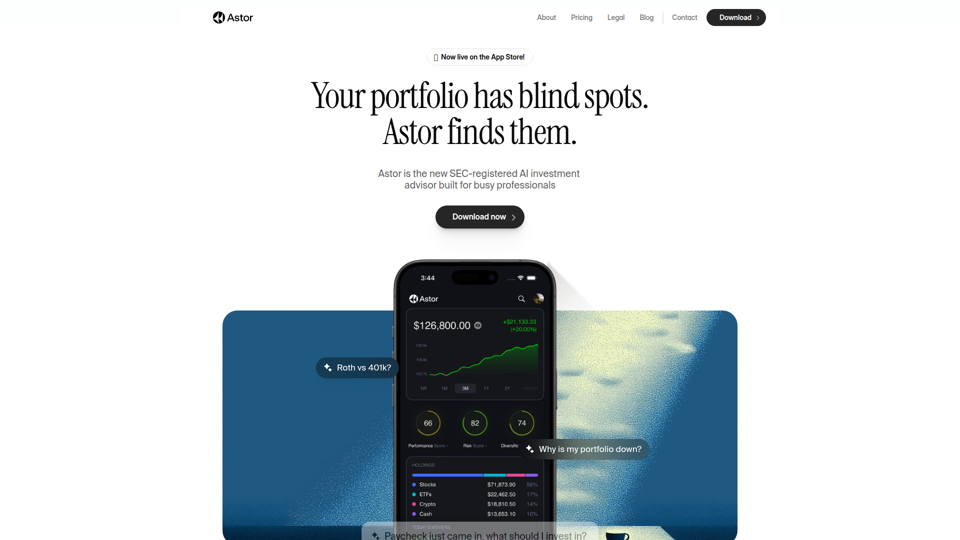
Astor is an SEC-registered AI investment advisor app that connects brokerage accounts, analyzes holdings, and provides personalized portfolio guidance and market updates, mainly for busy professionals such as tech workers, consultants, bankers, and founders. For professionals managing RSUs, retirement choices, or concentrated positions, it can speed up portfolio review and surface position-specific insights through 24/7 chat or voice support.
Bayesline
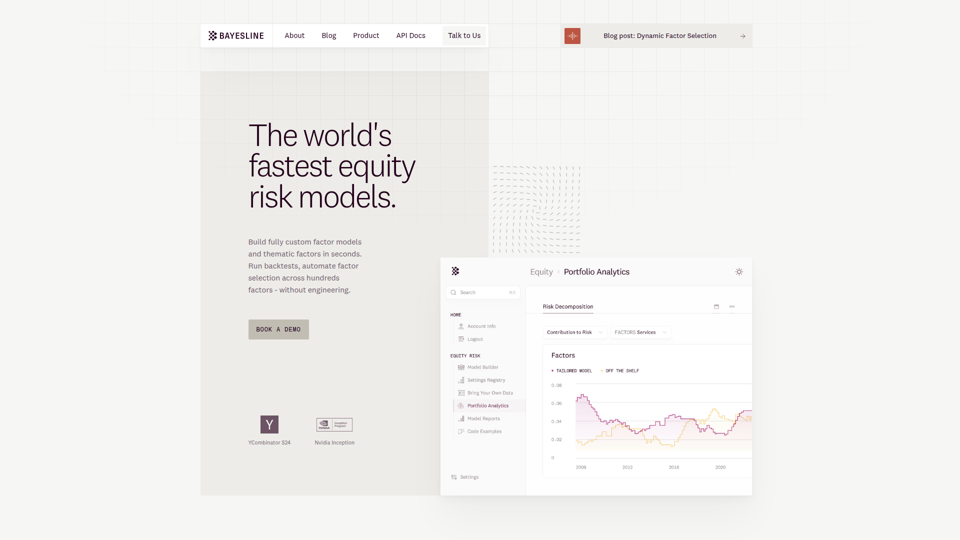
Bayesline is an analytics platform for asset managers that helps teams build custom equity risk models, run backtests, automate factor selection, and generate portfolio reports using vendor or proprietary data. For portfolio managers, quantitative researchers, and risk teams, its API-first workflow can speed model iteration and keep risk analytics aligned with changing market conditions and internal research.
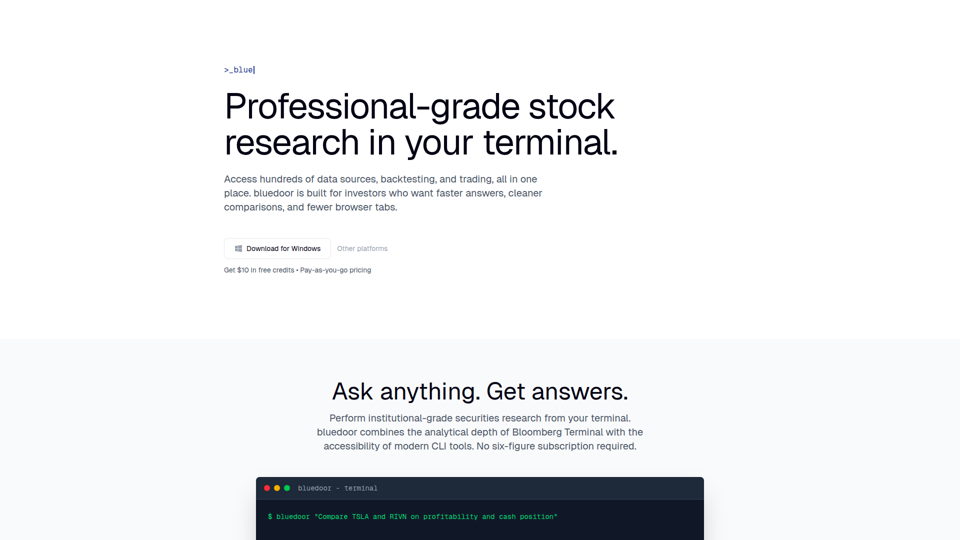
Professional-grade stock research in your terminal
Bluedoor is a terminal-based stock research tool that helps investors perform securities research, compare companies, backtest ideas, and support trading workflows using hundreds of data sources in one place. For investors and research-focused finance professionals, its terminal workflow can speed analysis, reduce tab-switching, and make cross-source insights easier to act on.

Freeport
Freeport is an internet-native investing platform that helps investors trade pre-IPO equity exposure, tokenized stocks, crypto, and yield products while using AI to filter trusted market information into actionable research. For investors and research-driven trading teams, its AI feed can reduce time spent on noisy social and news signals by organizing relevant themes, watchlists, and trade ideas around assets they follow.
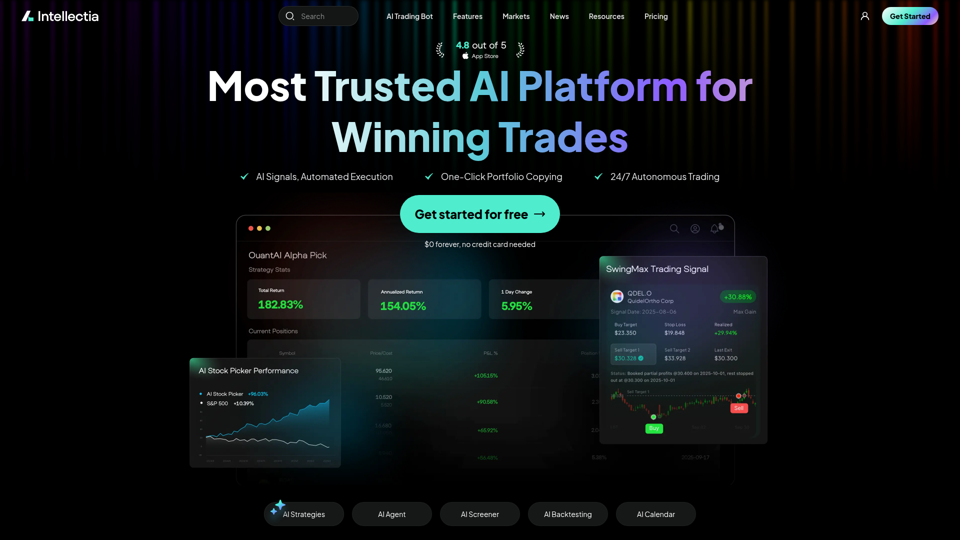
AI Investing Insights - Official Homepage - Intellectia AI™
Intellectia AI is an AI investing and trading platform that helps investors and active traders research markets, screen stocks, generate signals, backtest strategies, and execute or copy trades from a single dashboard. For retail traders and market analysts, AI tools like this can speed decision-making by turning real-time data, news, and technical signals into faster trade research and execution workflows.
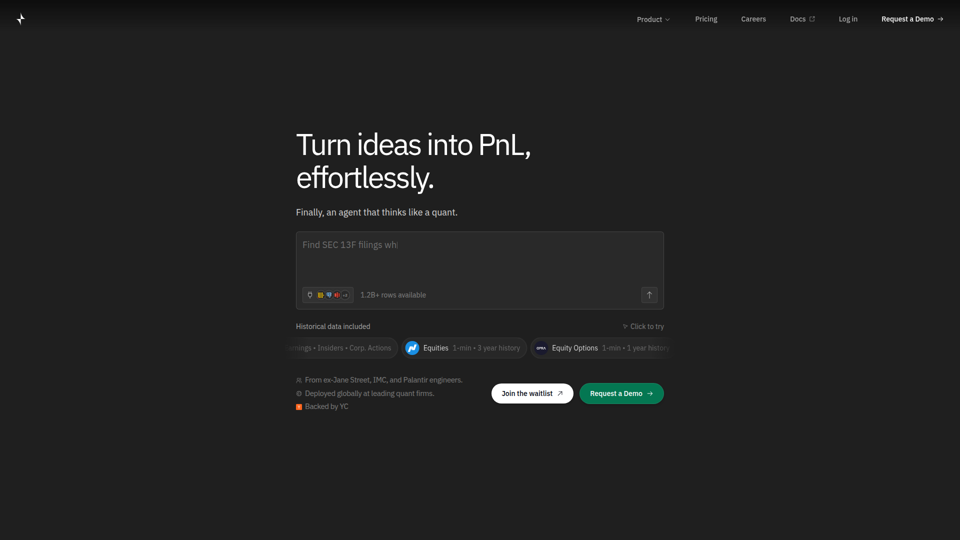
Sharpe | AI Research Agent for Quants
Sharpe is a Jupyter-native AI research agent for quantitative finance that helps quants, portfolio managers, traders, and researchers run multi-step analyses on large financial datasets and generate fully cited, reproducible notebooks. For quantitative research teams, it can reduce manual analysis time while improving consistency, traceability, and reuse of firm-specific methods across studies.