
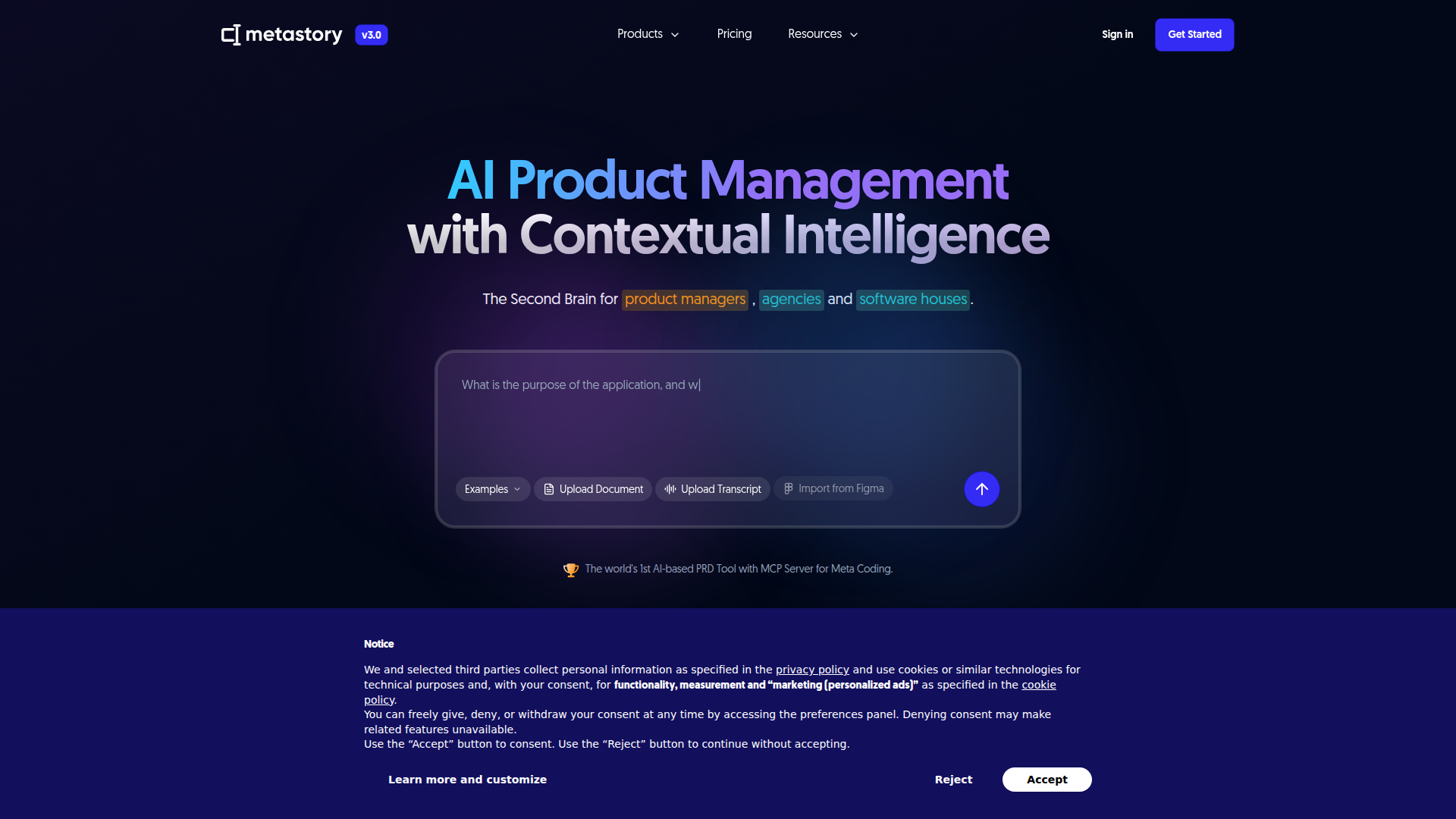
metastory · AI Product Management with Contextual Intelligence
Rate this Tool
Average Score
Total Votes
Select your score (1-10):
Detail Information
What
metastory is an AI product management platform positioned as a “second brain” for product managers, agencies, and software houses. It is built to turn early product context into structured requirements, linked UI screens, and estimation outputs, with a workflow that starts from conversation, documents, transcripts, or Figma imports.
The product appears to focus on upstream product definition and delivery planning rather than full software development execution. Its core workflow combines a context engine, AI-assisted requirement generation, screen-to-requirement mapping, reusable libraries, estimation boards, and integrations such as Jira, Figma, and MCP-based external tool connectivity.
Features
- AI-powered PRD and requirement generation: Converts project context into modules, features, subfeatures, user stories, and related requirement structures to reduce manual documentation work.
- Human-in-the-loop editing: Keeps users in control of AI-generated outputs, which is useful for teams that need reviewable and adjustable requirements rather than fully automated drafts.
- UI screen management and mapping: Imports screens and links them to requirements so teams can align product scope with actual interfaces and user journeys.
- Reusable library and cross-project sync: Stores reusable modules and features, helping teams maintain consistency across projects and reduce repeated setup effort.
- AI-based estimation board: Produces effort and cost estimates by module and feature, including role-based totals such as frontend, backend, and QA, to support quoting and planning.
- Jira, Figma, and MCP connectivity: Syncs with Jira and Figma and supports Model Context Protocol connections for broader tool interoperability, though the full range of supported endpoints is not specified on the page.
Helpful Tips
- Validate requirement depth before rollout: For teams with complex delivery processes, confirm whether the generated hierarchy matches internal standards for PRDs, epics, stories, and acceptance criteria.
- Use it where estimation speed matters most: The product seems especially relevant for agencies and software houses that need fast, repeatable scoping and quoting from incomplete inputs.
- Check sync behavior in detail: Since Jira and Figma synchronization are highlighted, buyers should review how conflicts, versioning, and bidirectional updates are handled in practice.
- Set review checkpoints around AI outputs: Human-in-the-loop controls are a strength, but teams should still define approval steps for requirements and estimates before they move into execution.
- Assess MCP needs realistically: MCP support may be valuable for custom workflows, but organizations should verify which external tools and data flows are truly available versus only technically possible.
OpenClaw Skills
Within the OpenClaw ecosystem, metastory could likely serve as a strong upstream context source for product and delivery automation. Likely use cases include skills that ingest a metastory project’s modules, features, estimates, and linked screens, then generate sprint briefs, stakeholder summaries, implementation checklists, QA coverage plans, or structured handoff packages for engineering and design teams. The MCP positioning also suggests potential for context-sharing workflows, although native OpenClaw integration is not stated on the page.
This combination could be particularly useful for digital agencies, product ops teams, and software consultancies. An OpenClaw agent layer could likely monitor requirement changes, detect estimation drift, translate screen-linked features into execution-ready work items, or assemble reusable proposal templates from previous projects. In practice, that would shift product managers from manually coordinating fragmented artifacts toward supervising a context-aware operating system for planning, quoting, and delivery preparation.
Embed Code
Share this AI tool on your website or blog by copying and pasting the code below. The embedded widget will automatically update with the latest information.
<iframe src="https://aimyflow.com/ai/metastory-ai/embed" width="100%" height="400" frameborder="0"></iframe>
Explore Similar Tools

Governed Data Access for AI Agents | Secure MCP Tools
Pylar is a governed data access platform that helps users give AI agents secure access to structured data through controlled SQL views and MCP tools, mainly for data and engineering teams. It lets developers operationalize AI safely by balancing agent capability with governance and access control.
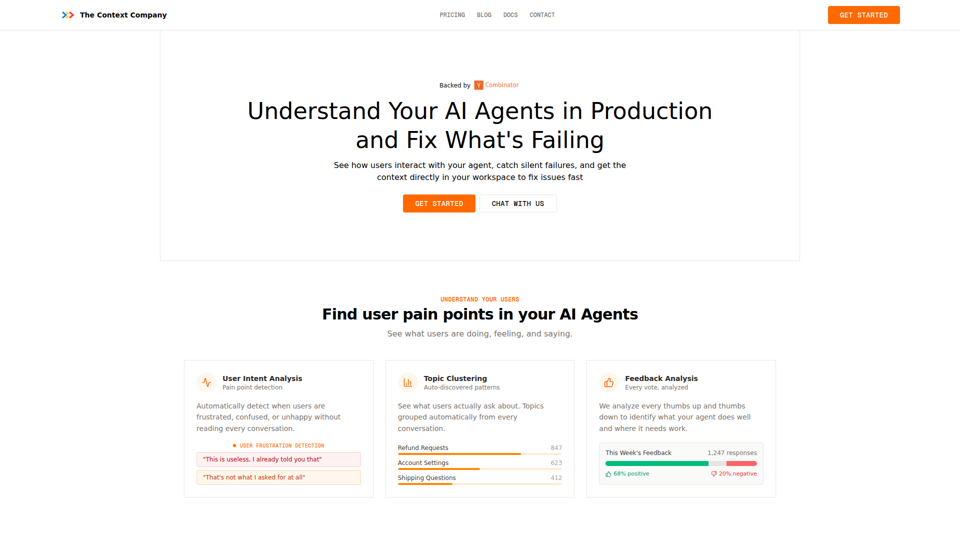
The Context Company | Understand User Behavior In Your AI Agents
The Context Company is an observability and user behavior analysis tool for AI agents that helps teams monitor production conversations, detect frustration and silent failures, cluster topics, and review feedback, mainly for developers and product teams shipping AI agents. In AI workflows, it can help engineering, support, and product functions prioritize fixes faster by surfacing hidden failure patterns and real user pain points directly from agent runs.

AI App Builder | Vibe Code Apps & Websites with AI, Fast
Lovable is an AI app builder that helps users create apps, websites, and digital products by describing ideas in chat, refining prototypes, and deploying them quickly, mainly for founders, product managers, designers, and marketers. In AI-driven product work, it can help these teams turn early concepts, screenshots, and feedback into working prototypes faster, reducing handoff delays between planning, design, and launch.
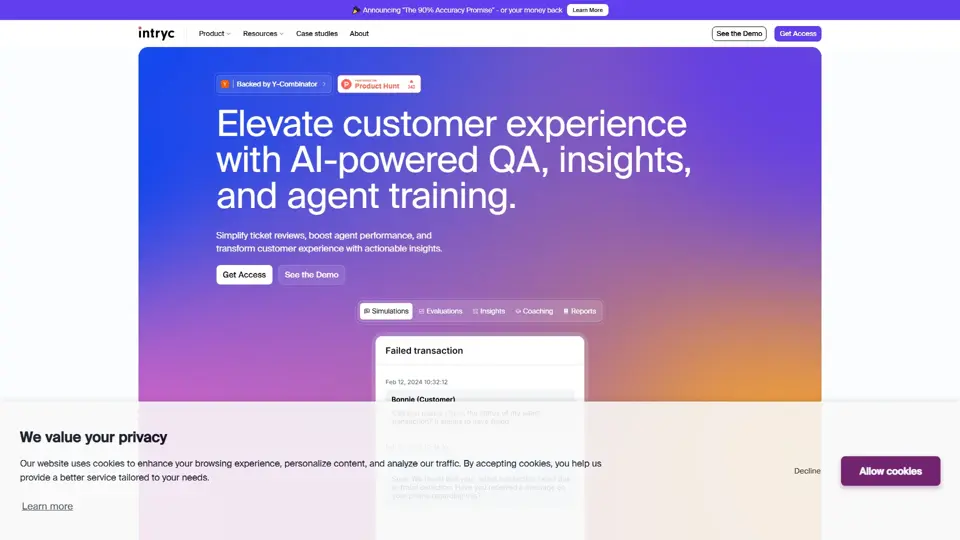
Intryc - Elevate your Customer Experience
Intryc is a customer experience platform that helps teams review support tickets, improve agent performance, and uncover actionable service insights, mainly for support and CX leaders. It gives QA and support managers a faster way to coach teams and raise service quality at scale.

VibeFlow - AI Full-Stack App Builder with Visual Backends
VibeFlow is an AI full-stack app builder that helps users create backend automations, data pipelines, dashboards, forms, and customer-facing apps through prompts and visual workflows, mainly for developers, founders, operations teams, and non-technical teams. In AI-assisted product and operations work, its editable visual backends can help teams validate, adjust, and maintain application logic more reliably than opaque code generation alone.
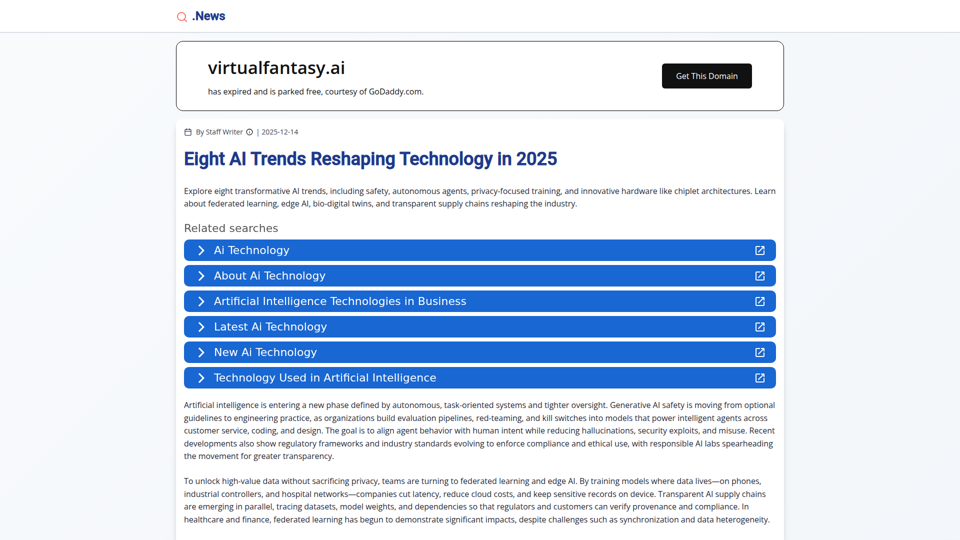
Eight AI Trends Reshaping Technology in 2025 | .News
This page is a news article outlining eight AI trends for 2025, helping technology professionals and business decision-makers understand developments such as AI safety, autonomous agents, federated learning, edge AI, and new hardware architectures. For product leaders, engineers, and compliance teams, this kind of trend overview can guide planning around safer deployment, privacy-preserving AI, and more efficient industry-specific systems.
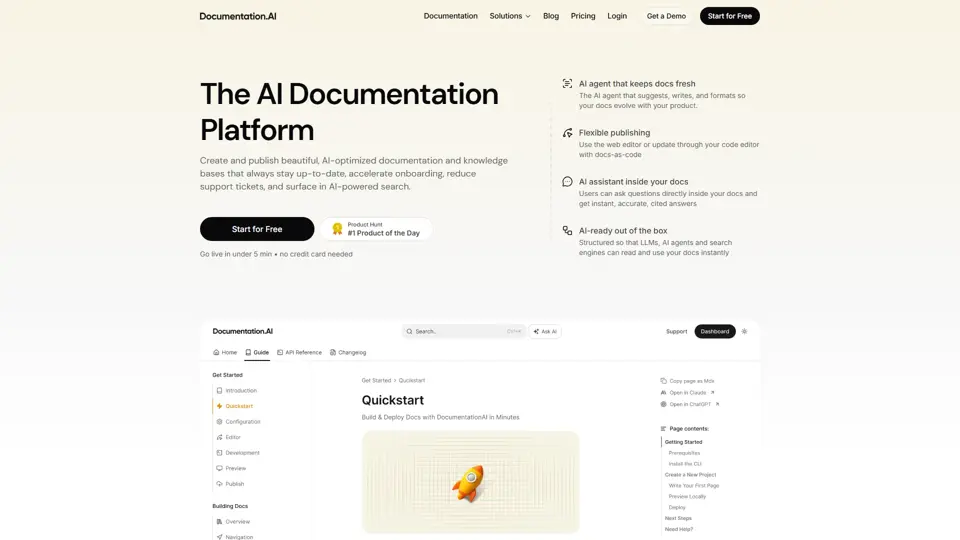
Documentation.AI – AI Documentation & Knowledge Base Software
Documentation.AI is an AI documentation and knowledge base platform that helps teams keep docs current, onboard users faster, and reduce support volume. In the AI era, it improves how support and product teams maintain institutional knowledge without constant manual rewriting.
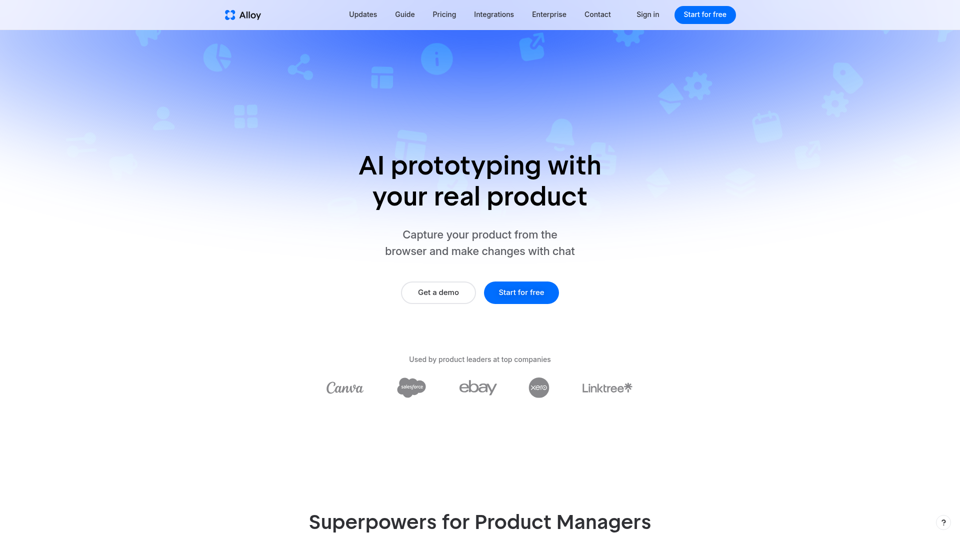
Alloy · AI prototyping with your real product
Alloy is an AI prototyping tool that captures pages from a real web app and lets product managers create interactive, on-brand prototypes with chat, mainly for professional product teams. By turning product ideas, customer requests, and team feedback into realistic prototypes quickly, it can help product managers and designers align faster and reduce time spent on manual mockups.