
Imagen: Text-to-Image Diffusion Models
Rate this Tool
Average Score
Total Votes
Select your score (1-10):
Detail Information
What
Imagen is a Google Research text-to-image diffusion model that generates photorealistic images from natural language prompts. It is presented as a research system rather than a generally available product, and the page emphasizes advances in image realism and image-text alignment.
The core workflow combines a large pretrained frozen language model for text understanding with cascaded diffusion models for image generation and super-resolution. Based on the page, Imagen is positioned as a state-of-the-art research benchmark in text-to-image generation, especially for evaluating how language understanding improves visual output quality.
Features
- Text-to-image generation: Converts input text into images, addressing prompt-based visual creation from natural language descriptions.
- Large language model text encoding: Uses a large frozen T5-XXL encoder to represent prompts, which the research says improves both fidelity and image-text alignment.
- Cascaded diffusion generation: Generates an initial 64×64 image and then upsamples it through text-conditional super-resolution stages to 256×256 and 1024×1024.
- Photorealistic output focus: The system is specifically designed for high-fidelity image synthesis, with the page highlighting strong photorealism in examples and evaluations.
- Benchmark-driven evaluation: Introduces DrawBench, a benchmark for testing compositionality, spatial relations, cardinality, rare words, long-form text, and other challenging prompt types.
- Research architecture improvements: The page cites a thresholding diffusion sampler and an Efficient U-Net architecture intended to improve guidance behavior, efficiency, and convergence.
Helpful Tips
- Treat it as a research model, not a commercial tool listing: The page does not describe product packaging, deployment options, or API availability, and it explicitly states that code and a public demo were not released.
- Assess prompt understanding separately from image realism: Imagen’s main research claim is that stronger text encoding materially improves image-text alignment, so evaluation should cover both semantic accuracy and visual quality.
- Review bias and safety constraints early: The page openly notes risks tied to web-scale training data, including harmful stereotypes, problematic content, and limitations when generating people.
- Check availability before planning adoption: Since the source describes a non-public research system, any operational use would likely depend on alternative implementations or future releases rather than direct access to Imagen itself.
- Use benchmark-style testing for comparisons: For this category of model, structured prompt sets similar to DrawBench are a practical way to compare compositional reasoning and prompt fidelity across systems.
OpenClaw Skills
Within the OpenClaw ecosystem, Imagen would most likely fit as a generation engine inside creative, research, or content-ops workflows—if access to the model were available through an internal deployment or future interface. Likely skills could include prompt expansion, creative brief translation into structured image prompts, benchmark-based image evaluation, and asset routing for design review. Since the page does not mention native integrations, this should be treated as a likely use case rather than a confirmed capability.
A broader OpenClaw workflow could pair language agents with image-generation evaluation agents to help marketing teams, creative studios, and research groups test prompt variants, score outputs for alignment, and document safety concerns. In industries such as advertising, publishing, and digital media, that combination could shift work from manual prompt experimentation toward more systematic prompt design and review pipelines. For research teams, OpenClaw could also orchestrate DrawBench-style testing and internal governance checks around bias, failure cases, and human evaluation.
Embed Code
Share this AI tool on your website or blog by copying and pasting the code below. The embedded widget will automatically update with the latest information.
<iframe src="https://aimyflow.com/ai/imagen-research-google/embed" width="100%" height="400" frameborder="0"></iframe>
Explore Similar Tools
Platform Overview | Robovision
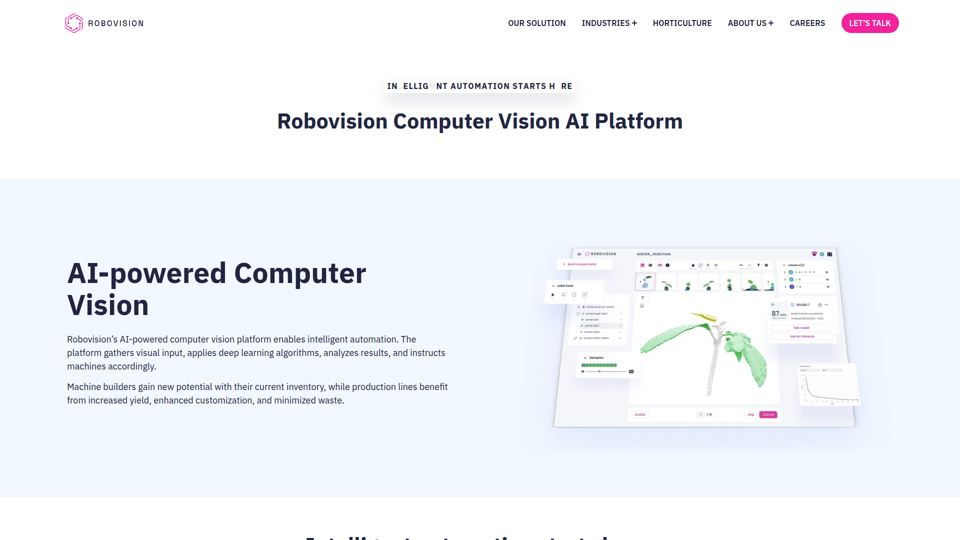
Robovision is an AI-powered computer vision platform that helps industrial teams build, test, optimize, and deploy vision models for intelligent automation, mainly for machine builders, manufacturers, and data scientists. In AI-driven production, it can reduce manual inspection work and let data scientists and operations teams focus more on improving models, quality control, and deployment speed.

Interface - The Frontier Lab for Digital Visual Simulation
Interface is a research lab for digital visual simulation that builds AI systems to model how people and objects appear, behave, and interact, mainly for world-model researchers and teams developing real-world AI applications. In the AI era, this can help research and simulation teams create more realistic visual training environments that improve how models understand human behavior and physical scenes.
Ångström AI — Accelerating molecular simulation using generative AI
Ångström AI is a generative AI molecular simulation platform that computes free energy differences, binding conformations, and hydration sites with ab initio-level accuracy much faster than traditional methods, mainly for drug discovery and computational chemistry teams. For computational chemists and molecular modelers, this can speed candidate evaluation and solvation or binding analysis by enabling faster, physics-informed sampling workflows.
Surf - Crypto's Ultimate AI
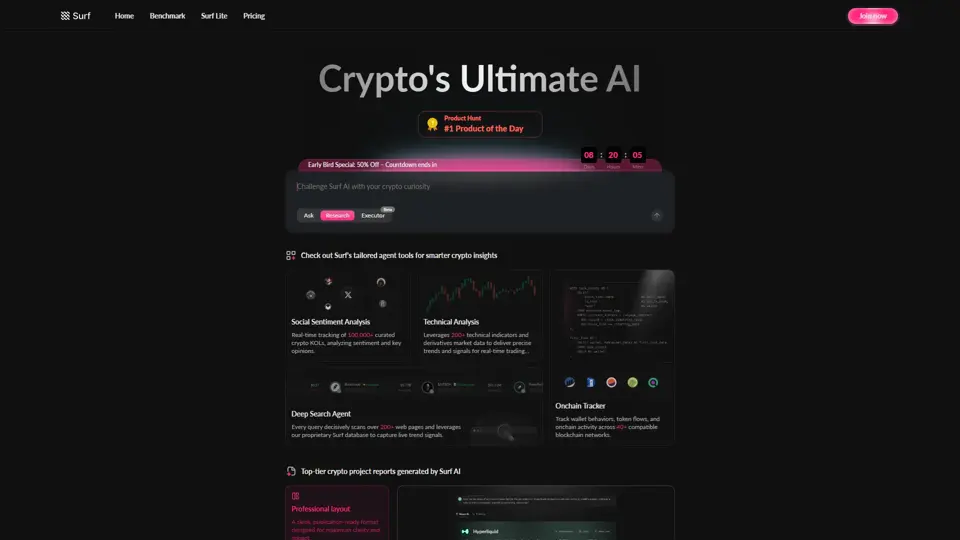
Surf is an AI-powered crypto research platform that helps traders and investors analyze cryptocurrency markets, trends, and trading opportunities. In the AI era, it helps crypto researchers synthesize fast-moving information and respond to market signals with greater speed.
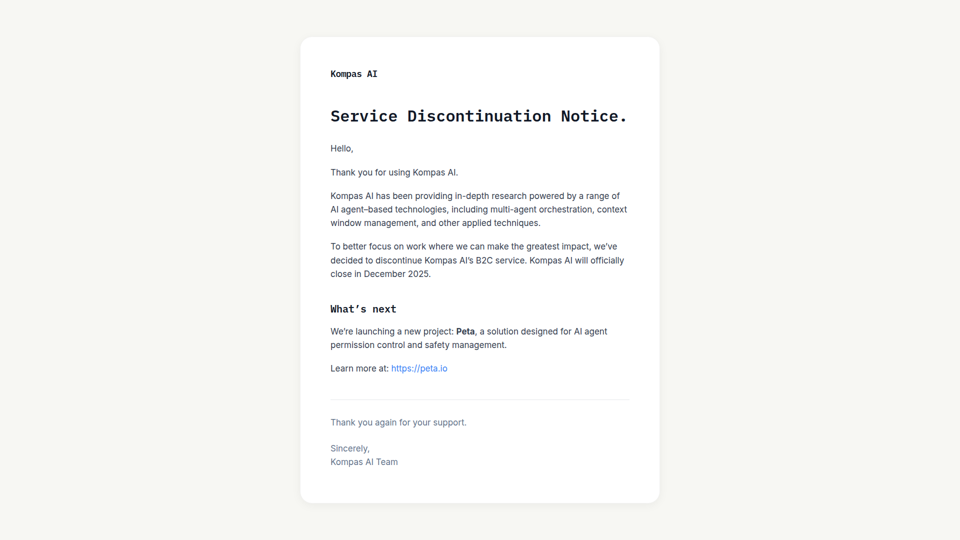
Service Discontinuation Notice - Kompas AI
Kompas AI is a discontinued B2C AI research service that helped users conduct in-depth research using multi-agent orchestration, context window management, and related AI agent techniques. Its planned transition toward AI agent permission control and safety management highlights how researchers and AI operations teams increasingly need governance tools alongside advanced agent workflows.

Andon Labs
Andon Labs is an AI research company that builds custom evaluations and real-world benchmarks for frontier AI models, helping AI labs, researchers, and engineers test how autonomous agents perform on long-horizon business, robotics, and spatial tasks. In the AI era, these evaluations can help safety researchers and model developers identify failure modes earlier and improve control protocols before deploying agents in real environments.
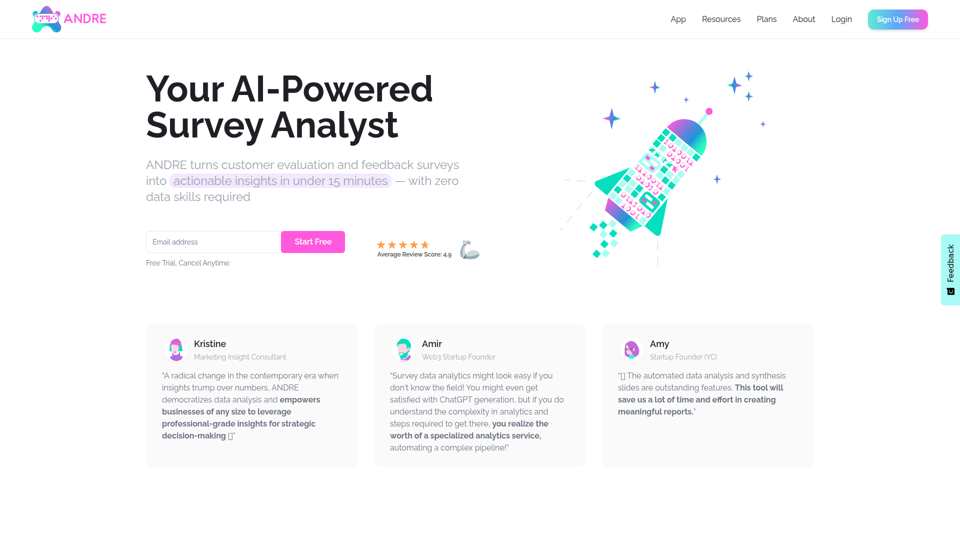
ANDRE - Synthetic Survey Data Analyst for Better CX
ANDRE is an AI survey data analyst that automates cleaning, analysis, and report creation for customer feedback and evaluation surveys, mainly for customer experience specialists, marketers, product teams, founders, and researchers. In AI-driven workflows, it can help these professionals turn narrative survey responses into faster, evidence-based decisions without requiring data science skills.
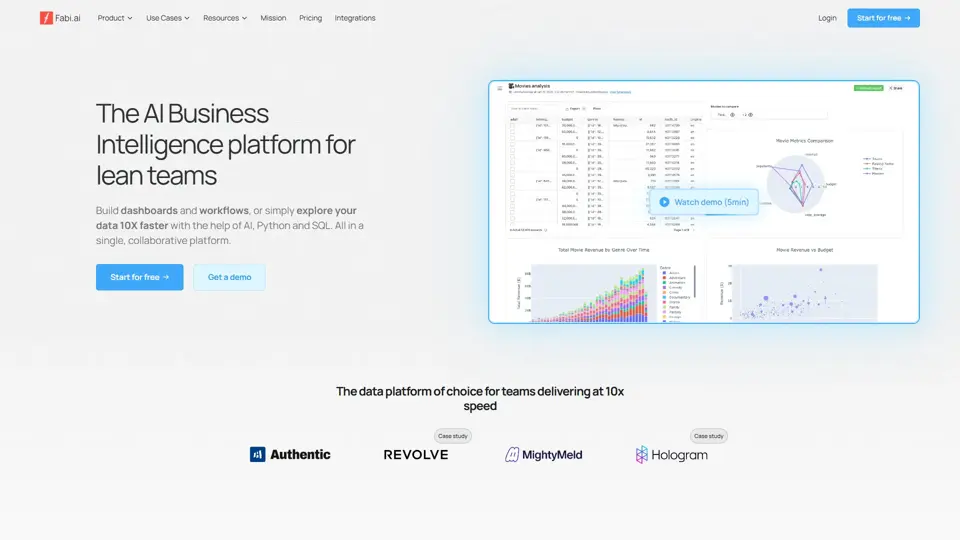
Fabi.ai: AI-powered data analysis platform | SQL + Python + AI
Fabi.ai is an AI-powered data analysis platform that combines SQL, Python, and automation to help analysts explore data and generate insights faster. It boosts productivity for data teams by reducing manual analysis steps and accelerating decision-making from raw data.