
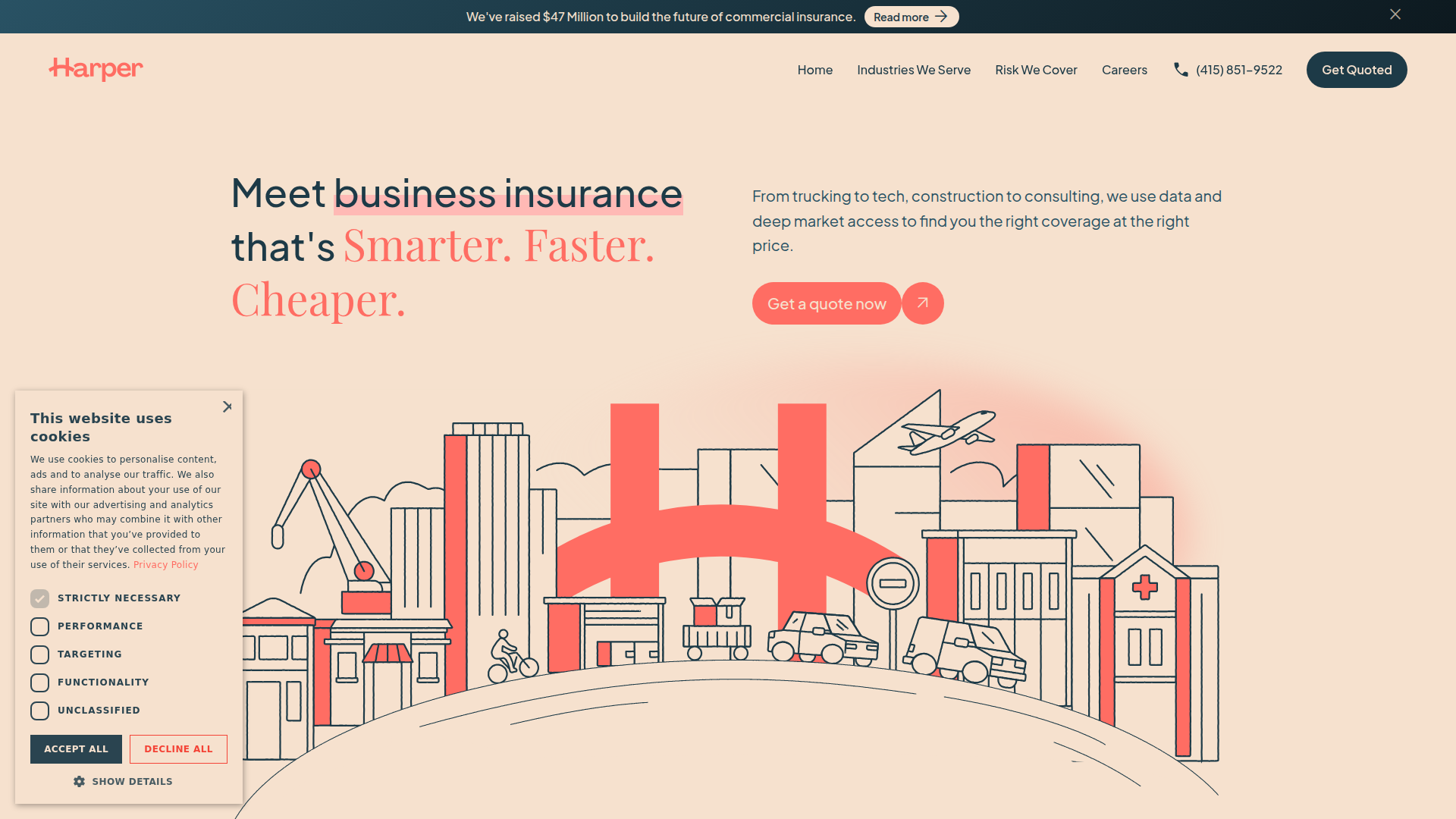
Harper Insure - Business insurance that's Smarter. Faster. Cheaper.
Rate this Tool
Average Score
Total Votes
Select your score (1-10):
Detail Information
What
Harper Insure is a commercial insurance broker focused on helping businesses find coverage across a wide range of risks and industries. The site positions the company around a combination of human expertise, data-driven market matching, and faster quote turnaround, with support for businesses ranging from trucking and automotive operations to technology, retail, public sector, hospitality, care providers, and complex regulated industries.
The core workflow appears to be quote intake, risk classification, carrier matching, and policy placement. Harper emphasizes using large volumes of quote intelligence and prior customer interaction data to identify suitable carrier markets and pricing, while keeping brokers in the loop rather than presenting the service as fully automated self-serve insurance software.
Features
- Commercial coverage across multiple policy types — Harper supports general liability, professional liability, garage liability, commercial auto, property, cyber, umbrella, and bonds, giving businesses a single brokerage point for common insurance needs.
- Industry-specific insurance placement — The company highlights experience in sectors such as aerospace, technology, transportation, retail, public entities, hospitality, security, and care services, which is useful when risks and contract requirements vary by industry.
- Data-driven carrier matching — Harper says it uses over 1 million datapoints on quote intelligence and analyzes prior customer interactions in real time to help match businesses to appropriate carriers and pricing.
- Human-led workflow with AI support — The site states that human expertise leads the process and AI amplifies it, suggesting a broker-assisted model designed to improve speed without removing specialist judgment.
- Faster quoting and underwriting workflow — Automated workflows, instant carrier matching, and real-time decisioning are presented as ways to reduce the traditional placement timeline.
- Support for difficult or complex submissions — Harper explicitly notes it is willing to review accounts that may have been described elsewhere as too tricky or too late, which indicates an appetite for harder-to-place business risks.
Helpful Tips
- Validate true carrier breadth for your industry — If your business operates in a specialized or regulated sector, ask which carrier markets are actually available for your risk class, since broad market access matters more than a generic quote form.
- Review policy fit, not just speed — Fast turnaround is useful, but buyers should still examine exclusions, limits, deductibles, and contract-specific requirements, especially for tech, transportation, and regulated operations.
- Test the broker on edge cases — Businesses with claims history, multi-state operations, contractual insurance requirements, or unusual exposures should use early conversations to assess how well the broker handles complexity.
- Compare operational support after placement — The page focuses mainly on quoting and placement; it provides limited detail on servicing, renewals, certificates, or claims support, so those areas are worth clarifying.
- Treat performance claims as directional until verified — The site includes metrics such as retention and placement success in certain categories, but buyers should confirm how those claims apply to their own coverage type and risk profile.
OpenClaw Skills
A likely OpenClaw use case would be building insurance intake and risk-triage agents around Harper’s quote workflow. For example, an OpenClaw agent could collect business details, classify industry and exposure types, organize required underwriting information, and route the submission into structured quote-ready packages before a broker review. This would fit well with Harper’s stated emphasis on data, automation, and broker-assisted placement, though the source page does not confirm a native OpenClaw integration.
Another likely workflow would involve vertical-specific insurance assistants for professions such as freight operators, software companies, care providers, or public entities. These agents could help teams map operational changes to coverage needs, prepare renewal data, summarize likely insurance gaps, and coordinate internal stakeholders before engaging Harper for placement. In practice, that combination could make insurance buying less fragmented for operations, finance, and risk teams by turning a traditionally manual process into a more structured decision workflow.
Embed Code
Share this AI tool on your website or blog by copying and pasting the code below. The embedded widget will automatically update with the latest information.
<iframe src="https://aimyflow.com/ai/harperinsure-com/embed" width="100%" height="400" frameborder="0"></iframe>
Explore Similar Tools
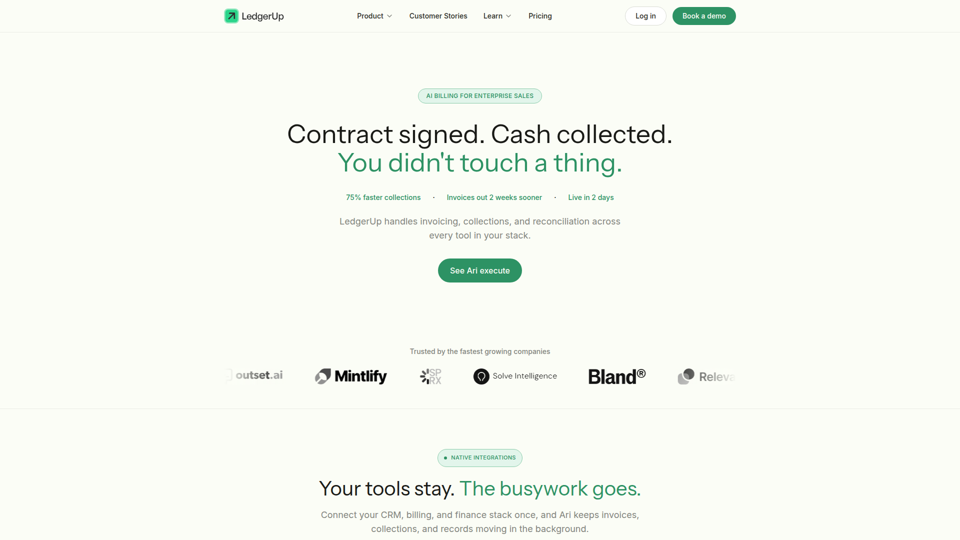
LedgerUp: Intelligence that runs your revenue operations
LedgerUp is an AI-powered revenue operations platform that automates contract-to-cash workflows including billing, collections, usage-based invoicing, and reconciliation, mainly for B2B SaaS and enterprise sales teams. For finance, revenue operations, and billing teams, its AI assistant can reduce manual follow-up and cross-system work by handling routine accounts receivable tasks inside existing workflows.
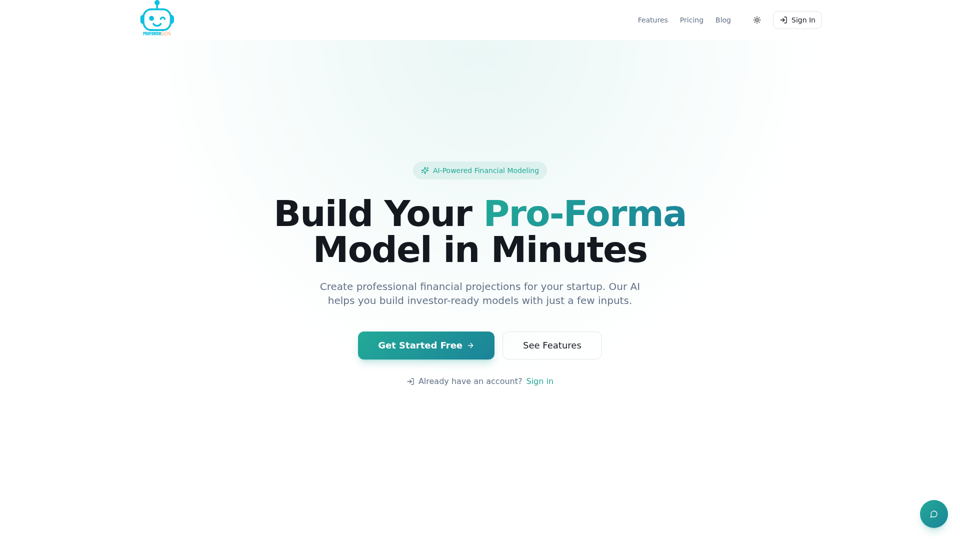
ProFormaGen | AI-Powered Financial Model Generator for Startups
ProFormaGen is an AI-powered financial modeling tool that helps startup founders, CFOs, and financial analysts create investor-ready pro forma projections, revenue models, expense forecasts, and cash flow plans in minutes. For finance and startup teams, it can reduce spreadsheet work and speed scenario planning with interactive dashboards, real-time updates, and Excel exports for investor and board review.
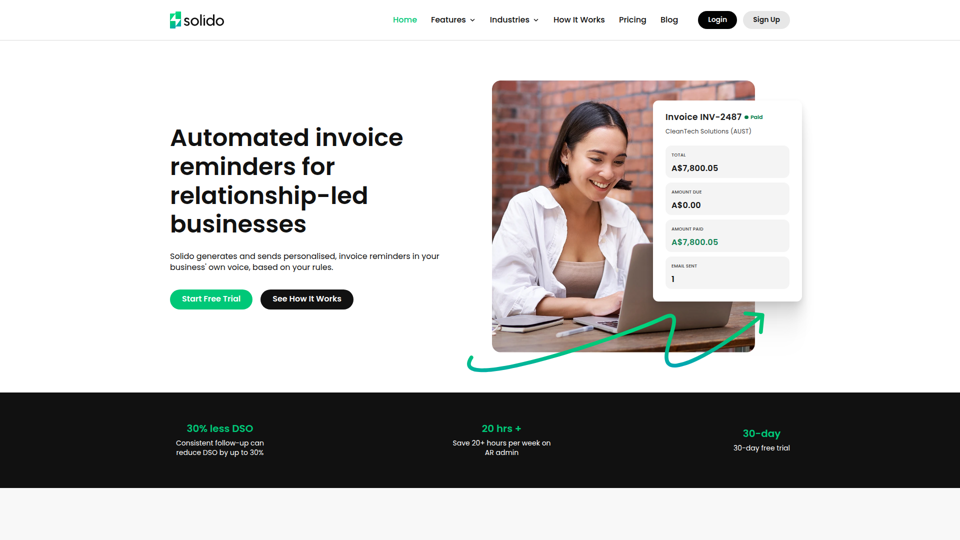
Solido | Automated Invoice Reminders
Solido is an automated invoice reminder tool that syncs with Xero, sends personalized follow-up emails from your own mailbox, and helps professional services firms, agencies, and technology businesses stay on top of receivables. For finance, accounts receivable, and operations teams, its AI-generated emails and rule-based workflows can reduce manual chasing while preserving client relationships and visibility into overdue invoices.
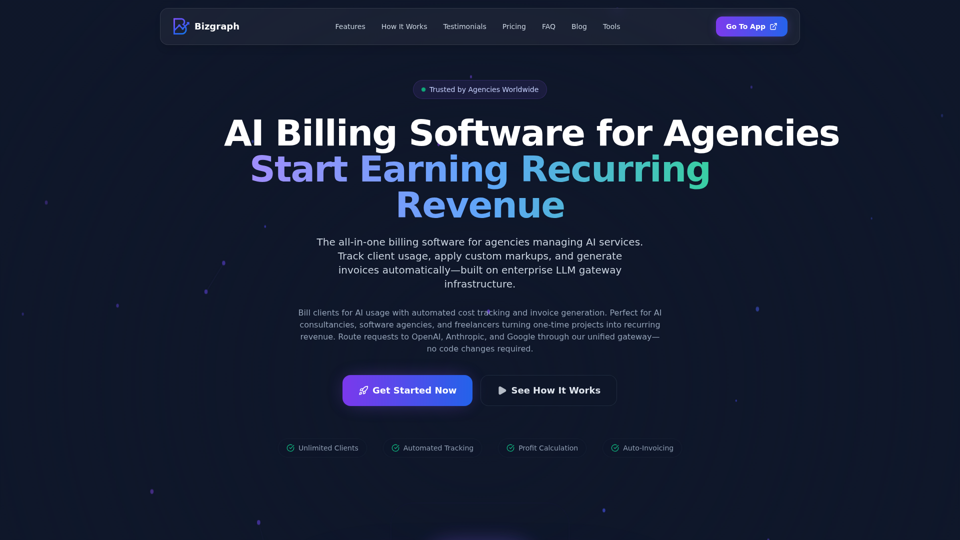
Bizgraph - AI Billing Software for Agencies | Recurring Revenue
Bizgraph is AI billing software for agencies, consultancies, and freelancers that helps them track client AI usage, apply custom markups, manage API keys, and automate invoicing for recurring revenue. For agency founders, CTOs, and finance operations teams, it can reduce manual billing work and improve profit visibility as client AI usage scales across multiple LLM providers.
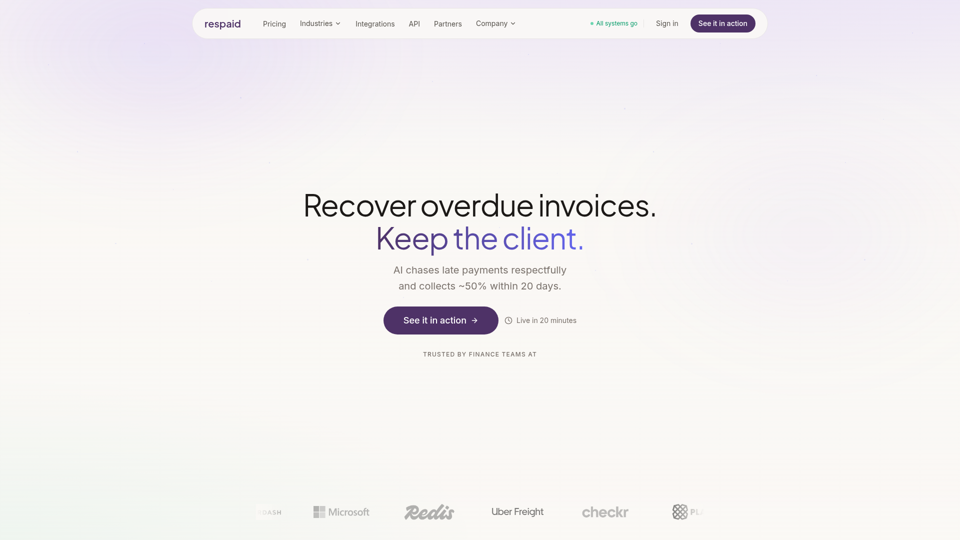
Respaid | Collect Overdue Invoices Without Losing Clients
Respaid is an AI accounts receivable tool that helps finance teams recover overdue invoices through respectful multi-channel outreach, mainly for CFOs, controllers, and AR teams at B2B companies. For finance and collections professionals, it can automate follow-ups and dispute responses while reducing reputational risk and preserving client relationships.
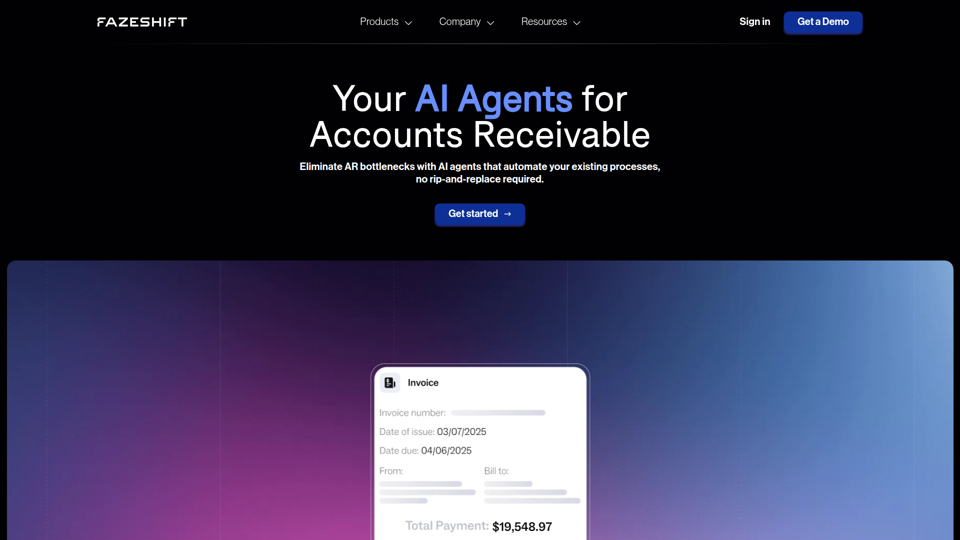
Fazeshift - AI Accounts Receivable
Fazeshift is an AI accounts receivable platform that automates invoicing, cash application, collections, contract review, and payment workflows for finance, accounting, and AR teams. In AI-enabled finance operations, it can help AR and revenue accounting professionals reduce manual matching and follow-up work so they can focus more on exceptions, customer issues, and cash flow management.

AI assistant for businesses | Manage bills and invoices
Kili was an AI assistant for businesses that helped manage bills, invoices, and expenses, mainly for teams handling accounting workflows. For finance and operations staff, tools like this can reduce manual data entry and speed routine invoice processing when connected to accounting software.
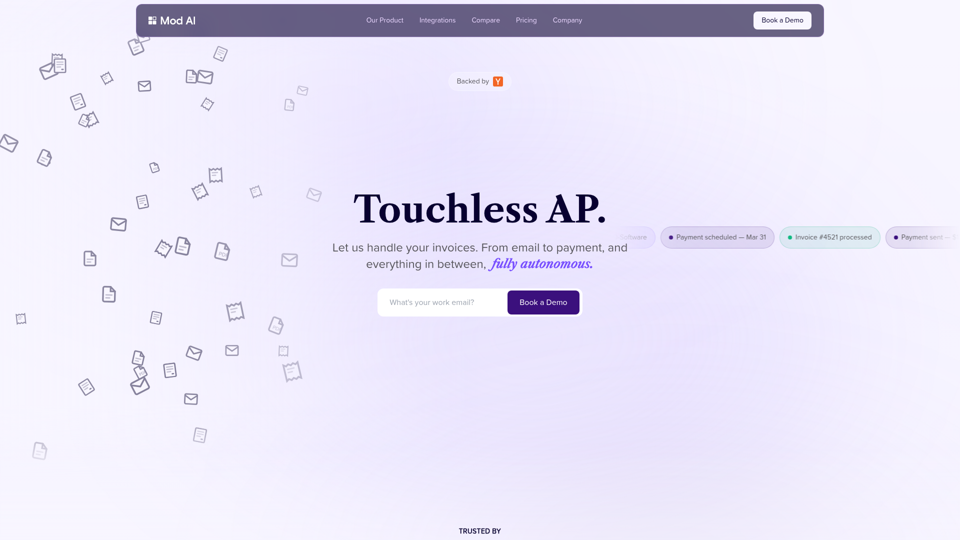
Touchless AP - Autonomous Accounts Payable Automation | Mod AI
Mod AI is an autonomous accounts payable automation tool that handles invoice processing, GL coding, approvals, payments, and reporting for finance teams and AP professionals. In AI-enabled finance operations, it can help controllers, AP managers, and accountants spend less time on manual inbox work and exceptions while improving payment timing, fraud checks, and workflow visibility.