
Constella — Find & Synthesize All Your Research
Rate this Tool
Average Score
Total Votes
Select your score (1-10):
Detail Information
What
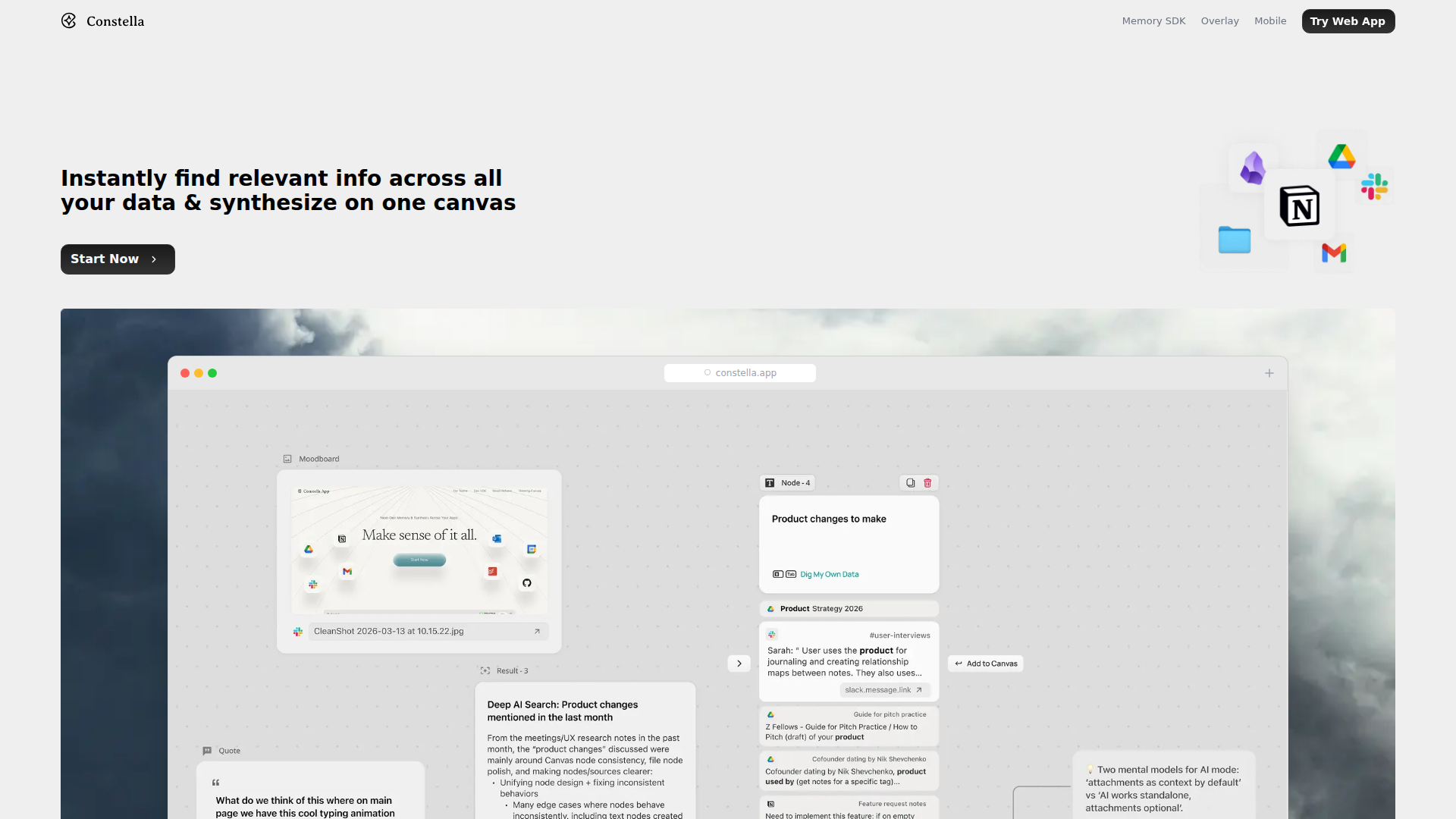
Constella is a research and knowledge retrieval product that helps people find relevant information across their data and synthesize it in one workspace. Based on the page, it is designed for users whose notes, references, and ideas are spread across multiple tabs or sources and who want faster recall and AI-assisted synthesis.
The product appears positioned as an AI memory and research layer for individuals such as professionals, researchers, creatives, founders, and ADHD users. Its core workflow centers on connecting sources, building a graph-style memory, retrieving relevant information with AI, and producing cited findings on a shared canvas for deeper thinking and research tasks.
Features
- Cross-source information retrieval: Finds relevant information across connected data sources, helping users reduce time spent searching between tabs and materials.
- Graph memory construction: Builds a graph-based memory from connected sources, which can improve recall and relationship mapping across fragmented information.
- AI deep research with findings: Supports deeper research workflows by surfacing findings, likely making synthesis faster for complex topics.
- Agent-driven cited answers: Runs agents that return cited answers, which is useful when users need traceable responses rather than unsupported summaries.
- Canvas-based synthesis: Brings information together on a single canvas, giving users a centralized space to organize and synthesize ideas.
- Visual thinking idea extraction: Identifies key ideas from visual thinking, which may help users capture insight from less structured creative or exploratory work.
Helpful Tips
- Evaluate how well the product connects to the sources that matter most in your workflow, since retrieval quality depends heavily on source coverage and structure.
- Test cited-answer quality on a small set of known research questions before broader adoption, especially if you rely on accuracy for professional or academic work.
- Use clear source organization and naming conventions when building graph memory, as AI retrieval systems typically perform better with cleaner inputs.
- If your work includes visual ideation, confirm what kinds of visual artifacts the product can interpret, because the page mentions visual thinking but does not detail supported formats.
- Review the privacy model carefully for team or sensitive research use; the page states that only the user sees their data, but it does not provide deeper implementation details here.
OpenClaw Skills
Constella could likely pair well with OpenClaw as a memory-centered research layer inside agent workflows. An OpenClaw skill could query Constella for prior notes, connected concepts, and cited findings, then use that context to support tasks such as literature reviews, founder research briefs, creative concept development, or professional knowledge retrieval. The page does not confirm a native integration, so this is best treated as a likely workflow pattern rather than a built-in capability.
In a broader OpenClaw ecosystem, teams could build agents that turn fragmented personal research into reusable operational memory. Likely use cases include an analyst agent that drafts evidence-backed summaries from a user’s research graph, a creative agent that extracts themes from visual ideation, or a personal knowledge assistant that surfaces relevant context before meetings or writing sessions. Combined with OpenClaw orchestration, this kind of product could shift knowledge work from manual searching toward continuous memory-assisted synthesis.
Embed Code
Share this AI tool on your website or blog by copying and pasting the code below. The embedded widget will automatically update with the latest information.
<iframe src="https://aimyflow.com/ai/constella-app/embed" width="100%" height="400" frameborder="0"></iframe>
Explore Similar Tools
Platform Overview | Robovision
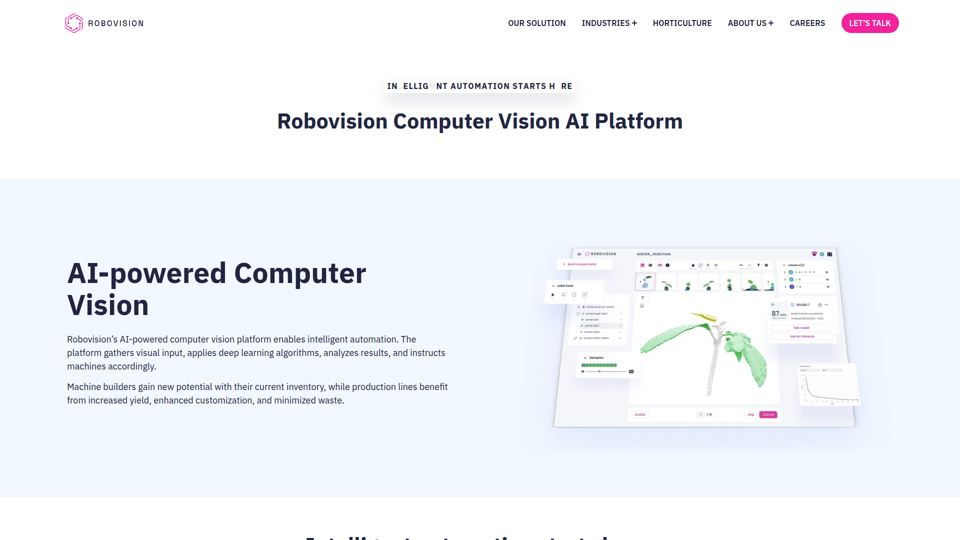
Robovision is an AI-powered computer vision platform that helps industrial teams build, test, optimize, and deploy vision models for intelligent automation, mainly for machine builders, manufacturers, and data scientists. In AI-driven production, it can reduce manual inspection work and let data scientists and operations teams focus more on improving models, quality control, and deployment speed.

Interface - The Frontier Lab for Digital Visual Simulation
Interface is a research lab for digital visual simulation that builds AI systems to model how people and objects appear, behave, and interact, mainly for world-model researchers and teams developing real-world AI applications. In the AI era, this can help research and simulation teams create more realistic visual training environments that improve how models understand human behavior and physical scenes.
Ångström AI — Accelerating molecular simulation using generative AI
Ångström AI is a generative AI molecular simulation platform that computes free energy differences, binding conformations, and hydration sites with ab initio-level accuracy much faster than traditional methods, mainly for drug discovery and computational chemistry teams. For computational chemists and molecular modelers, this can speed candidate evaluation and solvation or binding analysis by enabling faster, physics-informed sampling workflows.
Surf - Crypto's Ultimate AI
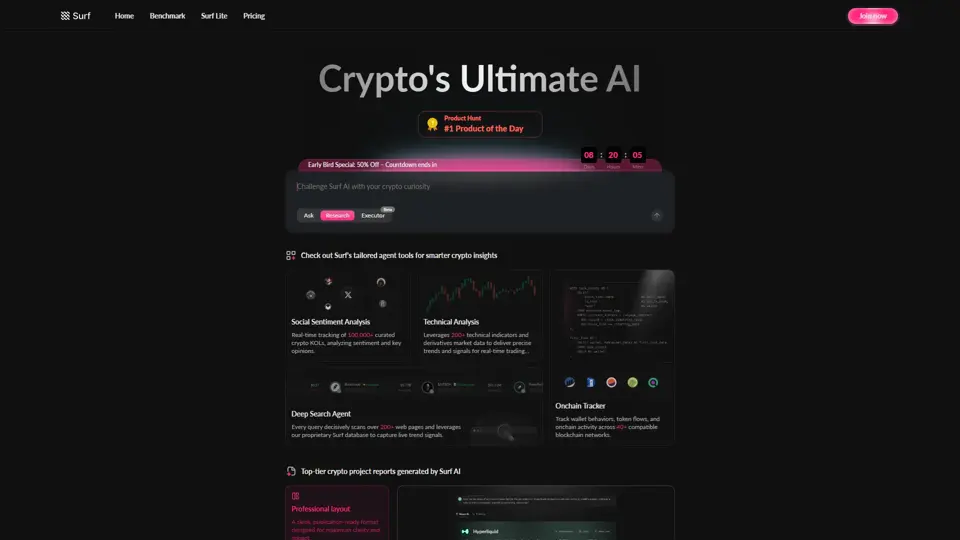
Surf is an AI-powered crypto research platform that helps traders and investors analyze cryptocurrency markets, trends, and trading opportunities. In the AI era, it helps crypto researchers synthesize fast-moving information and respond to market signals with greater speed.
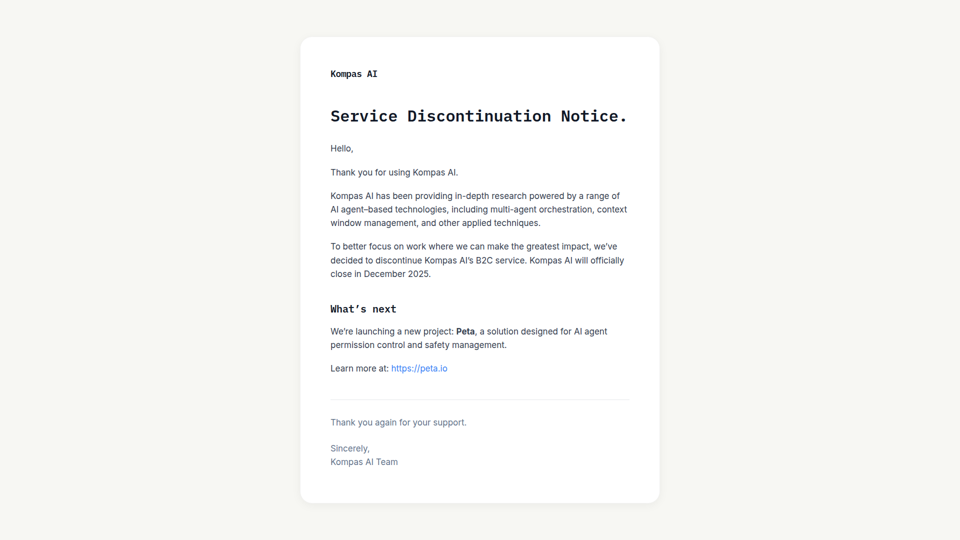
Service Discontinuation Notice - Kompas AI
Kompas AI is a discontinued B2C AI research service that helped users conduct in-depth research using multi-agent orchestration, context window management, and related AI agent techniques. Its planned transition toward AI agent permission control and safety management highlights how researchers and AI operations teams increasingly need governance tools alongside advanced agent workflows.
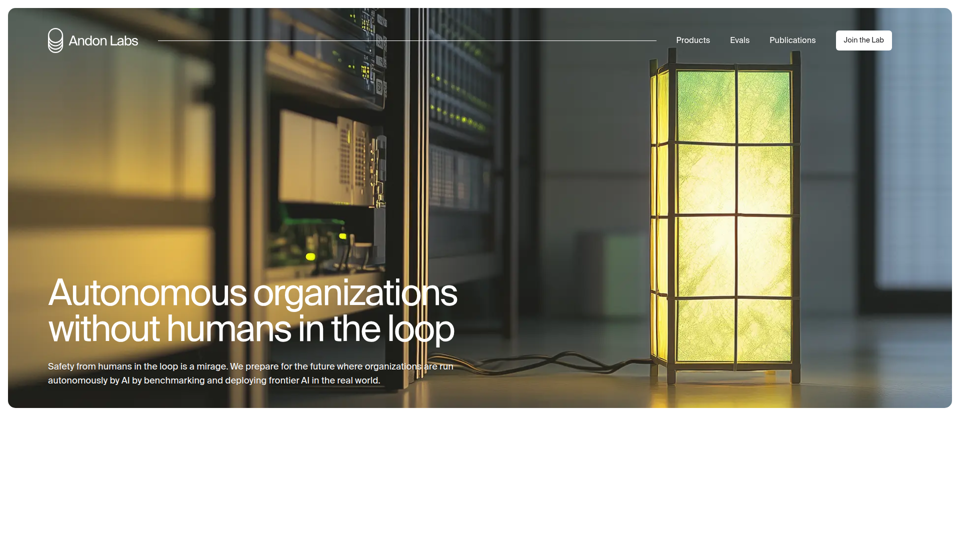
Andon Labs
Andon Labs is an AI research company that builds custom evaluations and real-world benchmarks for frontier AI models, helping AI labs, researchers, and engineers test how autonomous agents perform on long-horizon business, robotics, and spatial tasks. In the AI era, these evaluations can help safety researchers and model developers identify failure modes earlier and improve control protocols before deploying agents in real environments.
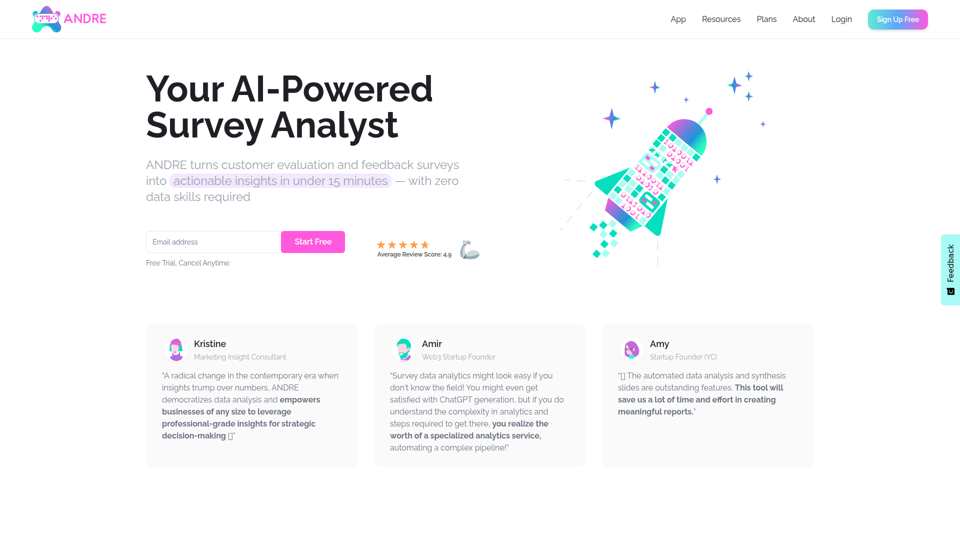
ANDRE - Synthetic Survey Data Analyst for Better CX
ANDRE is an AI survey data analyst that automates cleaning, analysis, and report creation for customer feedback and evaluation surveys, mainly for customer experience specialists, marketers, product teams, founders, and researchers. In AI-driven workflows, it can help these professionals turn narrative survey responses into faster, evidence-based decisions without requiring data science skills.
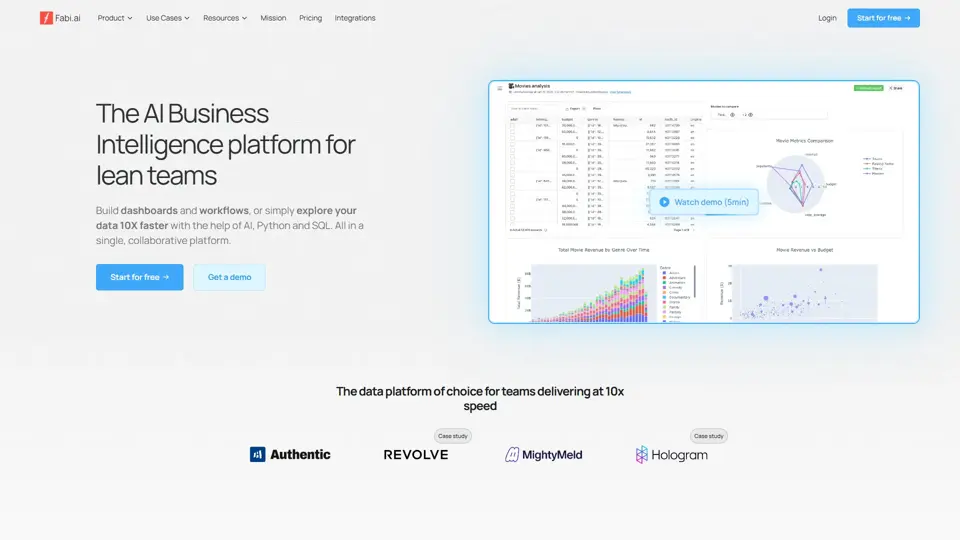
Fabi.ai: AI-powered data analysis platform | SQL + Python + AI
Fabi.ai is an AI-powered data analysis platform that combines SQL, Python, and automation to help analysts explore data and generate insights faster. It boosts productivity for data teams by reducing manual analysis steps and accelerating decision-making from raw data.